
Toplines
Japan may be considering using nuclear propulsion to power its future submarine fleet. Japan could significantly enhance its ability to independently counter the People’s Liberation Army Navy’s (PLAN) modernization and expansion by introducing nuclear submarines. Japanese Defense Minister Shinjiro Koizumi stated on September 11 that Japan would “not rule out” acquiring nuclear submarines (SSN).[1] An unnamed US Navy official reacted positively to questions about Japan potentially developing an SSN and stated that Japan’s domestic nuclear energy capacity could support a transition from diesel-electric submarines to SSNs.[2] Japan’s ruling Liberal Democratic Party (LDP) first suggested transitioning Japan’s submarine fleet to “next-generation” propulsion systems in October 2025, possibly indicating an interest in SSNs.[3] Koizumi further stated in November 2025 that all of Japan’s neighbors would soon possess SSNs but has not committed to developing a similar capability for Japan’s Maritime Self-Defense Force (JMSDF) at the time of writing.[4]
SSNs provide significant advantages compared to Japan’s existing diesel-electric submarine fleet — advantages that could allow Japan to take on a greater role in countering the expansion and modernization of the PLAN. SSNs possess a far greater operating range and speed than conventionally powered submarines and do not have to periodically “snorkel” near the surface to remain at sea, enhancing stealth.[5] The characteristics of conventionally powered submarines limit their operational role to pre-prepared ambushes and prevent them from pursuing surface vessels or SSNs.[6] An SSN fleet would allow the JMSDF to hold PLAN submarines and surface vessels at risk throughout the Pacific. This capability will likely be increasingly important for Japan as the PLAN will likely transition toward a largely nuclear-powered submarine fleet in the next decade and is set to significantly expand its surface warfare capabilities.[7] SSNs are also capable of carrying greater amounts of firepower due to their larger size and could carry land-attack missiles to provide Japan with a survivable counterstrike capability in the event of a major war.[8]
Japan may face political obstacles if it decides to develop an SSN, however. Japan’s Atomic Energy Basic Act circumscribes nuclear energy for peaceful use, which could preclude military-related nuclear propulsion.[9] Japan’s three non-nuclear principles, which have never been codified into law but influence public discourse, also oppose the production, possession, and introduction of nuclear weapons in Japan, and thus could drive opposition to military use of nuclear power.[10] SSNs are also far more costly than conventional submarines and require specialized production and maintenance capabilities, increasing the monetary requirements for developing and maintaining such a fleet.[11]
Politico reported on September 18 that a shipment of F-35 components containing advanced stealth technology was unexpectedly diverted to Hong Kong while in transit from Australia to the United States for maintenance this summer.[12] Anonymous sources told Politico that the shipment included an F-35 cockpit canopy with an advanced radar-absorbing stealth coating.[13] The US Department of Defense (DoD)’s F-35 Lightning II Joint Program Office (JPO) confirmed to Politico that it is “aware of a shipment issue of unserviceable F-35 Lightning II components” and is working “to retrieve these components, investigate the incident, and place safeguards to avoid a future occurrence.”[14] US defense contractor Lockheed Martin manages the global supply chain for F-35 components and uses commercial shipping providers to transport them.[15] ISW-CDOT cannot independently confirm which shipping provider was responsible for transporting the parts, why the shipment was rerouted to Hong Kong, or who currently has possession of the components.[16]
The F-35 components’ diversion to Hong Kong may have allowed the People’s Republic of China (PRC) to access and potentially study the components for reverse-engineering.[17] The PRC has aggressively sought to acquire sensitive data related to the F-35 and other advanced fighter aircraft, likely to support the People’s Liberation Army (PLA)’s modernization and potentially defeat US or allied forces in a future conflict over Taiwan. PLA Air Force (PLAAF) hackers infiltrated US computer systems and stole data on the F-35 from 2008 to 2014.[18] Hackers using known PRC cyberattack techniques also stole data on the F-35 from an Australian defense contractor’s system in 2016.[19] PRC agents have illegally recruited NATO fighter pilots, including a former US F-35 flight instructor, to train PLA pilots.[20] Reverse-engineering the F-35’s stealth canopy coating or other F-35 components could improve PLAAF advanced fighter aircraft or expose vulnerabilities that the PLA could exploit to defeat US, Japanese, and other allied F-35 aircraft in a potential conflict over Taiwan.[21]
Key Takeaways
- Japanese Nuclear Submarine Development: Japan may be considering transitioning from diesel-electric submarines to nuclear submarines, which would significantly enhance their operating range, speed, and stealth. Japanese nuclear submarines could enhance Japan’s ability to counter the People’s Liberation Army Navy in future Western Pacific conflicts, but their development may face Japanese domestic political opposition due to significant costs and general opposition to the introduction of nuclear weapons.
- F-35 Components Diverted to Hong Kong: Politico reported on September 18 that a shipment of F-35 components containing advanced stealth technology was unexpectedly diverted to Hong Kong while in transit from Australia to the United States. The F-35 component’s diversion to Hong Kong may have allowed the People’s Republic of China (PRC) to examine the components for reverse-engineering. The PRC has conducted multiple espionage and hacking operations to gain access to advanced US fighter aircraft technology to advance its own military modernization efforts and potentially expose vulnerabilities in US and allied systems.
Cross-Strait Relations
China
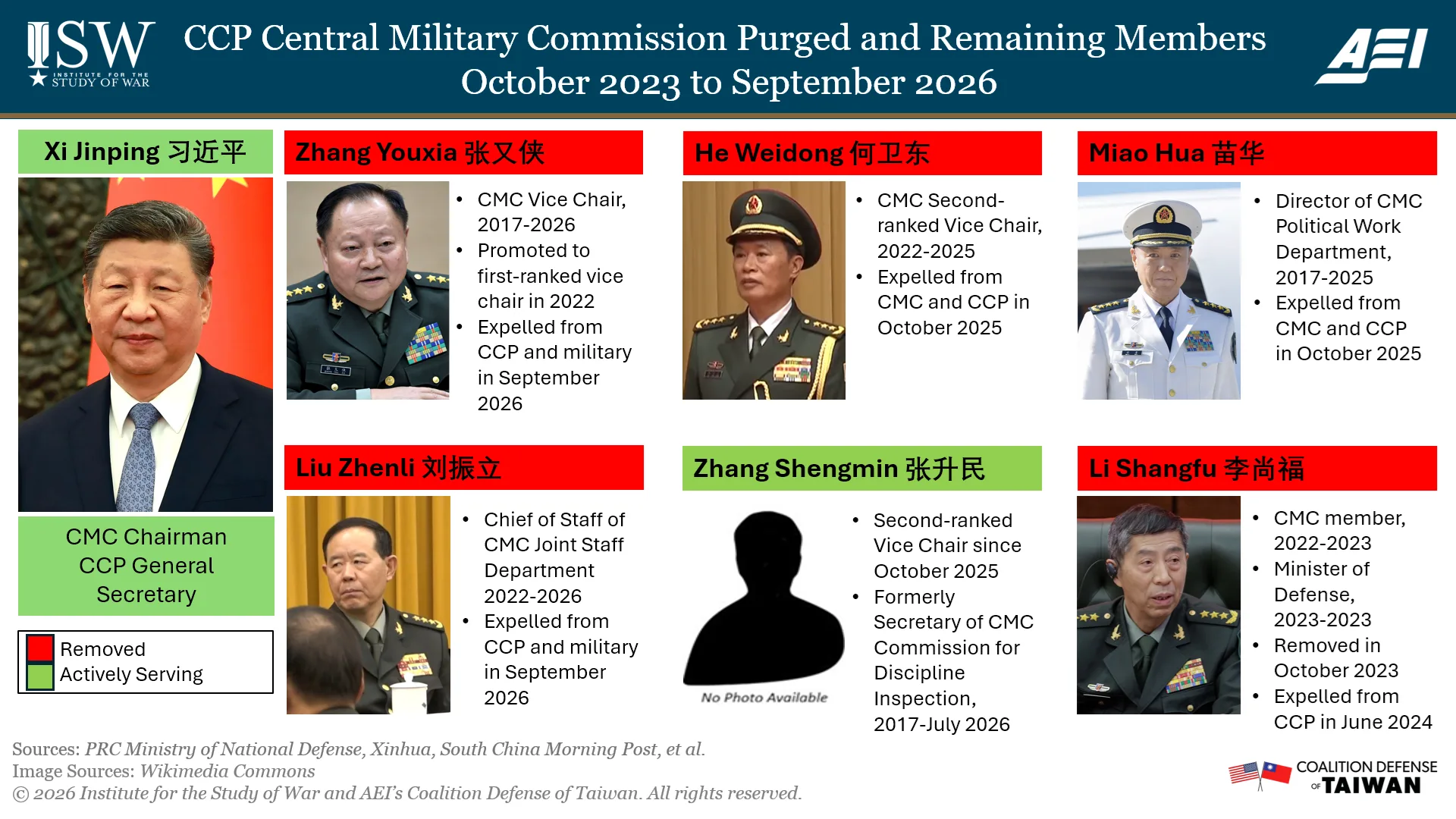
The Chinese Communist Party (CCP) officially expelled former Central Military Commission (CMC) members Zhang Youxia and Liu Zhenli from the PLA and the Party. CCP General Secretary Xi Jinping is likely consolidating his control over the PLA, which may lead to an increased emphasis on ensuring political loyalty within the PLA. PRC state media announced on September 21 that Zhang and Liu had been expelled from the CCP and PLA.[22] Both were placed under investigation and arrested in January.[23] Zhang served as Vice Chairman of the CMC, the PLA’s central military decision-making organ, since 2017 and was one of the few PLA officials with combat experience.[24] Liu served as the Chief of Staff for the CMC’s Joint Staff Department from 2022 until his removal.[25] PRC state media accused Zhang and Liu of violating political discipline rules, forming cliques, abusing their authority by accepting large sums of money, and failing to fulfill political responsibilities associated with their position.[26] ISW-CDOT previously assessed that Xi may have purged Zhang and Liu for undermining his authority over the military and forming factions within the PLA and the Party.[27]
The political justification presented for Zhang and Liu’s purges could reflect Xi’s efforts to increasingly politicize the PLA and prioritize ideological uniformity. A September 13 article in the PLA official newspaper, PLA Daily, stated that “the Party’s absolute leadership over the army is the foundation of the People’s Army and its soul,” arguing that political work has historically corresponded to overall PLA efficacy.[28] Other PLA Daily commentaries reflect this emphasis when describing the function of party committees within the PLA.[29] One article detailed an instance where an air defense brigade’s Party committee directed tactical-level changes, like greater dispersion between air defense systems, following the results of an exercise.[30] Such instances could suggest that the role of Party committees is expanding from enforcing political uniformity to actively shaping how the PLA intends to fight. PLA Daily frequently features articles discussing the importance of ideological rectification for PLA readiness.[31]
The expanded role of Party committees in military decision-making and increased links between perceived ideological correctness and warfighting capacity could have a deleterious impact on PLA readiness. ISW-CDOT has assessed that Xi’s purges have isolated him, leaving only himself and one other CMC member on what was once a seven-person committee, possibly creating a culture of sycophancy within the upper echelons of the PLA.[32] An overwhelming emphasis on political loyalty could also lead the PLA to promote officers based on political criteria rather than operational merit, although this has not yet been observed publicly. Emphasis on ideological conformity does not preclude military modernization but could create dynamics within the PLA that limit its ability to modernize effectively.
The United States and PRC are increasingly calling for the establishment of artificial intelligence (AI) safeguards to minimize risks of false intelligence reports or conflict escalation. US President Donald Trump and CCP General Secretary Xi Jinping will likely discuss AI safeguards, among other key issues, during their upcoming summit. CNN reported on September 18 that a US military analyst used an AI chatbot that produced an incorrect report that a PRC vessel was carrying nuclear weapons components, nearly resulting in US troops boarding the PRC vessel.[33]PRC state-affiliated tabloid Global Times called for AI safeguards following the reports of the incident.[34] Global Times cited experts who argued that the PRC and United States should cooperate on preventing AI risks such as informational “hallucinations.”[35] US and PRC experts have similarly discussed interventions to minimize AI risks, including a “hotline” to resolve AI-related incidents.[36]
US Treasury Secretary Scott Bessent met with PRC Premier He Lifeng on September 20. Bessent and He agreed to open a dialogue on AI, although they expressed different priorities. The PRC side reportedly sought to discuss issues of global AI governance, while the US side emphasized AI safety and security issues.[37] Bessent said that the two sides agreed to create a notification mechanism to inform one another of AI issues that could pose global security threats, however.[38]
CCP General Secretary Xi Jinping’s September 23 through 25 visit to the United States presents an opportunity to continue these bilateral discussions. The PRC officially confirmed Xi’s visit on September 21 following a call between US Secretary of State Marco Rubio and PRC Foreign Minister Wang Yi.[39] This visit marks Xi’s first visit to the United States in three years. Xi and Trump will likely discuss a number of bilateral security issues including Taiwan policy, arms control mechanisms, and military-to-military ties.[40] Anonymous sources have stated that Xi may bring a delegation of PRC CEOs with him on the visit, which could indicate that the PRC wishes to establish a coordination mechanism between US and PRC AI firms.[41] Wall Street Journal cited other unnamed sources on September 22 that called a PRC CEO delegation visit “unlikely,” however.[42]
Southeast Asia
Philippines
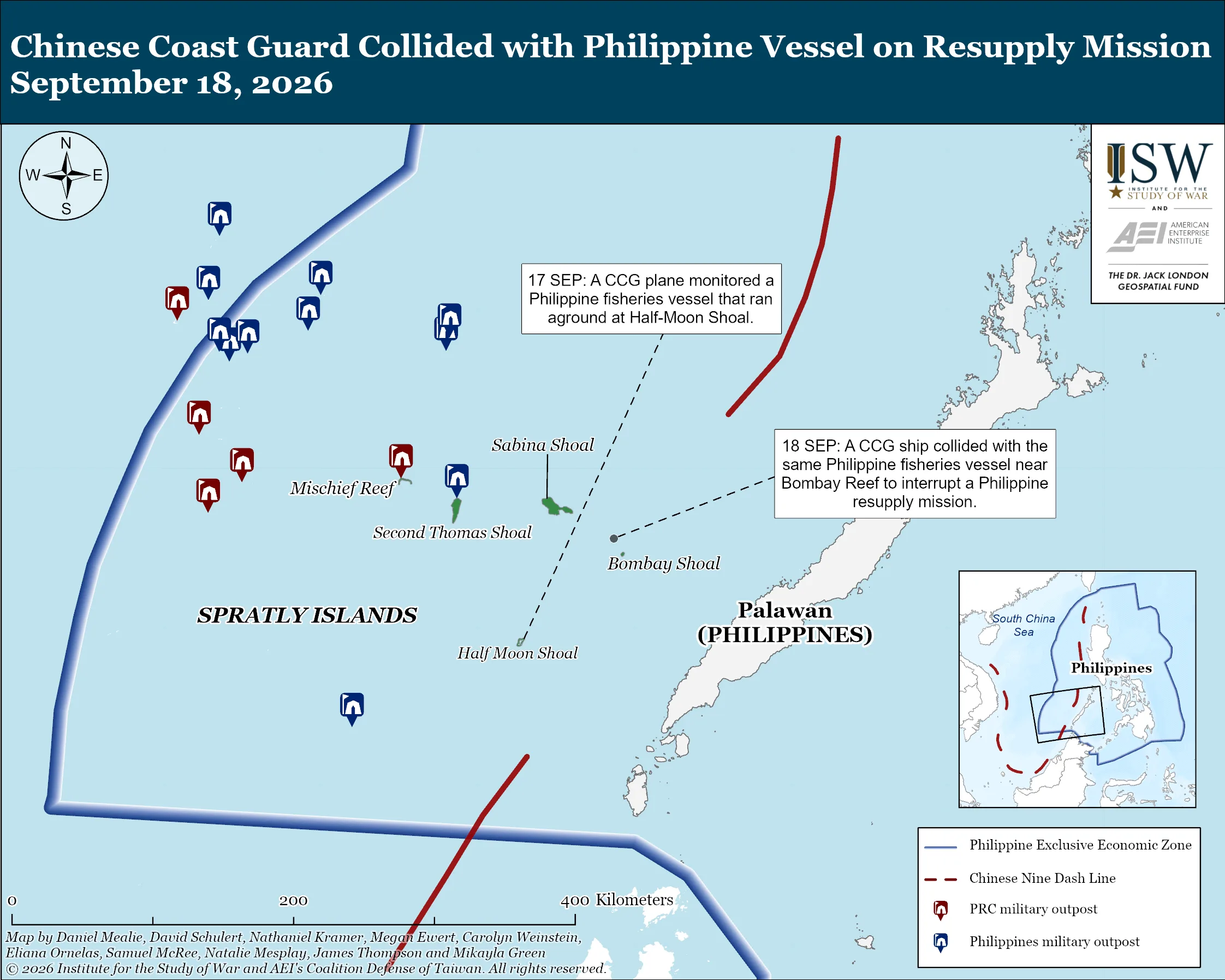
A China Coast Guard (CCG) ship may have deliberately rammed a Philippine fisheries ship while trying to stop a Philippine resupply mission in the Spratly Islands. The PRC likely views blocking resupply missions as an effective way to remove Philippine vessels from PRC-claimed waters. CCG ship 21585 (also known as Sanzhou’ao) collided with BRP Datu Magat Salamat, a Philippine Bureau of Fisheries and Aquatic Resources (BFAR) ship, on September 18 near the disputed Spratly Islands.[43] The incident occurred in the waters between Sabina Shoal and Bombay Shoal, 54 nautical miles from the Philippine island of Palawan, while Datu Magat Salamat was conducting a resupply mission to Philippine fishermen.[44] The Philippine Coast Guard (PCG) accused the CCG of deliberately ramming Datu Magat Salamat, while the CCG and PRC Ministry of Foreign Affairs (MFA) claimed the Philippine ship “provoked” the CCG and caused the collision by abruptly cutting in front of the CCG ship.[45] Both sides released videos of the collision.[46] The PCG also reported that a CCG plane monitored Datu Magat Salamat on September 17, when the ship accidentally ran aground at another Spratly Islands atoll, Half-Moon Shoal, and had to be towed off.[47] Ship-tracking data from Starboard Maritime Intelligence shows a CCG vessel patrolling near Half-Moon Shoal around the same time.
The PRC often tries to disrupt Philippine resupply missions in the South China Sea to prevent the Philippines from maintaining a long-term presence in PRC-claimed disputed waters. Sabina Shoal, Bombay Shoal, and Half-Moon Shoal are all within the Philippines’ Exclusive Economic Zone (EEZ) and are classified as “low-tide elevations,” meaning they are not permanently above water and cannot be claimed by another country.[48] The PRC claims them as its territory, however, along with nearly all of the South China Sea, and uses the CCG, PLAN, and Chinese Maritime Militia (CMM) to enforce its claims. Sabina Shoal was the site of a major PRC-Philippine confrontation in 2024. The PCG anchored its flagship, BRP Theresa Magbanua, in the shoal’s lagoon for several months until the CCG forced it to leave by ramming it and blocking resupply missions.[49] The PRC accused the Philippines of trying to establish a permanent outpost at the shoal by grounding a ship there, as the Philippines did at Second Thomas Shoal in 1999.[50] The CCG and CMM also attacked Philippine civilian fishermen near Sabina Shoal in December 2025 by blasting them with water cannons and cutting their anchor lines.[51] The PRC could believe that continually blocking and harassing Philippine ships could eventually force the Philippines to “cede ground” in the South China Sea.
Iran
US think tank the Center for Strategic and International Studies (CSIS) reported on September 17 that the PRC is expanding its ability to monitor military activity and collect signals intelligence (SIGINT) across the Middle East and Africa from the PLA Support Base in Djibouti. The PLA could use its enhanced intelligence collection capabilities to monitor US and US-allied military capabilities and activity in the region. The PRC’s base is located nine miles from the Gulf of Aden, 35 miles from Bab al Mandeb, and within ten miles of US, French, Italian, and Japanese military bases.[52] The PRC appears to have constructed two new communications facilities, featuring antennas, towers, and radomes capable of capturing high-frequency, very/ultra-high frequency, and satellite communications.[53] The PRC laid additional reinforced cable trenches in 2025, which could be used to install additional antennas later on.[54] The PRC presents its base in Djibouti as a hub for peacekeeping and humanitarian relief operations in Africa and Western Asia.[55]
This infrastructure is likely to increase PLA internal communications infrastructure in the region and may also increase the PLA’s ability to gather intelligence on regional conflicts and United States and Japanese military activity and communications.[56] The PRC is likely seeking to monitor activity from the Houthis, threats to the Red Sea and Gulf of Aden, and United States regional military activity. The United States has diverted a significant portion of its military assets and capacity to the Middle East and out of East Asia, and the PRC could use its base in Djibouti to monitor the latest United States military capabilities and build-up in the region, including military assets and resources that could eventually be diverted back to East Asia.[57] Commercial PRC satellites have aided Houthi targeting in the Red Sea, and the PLA has benefited from gathering data on how United States naval forces track and react to missile and drone attacks in real-world modern warfare.[58]
The PRC and Russia voted to abolish a United Nations (UN) panel of experts charged with monitoring Iran’s nuclear program and international sanctions compliance. The PRC and Russia on September 17 vetoed a US proposal to extend the panel’s mandate for a year.[59] The UN had reactivated the monitoring panel when it re-imposed sanctions on Iran in September 2025 after the United Kingdom, France, and Germany accused Iran of violating its obligations under the 2015 nuclear deal.[60] The PRC and Russia have maintained that the re-imposed “snapback” sanctions were invalid, however, and have prevented the UN from appointing experts to serve on the sanctions monitoring panel.[61] The PRC has continued to illicitly trade with and transfer weapons and other military equipment to Iran in violation of the “snapback” sanctions, while resisting US-imposed sanctions on PRC entities conducting the transactions.[62]
The PRC likely vetoed the panel of experts to protect its trade with Iran from international scrutiny, demonstrate its commitment to Iranian economic and regime stability, and advance its ideological opposition to sanctions. The PRC similarly vetoed new UN sanctions on North Korea in 2022 and abstained while Russia vetoed the establishment of a sanctions monitoring body for North Korea in 2024.[63] The PRC portrays itself as a “responsible great power” and a reliable partner that does not meddle in other countries’ “internal affairs” through sanctions or other means. Beijing does not fully support all of Iran’s warfighting decisions — for example, it has openly called for reopening the Strait of Hormuz — but nonetheless has helped enable Iran’s survival and rearmament throughout the war.[64]

[1] https://www.japantimes.co.jp/news/2026/09/11/japan/koizumi-japan-us-nuclear-submarines/
[2] https://www.navalnews.com/naval-news/2026/09/japan-defense-minister-nuclear-powered-submarines/
[3] https://www.japantimes.co.jp/news/2025/10/21/japan/politics/japan-ruling-bloc-defense/
[4] https://www.navalnews.com/naval-news/2025/11/japan-weighs-nuclear-submarines-as-new-defense-minister-koizumi-signals-break-from-postwar-nuclear-taboo/
[5] https://faculty.nps.edu/awashburn/docs/MORV6N4.pdf; https://www.twz.com/42900/the-truth-about-the-growing-diesel-submarine-threat-from-a-veteran-sub-hunter; https://www.usni.org/magazines/proceedings/2007/june/subs-littoral-diesels-just-blowing-smoke
[6] https://defencyclopedia.com/2014/04/27/anti-submarine-warfare-part-2-diesel-electric-submarines/; https://www.twz.com/42900/the-truth-about-the-growing-diesel-submarine-threat-from-a-veteran-sub-hunter
[7] https://www.uscc.gov/hearings/part-your-world-us-china-competition-under-sea
[8] https://archive.navalsubleague.org/2009/a-short-history-of-submarines-in-land-attack
[9] https://www.japaneselawtranslation.go.jp/en/laws/view/3759/en
[10] https://www.mofa.go.jp/policy/un/disarmament/nnp/
[11] https://www.japantimes.co.jp/news/2026/09/11/japan/koizumi-japan-us-nuclear-submarines/
[12] https://www.politico.com/news/2026/09/18/congress-f-35-china-investigation-01083647?utm_source=dlvr.it&utm_medium=twitter; https://www.bloomberg.com/news/articles/2026-09-21/f-35-parts-diversion-to-hong-kong-under-probe-in-us-congress; https://www.australiandefence.com.au/news/news/classified-australian-f-35-parts-disappear-in-hong-kong
[13] https://www.politico.com/news/2026/09/18/congress-f-35-china-investigation-01083647?utm_source=dlvr.it&utm_medium=twitter
[14] https://www.politico.com/news/2026/09/18/congress-f-35-china-investigation-01083647?utm_source=dlvr.it&utm_medium=twitter
[15] https://www.politico.com/news/2026/09/18/congress-f-35-china-investigation-01083647?utm_source=dlvr.it&utm_medium=twitter; https://www.bloomberg.com/news/articles/2026-09-21/f-35-parts-diversion-to-hong-kong-under-probe-in-us-congress; https://www.australiandefence.com.au/news/news/classified-australian-f-35-parts-disappear-in-hong-kong
[16] https://www.politico.com/news/2026/09/18/congress-f-35-china-investigation-01083647?utm_source=dlvr.it&utm_medium=twitter; https://www.bloomberg.com/news/articles/2026-09-21/f-35-parts-diversion-to-hong-kong-under-probe-in-us-congress; https://www.australiandefence.com.au/news/news/classified-australian-f-35-parts-disappear-in-hong-kong
[17] https://www.politico.com/news/2026/09/18/congress-f-35-china-investigation-01083647?utm_source=dlvr.it&utm_medium=twitter; https://www.bloomberg.com/news/articles/2026-09-21/f-35-parts-diversion-to-hong-kong-under-probe-in-us-congress; https://www.australiandefence.com.au/news/news/classified-australian-f-35-parts-disappear-in-hong-kong
[18] https://www.aei.org/commentary/china-taiwan-update-march-6-2026/; https://understandingwar.org/research/china-taiwan/china-taiwan-update-march-6-2026/; https://www.justice.gov/archives/opa/pr/chinese-national-who-conspired-hack-us-defense-contractors-systems-sentenced-46-months
[19] https://fortune.com/2017/10/14/hacked-f-35-data/; https://www.theguardian.com/australia-news/2017/oct/12/secret-files-on-jets-and-navy-ships-stolen-in-extensive-and-extreme-hack
[20] https://www.aei.org/commentary/china-taiwan-update-march-6-2026/; https://understandingwar.org/research/china-taiwan/china-taiwan-update-march-6-2026/; https://www.justice.gov/opa/pr/former-us-air-force-pilot-arrested-providing-defense-services-chinese-military; https://archive.dni.gov/files/NCSC/documents/products/Safeguarding_Our_Military_Expertise.pdf
[21] https://www.aei.org/commentary/china-taiwan-weekly-update-august-18-2025/; https://understandingwar.org/research/china-taiwan/china-taiwan-weekly-update-august-18-2025/; https://www.aei.org/commentary/china-taiwan-update-july-31-2026/; https://understandingwar.org/research/china-taiwan/china-taiwan-update-july-31-2026/
[22] http://society.people.com dot cn/n1/2026/0921/c1008-40802961.html
[23] https://understandingwar.org/research/china-taiwan/xi-jinpings-military-purges-leave-him-increasingly-powerful-but-isolated/
[24] https://www.reuters.com/world/china/china-expels-two-top-generals-party-military-alleging-disloyalty-corruption-2026-09-21/; https://www.nytimes.com/2026/09/21/world/asia/china-generals-expelled-corruption.html?eafs_enabled=false
[25] https://www.japantimes.co.jp/news/2026/09/22/asia-pacific/politics/china-generals-party-corruption/; https://www.scmp.com/news/china/politics/article/3368287/former-top-pla-generals-expelled-communist-party-factionalism-and-disloyalty?module=top_story&pgtype=section
[26] http://society.people.com dot cn/n1/2026/0921/c1008-40802961.html
[27] https://understandingwar.org/research/china-taiwan/xi-jinpings-military-purges-leave-him-increasingly-powerful-but-isolated/
[28] http://www.81 dot cn/yw_208727/16485471.html
[29] http://www.81 dot cn/yw_208727/16488230.html; http://www.81 dot cn/yw_208727/16487904.html; http://www.81.cn/yw_208727/16485455.html
[30] http://www.81 dot cn/yw_208727/16485455.html
[31] http://www.81 dot cn/yw_208727/16487890.html; http://www.81 dot cn/yw_208727/16487897.html; http://www.81 dot cn/yw_208727/16488220.html; http://www.81 dot cn/yw_208727/16487892.html; http://www.81 dot cn/yw_208727/16487110.html
[32] https://understandingwar.org/research/china-taiwan/xi-jinpings-military-purges-leave-him-increasingly-powerful-but-isolated/
[33] https://www.cnn.com/2026/09/18/politics/us-military-ai-false-intelligence-china-ship
[34] https://www.globaltimes dot cn/page/202609/1370982.shtml; https://www.cnn.com/2026/09/18/politics/us-military-ai-false-intelligence-china-ship
[35] https://www.globaltimes dot cn/page/202609/1370982.shtml
[36] https://www.reuters.com/world/china/us-china-security-experts-propose-nuclear-style-safeguards-ai-risks-2026-09-17/; https://carnegieendowment.org/emissary/2026/09/us-china-ai-hotline-how-to-build
[37] https://www.reuters.com/business/finance/us-treasurys-bessent-chinas-he-launch-talks-ai-trade-critical-minerals-2026-09-20/; https://www.scmp dot com/news/china/diplomacy/article/3368171/us-china-seek-xi-trump-summit-deliverables-new-york-talks
[38] https://www.nytimes.com/2026/09/20/business/us-china-ai-warning-system-national-security.html
[39] https://www.bloomberg.com/news/articles/2026-09-21/china-confirms-xi-s-first-trip-to-the-us-in-nearly-three-years
[40] https://www.scmp dot com/news/china/diplomacy/article/3367849/china-us-may-unveil-measures-boost-military-ties-when-xi-visits-washington?module=top_story&pgtype=subsection;
[41] https://www.reuters.com/business/retail-consumer/exclusive-chinas-xi-bring-large-ceo-delegation-us-visit-sources-say-2026-09-04/
[42] https://www.wsj.com/world/china/trump-summit-with-xi-unlikely-to-include-chinese-ceos-7a9e90dd
[43] https://news.usni.org/2026/09/18/video-china-coast-guard-rams-philippine-fisheries-vessel-in-south-china-sea
[44] https://www.reuters.com/world/china/china-vessel-rams-damages-philippine-fishing-boat-coast-guard-says-2026-09-18/
[45] https://www.globaltimes dot cn/page/202609/1370827.shtml ; http://www.81 dot cn/fyr/16487250.html ; https://www.fmprc.gov dot cn/fyrbt_673021/202609/t20260918_12025801.shtml
[46] https://x.com/jaytaryela/status/2100814487100227590 ; https://x.com/ChinaMilBugle/status/2100899100187365693
[47] https://x.com/jaytaryela/status/2100787308836581851
[48] https://legal.un.org/riaa/cases/vol_XXXIII/153-617.pdf ; https://www.un.org/depts/los/convention_agreements/texts/unclos/part2.htm
[49] https://understandingwar.org/research/china-taiwan/china-taiwan-weekly-update-september-20-2024/ ; https://understandingwar.org/research/china-taiwan/china-taiwan-weekly-update-september-13-2024/
[50] https://understandingwar.org/research/china-taiwan/china-taiwan-weekly-update-september-13-2024/
[51] https://understandingwar.org/research/china-taiwan/china-taiwan-update-december-19-2025/
[52] https://features.csis.org/hiddenreach/china-djibouti-base-upgrade/
[53] https://features.csis.org/hiddenreach/china-djibouti-base-upgrade/
[54] https://features.csis.org/hiddenreach/china-djibouti-base-upgrade/
[55] https://military.cctv dot com/2025/07/12/ARTIROODSs5kAXoA8ur4FYtJ250712.shtml; https://www.xinhuanet dot com/world/2017-07/11/c_1121302146.htm
[56] https://features.csis.org/hiddenreach/china-djibouti-base-upgrade/ ; https://www.scmp dot com/news/china/military/article/3368246/djibouti-base-upgrade-may-offer-pla-window-foreign-military-middle-east-operations?module=top_story&pgtype=subsection
[57] https://www.scmp dot com/week-asia/politics/article/3346849/us-militarys-iran-war-pivot-forces-asia-pacific-security-rethink
[58] https://www.hudson.org/national-security-defense/war-above-war-how-chinese-satellites-support-iran-mena-defense-can-kasapoglu
[59] https://apnews.com/article/united-nations-iran-sanctions-russia-china-c509e344bc45ba87670b9a668afbbb49
[60] https://www.reuters.com/world/china/russia-china-end-mandate-independent-monitoring-un-sanctions-iran-2026-09-17/
[61] https://www.reuters.com/world/china/russia-china-end-mandate-independent-monitoring-un-sanctions-iran-2026-09-17/
[62] https://www.bloomberg.com/news/articles/2026-05-02/beijing-tells-chinese-firms-to-ignore-us-sanctions-on-refiners ; https://www.globaltimes dot cn/page/202609/1370891.shtml
[63] https://www.cnn.com/2022/05/26/asia/us-north-korea-united-nations-intl-hnk ; https://news.un.org/en/story/2024/03/1148121
[64] https://understandingwar.org/research/china-taiwan/china-taiwan-update-september-18-2026/