
Toplines
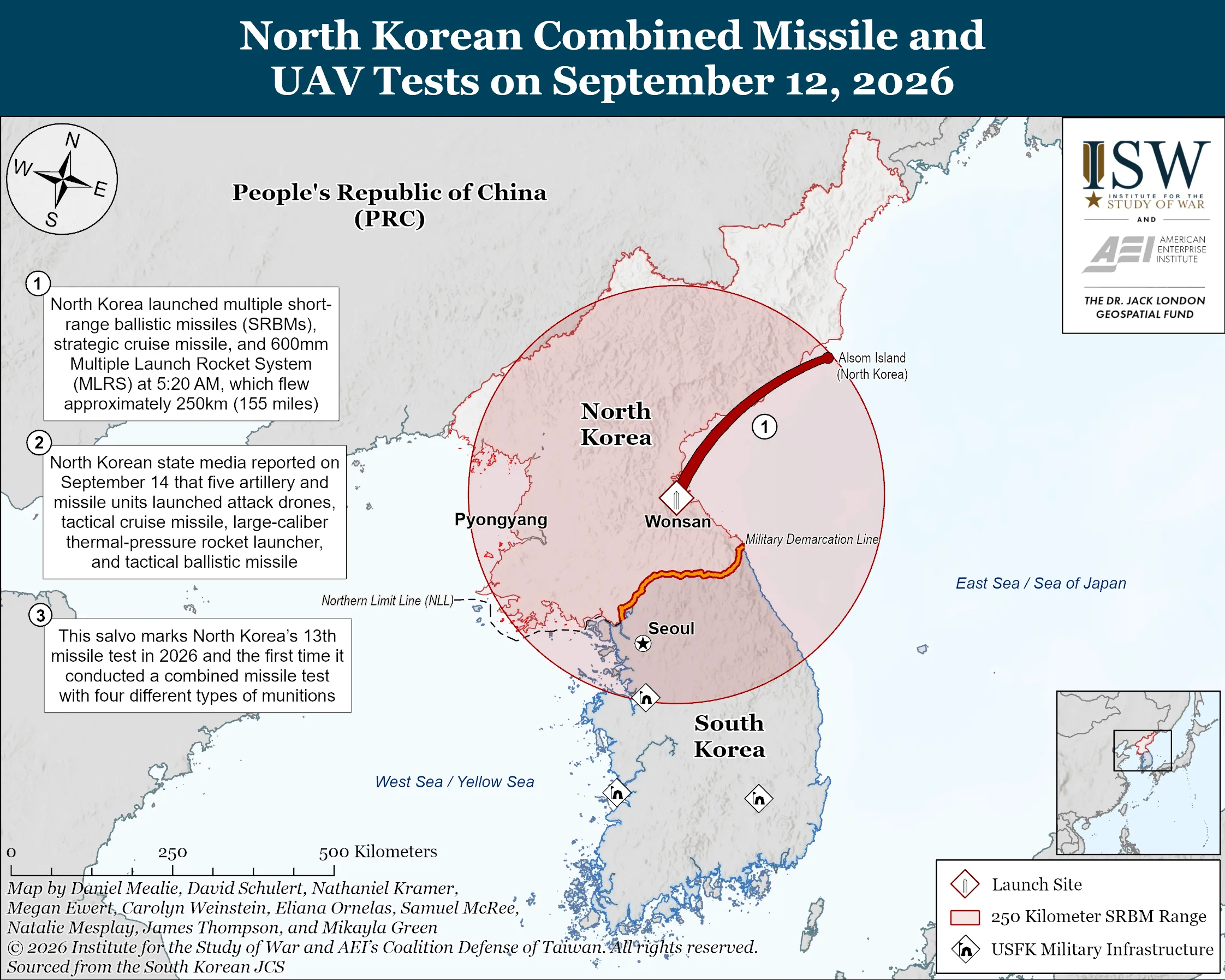
North Korea is likely developing a makeshift long-range strike complex that is increasingly integrating various munitions and systems. This strike complex may improve North Korea’s ability to penetrate South Korea’s integrated air and missile defense (IAMD) network. North Korea conducted a major missile and drone exercise on September 12.[1] The test consisted of tactical erector launcher (TEL)-fired Hwasong-11 short-range ballistic missiles (SRBM), 600mm multiple launch rocket systems (MLRS), cruise missiles, and two types of drones.[2] North Korean state media reported that the exercise aimed to improve North Korea’s integrated fire command system and practice using automated fire command across multiple platforms.[3] The September 12 exercise marked the first time North Korea used four different types of munitions — SRBM, MLRS, cruise missiles, and drones — in a single strike exercise.[4]
The September 12 exercise likely practiced a joint precision strike against South Korea designed to penetrate South Korea’s advanced IAMD network. The Russian military regularly combines ballistic and cruise missiles with long-range drones when striking Ukrainian infrastructure and population centers to complicate interception.[5] North Korea’s inclusion of long-range strike drones in the September 12 exercise is notable, and one variant of a drone used in the exercises bears some resemblance to a type of long-range drone used in Ukraine and the Middle East.[6] North Korea may be learning from Russian strike packages and is likely seeking to emulate them by developing more diverse strike capabilities.
The September 12 exercises also likely brought together units from the Korean People’s Army (KPA) Ground Forces, which are responsible for long-range artillery, and the KPA Strategic Force, which is responsible for long-range surface-to-surface missiles.[7] North Korea may be improving its ability to conduct joint strikes with units from both services, increasing the frontline support that KPA Strategic Force units may provide in a conventional conflict. ISW-CDOT has assessed that North Korea’s frontline artillery units may be shifting toward long-range strikes and away from tactical fire support, as reflected in the September 12 exercise’s inclusion of long-range artillery units in a long-range strike test.[8]
Improved joint strike capabilities likely increase the threat that North Korea’s conventional and nuclear forces pose to South Korea, although key limitations likely remain in the North Korean strike system. Russia’s long-range strike campaign has strained Ukrainian air defenses and created interceptor shortages, although this has not proved decisive to the outcome of the conflict.[9] North Korea also likely lacks the complex intelligence, surveillance, and reconnaissance architecture necessary to execute precision strikes effectively, although support from Russia or the PRC could remedy this shortcoming.[10] North Korea could still create significant effects without highly precise munitions if it can overwhelm South Korean IAMD with large and diverse strike packages.
North Korea is likely expanding its uranium enrichment facilities to increase its nuclear production and strengthen its nuclear forces’ survivability. The International Atomic Energy Agency (IAEA) assessed on September 9 that North Korea’s newly constructed uranium enrichment facility at the Yongbyon nuclear complex could accommodate up to 28 centrifuge cascades, a term that refers to a series of gas centrifuges that produce enriched uranium.[11] The IAEA assessed that the new two-story building at Yongbyon is likely North Korea’s second uranium enrichment facility.[12] The IAEA could not estimate the facility’s potential production of highly enriched uranium (HEU) or the number of nuclear weapons it could support due to the IAEA’s limited access to North Korean data.[13] The IAEA also reported that North Korea began operations in the Kangson enrichment facility in January 2026.[14] North Korea constructed the Kangson facility in 2024.[15] The IAEA concluded that the expansion of enrichment facilities indicates that North Korea’s overall uranium enrichment capacity is continuing to increase.
An unnamed Russian representative to the IAEA criticized the IAEA’s report for creating a “misleading” impression on September 10. The unnamed Russian representative stated the IAEA had not conducted inspections in North Korea since 2009, thus making its conclusions about North Korea’s nuclear infrastructure unreliable.[16] The unnamed Russian representative could have made this statement in defense of Russia’s ally. Russia-North Korea relations have increased significantly in recent years due to North Korea’s support for the Russian war effort in Ukraine.
Workers’ Party of Korea (WPK) General Secretary Kim Jong Un stated in June that North Korean nuclear production capabilities doubled in the past five years.[17] The Yongbyon facility expansion will improve uranium gas production efficiency due to the increased number of machines. ISW-CDOT previously assessed that the Yongbyon facility expansion addresses North Korea’s increased demand for enriched uranium.[18] Increased uranium production would help achieve Kim’s stated goal from the Ninth Party Congress in February to expand production of North Korea’s large nuclear warheads and tactical nuclear weapons.[19] North Korea likely aims to diversify delivery platforms and increase the quantity of nuclear warheads it possesses to make its nuclear forces more survivable against potential decapitation strikes.
South Korea’s ability to develop nuclear-powered attack submarines (SSN) may depend less on resolving nonproliferation concerns than on demonstrating a clear operational requirement for SSNs to the United States. The IAEA announced on September 8 that the South Korean government submitted its intention to begin consultations on arranging the required safeguard procedures to acquire SSNs.[20] South Korea has repeatedly stated that it will cooperate with IAEA safety protocols when developing SSNs. South Korea likely intends to quell concerns that Seoul is seeking nuclear latency by reaffirming its commitment to nonproliferation. South Korea has sought US support for submarine construction and fuel sourcing. US President Donald Trump approved South Korea’s plan to construct SSNs during an October 2025 summit with South Korean President Lee Jae-Myung, though such efforts would require approval from the US Congress. South Korea’s negotiations with the United States have not yet advanced, however, as South Korea has not explicitly stated the SSNs’ operational requirements, likely in anticipation of PRC protests. Strengthening the operational justification for South Korean SSNs to the US Navy — particularly the US Department of Energy’s Naval Nuclear Propulsion Program — may be more important for South Korea than addressing nonproliferation concerns.
US Chief of Naval Operations Daryl Caudle stated on September 9 that South Korea has little need for SSNs if they will not operate beyond waters near the Korean Peninsula. Caudle stated that South Korea should have a strong operational justification for developing SSNs rather than using them as a symbol of national prestige.[21] The South Korean Ministry of Foreign Affairs (MOFA) responded to the comment on September 11 by stating that the development of SSNs is intended to strengthen security on the Korean Peninsula, but did not state whether SSNs would support operations beyond South Korean waters.[22] Lee previously stated in October 2025 that South Korea’s existing diesel-powered submarines lack the endurance needed to track North Korean or PRC submarines.[23] Some media outlets, however, reported that Lee said “submarines close to the PRC” instead of “PRC submarines.”[24] The Lee administration has not yet announced how, or whether, SSNs would support US operations in the Indo-Pacific. South Korea would likely need to further clarify its intentions for its SSN program to advance negotiations with the United States, obtain access to enriched uranium required for operating SSNs, and secure congressional approval of a potential joint development agreement.
Key Takeaways
- North Korean Missile Development: North Korea conducted a missile and drone exercise on September 12 that used four different types of munitions in a single strike exercise, indicating that North Korea is increasingly looking to integrate various types of munitions and systems into its long-range strike complex. Improved joint strike capabilities would likely increase the threat posed by North Korea’s conventional and nuclear forces to South Korea’s integrated air and missile defense network.
- North Korean Uranium Enrichment: The International Atomic Energy Agency (IAEA) reported on September 9 that North Korea’s uranium enrichment facilities at Yongbyon and Kangson are continuing to expand, increasing North Korea’s overall uranium enrichment capacity. Workers’ Party of Korea General Secretary Kim Jong Un stated at the Ninth Party Congress that one of North Korea’s primary goals was increasing its nuclear warhead and tactical nuclear program, likely to increase nuclear survivability and deterrence.
- South Korean Nuclear Submarine Development: South Korea is continuing to cooperate with IAEA safety protocols as it works to develop nuclear submarines, in accordance with Seoul’s commitment to nonproliferation. South Korea, despite repeated statements on the importance of nuclear submarine development to South Korea’s defense, has not yet explicitly stated the operational requirements for these nuclear submarines, which could limit US willingness to agree to joint production efforts.
North Korean Domestic Politics
Nothing significant to report.
North Korean Military Developments
See toplines.
North Korean Foreign Relations
Nothing significant to report.
North Korean Cognitive Warfare
Nothing significant to report.
Inter-Korean Relations
The Lee Jae Myung administration will neither pursue an independent nuclear armament nor accept Pyongyang’s demands for nuclear-state recognition, in line with its stated “peaceful coexistence” policy, amid growing concerns that Washington might accept North Korea’s nuclear status. South Korean Vice Minister of National Defense Lee Doo-hee clarified on September 10 that the Lee Jae Myung administration is not considering developing independent nuclear weapons capabilities.[25] Lee Doo-hee reaffirmed that Seoul also does not officially recognize Pyongyang as a nuclear state, while acknowledging the existence of North Korea’s nuclear capabilities.[26] The Lee Jae Myung administration is continuing to pursue its peninsula-wide denuclearization objectives.[27] Lee Doo-hee’s statement likely reflects the administration’s response to representatives from the South Korean conservative bloc urging South Korea to develop independent nuclear capabilities. The conservative bloc cited US President Donald Trump’s decision to scale down multiple US-South Korean combined military exercises in exchange for potential US-North Korea engagement, stating concerns about US reliability.[28] The conservative bloc also expressed concern over Washington’s possible acceptance of North Korea’s demand for nuclear-state recognition.[29] Opposition People Power Party (PPP) floor leader Jeong Jeom-sig advocated on September 8 for a number of potential options deterring North Korean nuclear expansion, including US-South Korea nuclear-sharing arrangements.[30] Pyongyang currently justifies its nuclear development as a necessary deterrent of “foreign aggression” and has stated that the United States must recognize its nuclear capabilities before diplomatic engagement can occur. The Lee Jae Myung administration, by contrast, is maintaining its “peaceful coexistence” policy, predicated on the complete denuclearization of both Koreas. The Lee Jae Myung administration is continuing to preemptively clarify its stance on controversial issues amid concerns over Washington’s actions, quelling South Korean domestic conservative arguments and underscoring the administration’s commitment to fostering sustainable US-North Korea dialogue.
The Lee Jae Myung administration is likely to maintain its support for proactive engagement with North Korea by supporting Washington’s efforts to initiate talks with Pyongyang, aided by the increased Ministry of Unification (MOU) budget for inter-Korean cooperation. The Lee administration expanded the overall 2027 MOU budget by 10.2 billion KRW ($7.56 million) compared to the 2026 budget.[31] The administration reduced the budget for MOFA’s international denuclearization and human rights advocacy programs in its 2027 budget proposal.[32] The affected projects include MOFA’s “Enhancing International Cooperation for the Denuclearization of North Korea” project, which aimed to promote international understanding of the significance of the North Korean nuclear issue.[33] Seoul allocated 151.5 billion KRW ($112.5 million) to other unspecified “economic cooperation projects” within the MOU’s Inter-Korean Cooperation Fund.[34] MOU Spokesperson Yoon Min-ho stated on September 14 that these funds serve as preliminary reserves to finance inter-Korean engagement, adding that the MOU plans to deliver medical equipment to a hospital in Pyongyang for humanitarian purposes.[35] The Lee administration’s expansion of the MOU’s inter-Korean cooperation budget reflects its efforts to fund humanitarian initiatives as a way to thaw inter-Korean relations. The Lee administration likely hopes that inter-Korean dialogue would follow potential US-North Korea dialogue, which seems unlikely at present given North Korea’s previous responses to South Korean engagement efforts. Unification Minister Chung Dong-young argued on September 9 that Seoul’s primary mission is to cultivate an environment to facilitate US-North Korea dialogue.[36] Seoul also seeks to prevent a scenario where Washington accommodates Pyongyang’s demand for nuclear-state recognition and sidelines South Korea — a long-standing concern known as the “Korea Passing” phenomenon.[37]
South Korean Domestic Politics
South Korean President Lee Jae Myung faces increasing political pressure as heightened US demands for South Korean participation in the Iran War come amid declining domestic support for the Lee administration. South Korean media outlet JoongAng Ilbo asked all 17 members of the National Defense Committee from September 7 to 11 to state their positions on potential South Korean troop deployment to aid US efforts in Iran, and only three PPP lawmakers supported deploying South Korean troops to the Strait of Hormuz.[38] Ruling Democratic Party (DP) lawmaker and Chairman of the National Assembly’s National Defense Committee Jin Seong-jun said on September 14 that it was unclear whether a potential deployment consent bill would pass a National Assembly vote given the current sentiment among the ruling bloc.[39] Lee must receive parliamentary approval before deploying South Korean forces abroad. Representatives of the four progressive parties broadly aligned with the ruling camp — the Cho Kuk Innovation Party, Progressive Party, Basic Income Party, and Social Democratic Party — urged the National Assembly to pass a resolution opposing troop deployment on September 14.[40]
The Lee administration has not formalized its position on deploying forces to support US military operations in Iran following US President Donald Trump’s August 17 criticism of Lee for allegedly refusing a US request for South Korean troop support.[41] South Korea has denied that Lee rejected the request, however.[42] South Korean Foreign Minister Cho Hyun said South Korea had not yet decided whether to deploy forces to the Middle East in his September 11 phone call with Iranian Foreign Minister Abbas Araghchi.[43] South Korea dispatched a fact-finding team to the United Arab Emirates (UAE) to assess the operational environment in the Strait of Hormuz, likely to support a decision on force deployment.[44] The South Korean National Security Council (NSC) will discuss the team’s findings on September 17.[45]
Lee’s public approval ratings may continue to decline in the near term, as either decision could carry political costs for the Lee administration. South Korea’s rejection of providing military support would adversely affect ongoing negotiations with the United States on transferring wartime operational control, developing SSNs, and expanding cooperation in shipbuilding. Deploying troops could also generate domestic political backlash, which is likely a major concern given that in August Lee’s approval rating reached its lowest level since Lee took office in June 2025.[46] A survey published on September 10 found that approximately 45 percent of South Koreans opposed deploying troops to Iran.[47] Lee is thus likely to consider non-combative support or technological assistance for US operations as a means of managing alliance relations while advancing negotiations with Washington.[48]
Counter-North Korean Coalition Building Efforts
See toplines.

[1] https://www.nknews.org/2026/09/north-korea-launched-several-missiles-and-drones-in-concentrated-attack-drill/
[2] https://www.nknews.org/2026/09/north-korea-launched-several-missiles-and-drones-in-concentrated-attack-drill/; https://kcnawatch.org/newstream/1789335299-623711402/%EC%A1%B0%EC%84%A0%EC%9D%B8%EB%AF%BC%EA%B5%B0-%EA%B0%81%EA%B8%89-%EB%A0%A8%ED%95%A9%EB%B6%80%EB%8C%80-%EC%9E%A5%EA%B1%B0%EB%A6%AC%ED%8F%AC-%EB%B0%8F-%EB%AF%B8%EC%8B%B8%EC%9D%BC%EA%B5%AC%EB%B6%84/; https://www.yna.co.kr/view/AKR20260912006252504?section=nk/news/all
[3] https://kcnawatch.org/newstream/1789335299-623711402/%EC%A1%B0%EC%84%A0%EC%9D%B8%EB%AF%BC%EA%B5%B0-%EA%B0%81%EA%B8%89-%EB%A0%A8%ED%95%A9%EB%B6%80%EB%8C%80-%EC%9E%A5%EA%B1%B0%EB%A6%AC%ED%8F%AC-%EB%B0%8F-%EB%AF%B8%EC%8B%B8%EC%9D%BC%EA%B5%AC%EB%B6%84/
[4] https://www.chosun.com/english/national-en/2026/09/15/AWOCLTR4AFDMPJPSXFV67OEQIM/
[5] https://understandingwar.org/research/russia-ukraine/russian-offensive-campaign-assessment-september-12-2026/; https://www.csis.org/analysis/shahed-geran-how-russia-continues-reinvent-one-way-attack-drone; https://understandingwar.org/research/russia-ukraine/russian-offensive-campaign-assessment-september-9-2026/
[6] https://www.nknews.org/2026/09/north-korea-launched-several-missiles-and-drones-in-concentrated-attack-drill/; https://www.csis.org/analysis/shahed-geran-how-russia-continues-reinvent-one-way-attack-drone; https://www.cnbc.com/2026/03/05/iran-shahed-136-drone-cost-air-defense-gulf-war-us-israel-gulf-scorpion-strike-centcom.html
[7] https://armypubs.army.mil/epubs/DR_pubs/DR_a/ARN30043-ATP_7-100.2-000-WEB-2.pdf; https://www.usni.org/press/books/north-korean-peoples-army
[8] https://understandingwar.org/research/china-taiwan/korean-peninsula-update-august-19-2026/
[9] https://www.wsj.com/world/europe/dueling-airstrikes-fuel-angst-as-russia-ukraine-war-escalates-a6c0a67b?eafs_enabled=false
[10] https://www.iiss.org/online-analysis/military-balance/2023/12/a-tale-of-two-satellites-isr-on-the-korean-peninsula/; https://www.38north.org/2026/04/drones-and-operational-shift-north-koreas-adaptation-to-a-changing-warfare-environment/
[11] https://nk.news1.kr/news/articles/6284795 ; https://unterm.un.org/unterm2/en/view/UNHQ/B9BB5D50E9B101F685256D0F004F1B1F
[12] https://nk.news1.kr/news/articles/6284795
[13] https://nk.news1.kr/news/articles/6284795
[14] https://www.bbc.com/news/articles/cy0zqk2w92lo
[15] https://www.bbc.com/news/articles/cy0zqk2w92lo
[16] https://www.nknews.org/2026/09/russia-slams-u-n-watchdog-for-reporting-on-north-korean-nuclear-facility/
[17] https://nk.news1.kr/news/articles/6284795
[18] https://understandingwar.org/research/china-taiwan/korean-peninsula-update-march-12-2026/
[19] https://understandingwar.org/research/china-taiwan/korean-peninsula-update-march-12-2026/
[20] https://nk.news1 dot kr/news/articles/6283113
[21] https://www.segye dot com/newsView/20260910516160?OutUrl=naver
[22] https://www.joongang.co dot kr/article/25461038
[23] https://www.chosun dot com/politics/politics_general/2025/10/30/2LYU4Y5CVJAKNPE624W2NFGWVQ/; https://www.hani.co dot kr/arti/politics/politics_general/1226242.html
[24] https://www.hani.co dot kr/arti/politics/politics_general/1226242.html
[25] https://www.yna.co.kr/view/AKR20260910154600001?section=politics/defense
[26] https://www.yna.co.kr/view/AKR20260910154600001?section=politics/defense
[27] https://unikorea.go.kr/viewer/skin/doc.html?fn=6f8739eb03e1478a94ec79c58d1fd986.pdf&rs=/viewer/doc/202609/
[28] https://understandingwar.org/research/china-taiwan/korean-peninsula-update-august-26-2026/
[29] https://www.yna.co.kr/view/AKR20260821143000001
[30] https://www.newsis dot com/view/NISX20260908_0003780638
[31] https://www.asiae.co dot kr/article/2026090110123902895
[32] https://www.yna.co.kr/view/AKR20260913042700504
[33] https://www.yna.co.kr/view/AKR20260913042700504
[34] https://www.yna.co.kr/view/AKR20260911114200001
[35] https://news.kbs.co.kr/news/pc/view/view.do?ncd=8662505
[36] https://www.yna.co.kr/view/AKR20260909176900001
[37] https://asiae.co dot kr/article/2026082810512043847
[38] https://www.joongang.co dot kr/article/25461239
[39] https://www.donga dot com/news/Politics/article/all/20260915/134668482/2
[40] https://www.ksmnews.co dot kr/news/view.php?idx=621966
[41] https://www.pbs.org/newshour/show/trump-lashes-out-at-south-korea-over-its-refusal-to-join-iran-war
[42] https://www.koreajoongangdaily dot com/korea/defense-minister-says-trumps-claim-on-koreas-iran-response-not-consistent-with-facts/12832401
[43] https://www.yna.co.kr/view/AKR20260911098800504?section=politics/diplomacy
[44] https://www.khan.co dot kr/article/202609082226005#ENT
[45] https://www.khan dot co.kr/article/202609091634001#ENT
[46] https://imnews.imbc dot com/news/2026/politics/article/6851609_36911.html
[47] https://www.hani.co dot kr/arti/politics/politics_general/1277140.html
[48] https://www.joongang.co dot kr/article/25461526