
The Institute for the Study of War (ISW) and The Critical Threats Project (CTP) at the American Enterprise Institute are publishing updates Monday through Friday to provide analysis on the war with Iran. Most updates cover events from the past 24-hour period, whereas Monday updates also include events from the preceding weekend, collected after ISW-CTP’s 2:00 PM ET Friday data cutoff. ISW-CTP may publish special updates on Saturdays and Sundays if events warrant, however.
Key Takeaways
- US efforts to restore freedom of navigation appear to be having some success in challenging Iran’s ability to enforce control over the Strait of Hormuz. Increased commercial vessel transit levels indicate that Iran is having difficulty in preventing some commercial vessels from using the southern route. Iran may seek alternative ways to demonstrate or restore control over the strait as the United States challenges Iran’s ability to threaten vessels.
- The roughly 50 percent reported failure rate of Iranian ballistic missiles fired at Jordan on September 1 may reflect the degradation of Iran’s longer-range missile capabilities.
- The Financial Times (FT) reported on September 1 that Russia has been covertly helping Iran develop advanced cruise missile technology since around November 2023. Iran’s development and operationalization of this technology would likely improve its ability to threaten US land and naval assets in the region. Developing supersonic cruise missile technology takes substantial time, and it is currently unclear how far along Iran is in developing this technology.
- Iran is likely pursuing two separate but related lines of effort to advance Iranian objectives in Iraq amid Iraqi government efforts to disarm Iranian-backed Iraqi militias. Iran reportedly pushed unspecified Iraqi government actors and Iranian-backed Iraqi militias to reach a settlement in which the militias would “discreetly” retain their weapons by storing them either in Popular Mobilization Forces (PMF)-controlled depots or in the militias’ own depots under the condition that they would not use them without PMF approval. Iran is also reportedly pursuing a plan to build a new cadre of smaller, more ideological militias over which Iran would have strong control.
Toplines
US efforts to restore freedom of navigation appear to be having some success in challenging Iran’s ability to enforce control over the Strait of Hormuz. US officials told Axios on September 2 that approximately 40 vessels carrying millions of barrels of oil transited the Strait of Hormuz on September 1.[1] US Energy Secretary Chris Wright also confirmed that oil tankers transported over 17 million barrels of oil through the strait on August 31, which is the highest volume of oil exports through the strait since the start of the US-Israel-Iran War.[2] This amount is close to pre-war levels, which averaged 21.6 million barrels per day in the fourth quarter of 2025.[3] The US Energy Information Administration estimated on August 10 that an average of 4.9 million barrels per day transited the strait in the second quarter of 2026, highlighting how oil export volumes through the strait have improved compared to earlier in the war.[4] These transit levels indicate that Iran is having difficulty in preventing some commercial vessels from using the southern route. There have recently been several indicators that Iranian forces are facing operational constraints. The Islamic Revolutionary Guards Corps (IRGC) recently attempted to use shore-based rocket launchers instead of fast attack craft (FAC) to deploy mines and has reportedly used FAC to physically identify vessels because Iran retains only a few functioning radars covering the southern route.[5] These less optimal methods suggest that US strikes have degraded some of Iran’s maritime surveillance and mine-laying capabilities.[6] The IRGC’s repeated false claims that vessels are striking naval mines in the strait likely similarly reflect an effort to preserve the perception that the southern route remains unsafe.[7] US Central Command (CENTCOM) previously reported on August 27 that US forces cleared all naval mines in the strait.[8]
Iran is trying to reconstitute military capabilities to threaten shipping in the strait. US President Donald Trump stated on September 1 that Iran had nearly rebuilt some of its radar systems before the United States struck them again on September 1.[9] The United States has also targeted Iranian coastal radar systems in previous rounds of strikes, including in June.[10] CENTCOM confirmed that its September 1 strikes targeted Iranian air defense sites, radar systems, maritime assets and facilities, mine-laying capabilities, and communications sites.[11] Iran appears committed to restoring the surveillance and maritime capabilities required to enforce its control over the strait despite repeated US strikes. Iran will likely continue to attempt to reconstitute these capabilities because Iran does not appear willing to relinquish control of the strait, which remains a core Iranian objective.
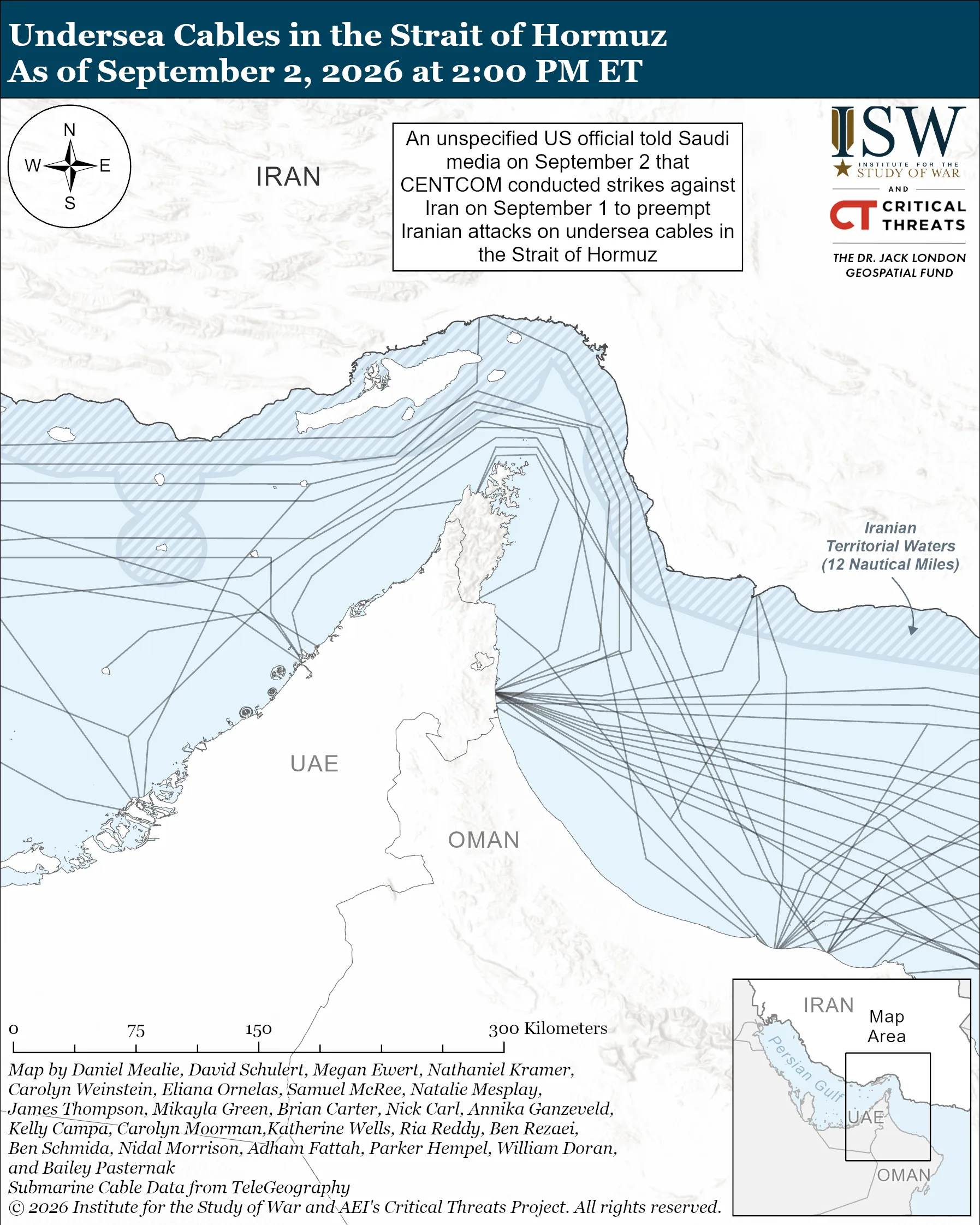
Iran may seek alternative ways to demonstrate or restore control over the strait as the United States challenges Iran’s ability to threaten vessels. An unspecified US source told Saudi-based Al Arabiya on September 2 that CENTCOM’s September 1 strikes sought to preempt Iranian attacks on undersea communications cables in the strait.[12] This report, if accurate, could indicate that Iran is considering expanding its coercive activity in the strait beyond attacks on vessels to fixed undersea infrastructure. IRGC-affiliated outlets have previously discussed using undersea cables as another source of leverage.[13] IRGC-affiliated Fars News and Tasnim News Agency argued in May that Iran should assert sovereignty over fiber-optic cables transiting the strait and require foreign operators to obtain permits and pay fees, for example.[14] The Wall Street Journal (WSJ) separately reported on August 16 that the IRGC had developed plans for “further escalation,” including plans to sabotage undersea internet cables.[15] These reports suggest that Iran is considering new tools to preserve the perception that it still controls the strait as it faces constraints in its ability to threaten shipping. It is unclear, however, whether Iran possesses the technical capability to damage undersea cables effectively.
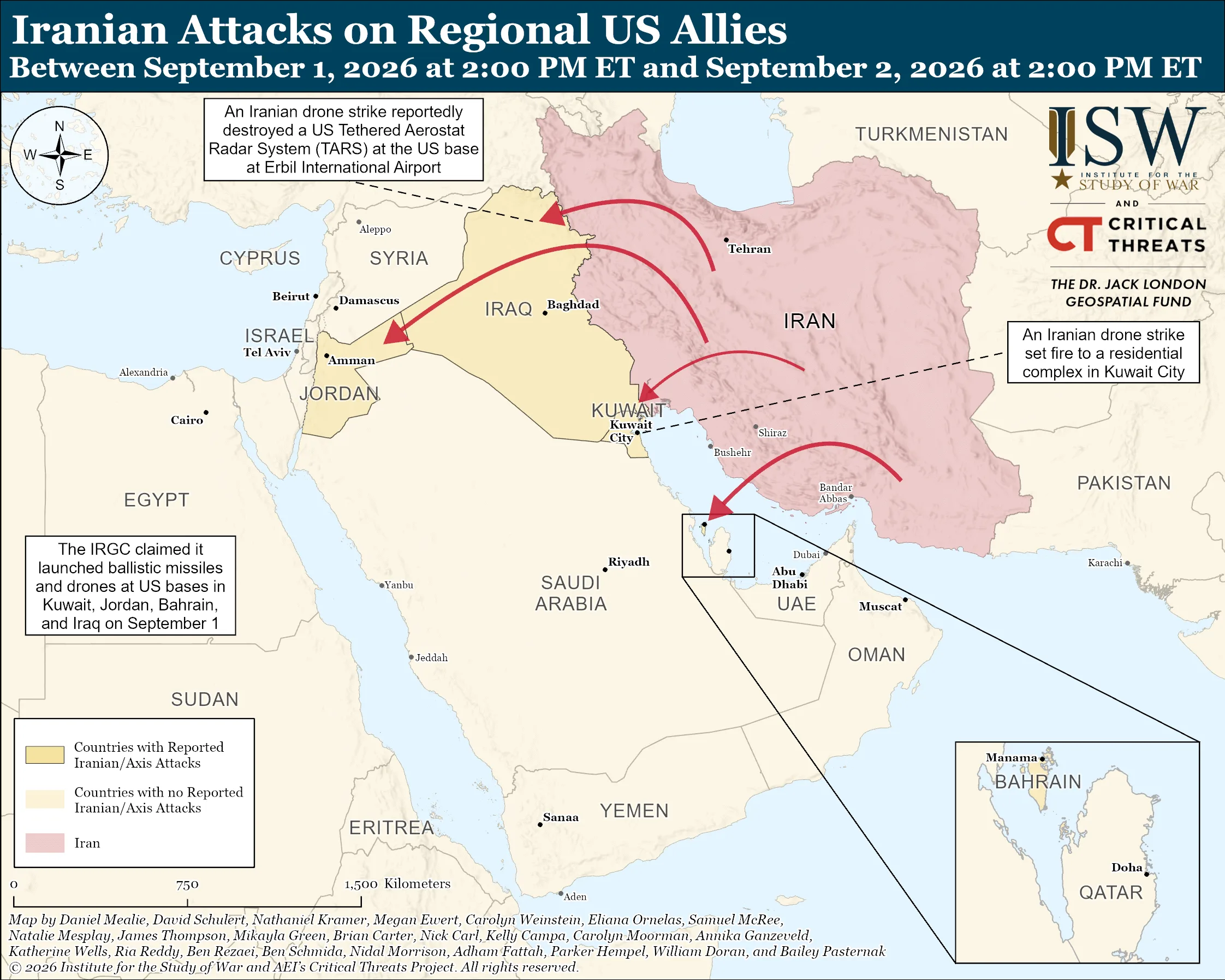
Iran likely seeks to use attacks on regional countries and messaging to their populations to pressure these states to reduce military cooperation with the United States. The IRGC claimed on September 2 that it conducted combined missile and drone attacks targeting US bases in Kuwait, Jordan, Bahrain, and Iraq.[16] US officials told Axios on September 1 that US air defenses intercepted two Iranian drones targeting a US base in Erbil, Iraqi Kurdistan.[17] Iran has repeatedly claimed that the presence of US forces imposes a security cost on host countries and continues to try to generate public pressure on regional states to distance themselves from the United States.[18] The IRGC directly addressed the Kuwaiti public on September 2 after claiming a missile and drone attack on Ali al Salem Air Base.[19] The IRGC stated that the attack was intended to help Kuwait “cleanse” its territory of US forces.[20] IRGC Political Affairs Deputy Brigadier General Yadollah Javani separately called on regional countries on September 2 to “expel the Americans” and warned that Iran would respond to attacks launched from countries that host US forces.[21] These IRGC statements suggest that Iran is trying to turn regional opposition to US basing into a source of pressure on the United States. The IRGC previously released a statement in July thanking the Jordanian people for allegedly providing Iran with information that aided Iran’s attacks on US bases in Jordan and called on Jordanians to demand the removal of US forces.[22]
This IRGC effort is consistent with broader Iranian attempts to raise the military and political costs of continued US involvement in the war on the United States. Voice of Iran, which has historically been affiliated with the Supreme Leader’s office, argued on September 1 that prolonged disruption in the strait would raise oil prices, inflation, and other economic pressure in the United States and increase political pressure on President Trump ahead of the midterm elections in November 2026.[23]
The roughly 50 percent reported failure rate of Iranian ballistic missiles fired at Jordan may reflect the degradation of Iran’s longer-range missile capabilities. US officials told Axios on September 1 that Iran fired approximately 25 ballistic missiles at Jordan on September 1, but that only about half reached Jordanian airspace.[24] Jordanian air defenses intercepted 10 missiles, and three others landed in open areas.[25] The reported failure rate could indicate that Iran used older, less advanced missiles or newer, potentially hastily produced missiles with lower reliability in the attack. Iran experienced a similarly high failure rate during its April 2024 True Promise I attack on Israel.[26] About 50 percent of the missiles that Iran launched at Israel at the time either failed to launch or crashed before reaching their targets.[27] Although the exact mid-flight failure rate of Iranian missiles in later attacks is unclear, some reports have estimated that roughly 10 percent of Iranian missiles failed during True Promise II in October 2024.[28] The similar failure rates between Iran’s True Promise I attack and its September 1 attack may therefore indicate the degradation of Iran’s longer-range missile capabilities.
FT reported on September 1 that Russia has been covertly helping Iran develop advanced cruise missile technology since around November 2023.[29] Iran’s development and operationalization of this technology would likely improve its ability to threaten US land and naval assets in the region. FT reported, citing leaked Russian correspondence, travel records, and military patents, that Russian state defense firms signed a contract with Iran’s Defense Ministry in November 2023 to develop Iran’s cruise missile propulsion technology.[30] Russian defense firm NPO Mashinostroyenia has sent cruise missile experts to Iran in recent years to help Iran develop ramjet propulsion systems, which enable cruise missiles to fly at supersonic speeds and thereby bypass modern air defense systems more easily.[31] Iranian cruise missiles employ turbojet and turbofan engines and have not been very effective in conflicts with the United States and Israel over the past two years.[32] Iran launched around 30 cruise missiles at Israel in April 2024, but Israel was able to shoot down most of the missiles outside of Israeli airspace, for example.[33] Iran likely used the Paveh-351 cruise missile during the attack.[34] This missile employs a turbojet engine and takes about two hours to reach Israel from Iran.[35] Iran’s development of cruise missiles with ramjet engines would likely improve Iran’s ability to conduct effective cruise missile attacks. FT noted that Iranian defense officials were reportedly negotiating the next phase of the cruise missile technology agreement with Russia as of June 2026.[36]
Developing cruise missile technology takes substantial time, and it is currently unclear how far along Iran is in developing this technology. The Indian Navy developed a similar supersonic anti-ship cruise missile with NPO Mashinostroyenia in 1998, but the missile was not fully operational until 2005.[37] The Russo-Iranian cooperation on supersonic cruise missile technology began in 2023, and Iran has been in two full-scale wars against the United States and Israel since then.[38] ISW-CTP cannot determine the timeline required for Iran to fully operationalize this technology.
Iran is likely pursuing two separate but related lines of effort to advance Iranian objectives in Iraq amid Iraqi government efforts to disarm Iranian-backed Iraqi militias. Informed sources told Iraqi media on September 1 that Iran pushed unspecified Iraqi government actors and Iranian-backed Iraqi militias to reach a settlement in which the militias would “discreetly” retain their weapons by storing them either in Popular Mobilization Forces (PMF)-controlled depots or in the militias’ own depots under the condition that they would not use them without PMF approval.[39] This settlement would likely mean, in reality, that the Iranian-backed militia-controlled PMF would accept and oversee weapons from Iranian-backed militias that answer to Iran and operate outside of the PMF.[40]
This Iranian effort comes amid Iraqi Prime Minister Ali al Zaydi’s attempts to reform the PMF through an amended draft PMF Law that could fulfill US objectives regarding militia disarmament.[41] The Iraqi Parliament is unlikely to approve the amended law, given that parliamentarians affiliated with Iraqi militias that control PMF brigades are parliamentary committee members who must review and approve the draft law before Parliament can convene and vote on the law.[42] The United States has pressured Zaydi to disarm the militias due to militia attacks on US and foreign targets in Iraq and the region in recent months, to which Zaydi responded by setting a September 30 deadline to restrict arms to the state and taking limited steps toward disarmament.[43] Iraqi Commander-in-Chief Spokesperson Sabah Numan recently claimed on August 28 that the militias have so far surrendered half of their weapons.[44] It is nearly impossible for the Iraqi government to verify this information given the clandestine nature of the militias, however.[45]
This Iranian effort to circumvent disarmament by potentially giving the PMF control over militia weapons comes as Iran is also reportedly pursuing a plan to build a new cadre of smaller, more ideological militias over which Iran would have strong control. These militias would support the political activity of existing Iranian-backed Iraqi actors. Security sources told Iraqi media on September 1 that unspecified actors, almost certainly referring to Iran, may create small, anonymous groups that do not have the name of known militias after the implementation of the disarmament settlement described above.[46] The sources added that the unspecified actors could use these new groups to support the political activity of existing Iranian-backed Iraqi actors, such as by threatening government officials opposed to Iranian-backed Iraqi actors’ agendas.[47] This effort is also consistent with Iran’s reported effort to encourage some of its larger Iraqi militia partners to move into politics.[48] Iraqi sources told Reuters in June that the IRGC has reportedly formed multiple Iraqi militia cells that directly report to the IRGC, possibly in an initial effort to build this new, loyal cadre of ideological militias.[49] Iran may calculate that these new militias would still be able to access weapons under PMF control, even if the cell members only respond to the IRGC. This calculation, however, depends on Iran continuing to wield influence over the PMF.
US and Partner Military Operations
See topline section.
Iranian Strike Campaign
Assessed Iranian War Aims:
- Secure international recognition of Iranian control over the Strait of Hormuz
- Degrade the US ability and willingness to continue the war
- Restore deterrence vis-à -vis the United States and its regional partners
- Divide the United States and Israel from the Arab states
See topline section.
US-Iran Negotiations
Nothing significant to report.
Iranian Domestic Affairs
Nothing significant to report.
Lebanon
Hezbollah is very likely training and equipping Syrian Assadist insurgents to conduct attacks in Syrian territory to destabilize Syria and prevent Syrian government forces from disrupting Hezbollah’s military activities. Lebanese and international media reported on September 2 that Lebanese General Security forces arrested five Syrian and Lebanese members of an Assadist insurgent network, including a former Assad regime intelligence officer, in Akkar District, northern Lebanon.[50] Lebanese judicial and security sources said that the network includes at least 50 Assadist fighters who reached Hezbollah training camps in the Bekaa Valley.[51] The fighters typically travel from Syria’s coastal provinces through northern and eastern Lebanon to Beirut’s Hezbollah-dominated southern suburbs before departing for the training camps.[52] Lebanese media reported on September 2 that Hezbollah is training Assadist insurgents to assemble and pilot drones and prepare improvised explosive devices before the fighters return to Syria.[53] The judicial and security sources also told Saudi media that the insurgents primarily intend to conduct attacks in Syria’s Alawite-majority coastal provinces, as well as coordinate assassinations and destabilize both Lebanon and Syria.[54]
Hezbollah likely intends for such attacks to compel the Syrian government to divert resources from counter-smuggling efforts to focus on threats to Syrian stability.[55] Lebanese and Syrian authorities have threatened Hezbollah’s weapons smuggling activities in recent months by interdicting Hezbollah weapons shipments and expanding border security coordination.[56] Hezbollah’s strategic objective in Syria is to redevelop and preserve its ground lines of communication (GLOCs) from Iraq to Lebanon, through which the group receives weapons and components from Iran. Hezbollah likely calculates that destabilizing Syria and forcing Syrian forces to focus on internal threats will enable the group to reconstitute these GLOCs. ISW-CTP previously reported in January 2026 that former Assad regime officers have attempted to organize insurgent activity against the Syrian government from Lebanese territory, although Alawite and Assadist insurgents have not conducted a successful attack in Syria since December 2025.[57]
Iraq
See topline section.
Arabian Peninsula
Nothing significant to report.

[1] https://www.axios.com/2026/09/02/iran-tankers-hormuz-attacks-oil
[2] https://www.cnbc.com/2026/09/02/energy-secretary-chris-wright-tells-cnbc-that-more-than-17-million-barrels-of-oil-transited-hormuz-on-monday.html
[3] https://www.eia.gov/outlooks/steo/report/global_oil.php
[4] https://www.eia.gov/outlooks/steo/report/global_oil.php
[5] https://www.reuters.com/world/middle-east/us-forces-strike-two-iranian-launchers-irans-larak-island-us-official-says-2026-08-30 ;
https://maritime-executive.com/article/us-pre-empts-iranian-rocket-deployment-of-sea-mines-in-strait-of-hormuz ;
https://x.com/MartinKelly/status/2094129711483891783
[6] https://x.com/CENTCOM/status/2094916573920199143?s=20 ;
https://x.com/CENTCOM/status/2063030319490744715?s=20 ;
https://x.com/CENTCOM/status/2074670840893870433?s=20
[7] https://t.me/farsna/459686 ;
https://t.me/farsna/459138
[8] https://x.com/CENTCOM/status/2093131928023023729?s=20
[9] https://www.foxnews.com/live-news/us-iran-war-news-trump-leader-latest-today-september-1#post-725fc90 ;
https://x.com/CENTCOM/status/2094916573920199143?s=20
[10] https://x.com/CENTCOM/status/2070607101207232829?s=20 ;
https://x.com/CENTCOM/status/2064512017197941163?s=20 ;
https://x.com/CENTCOM/status/2063081770422030840?s=20
[11] https://x.com/CENTCOM/status/2094916573920199143?s=20
[12] https://x.com/AlArabiya_Eng/status/2095128871205011934?s=20
[13] https://understandingwar.org/research/middle-east/iran-update-special-report-may-13-2026/
[14] https://t.me/Tasnimnews/414162 ;
https://t.me/farsna/435121
[15] https://www.wsj.com/world/middle-east/iran-plan-escalate-war-cc657664
[16] https://t.me/farsna/459656
[17] https://www.axios.com/2026/09/02/iran-tankers-hormuz-attacks-oil
[18] https://www.khabaronline dot ir/news/2262669/ ;
https://nournews dot ir/fa/news/315615/ ;
https://www.mehrnews dot com/news/6904236/
[19] https://t.me/farsna/459656
[20] https://t.me/farsna/459656
[21] https://t.me/farsna/459596
[22] https://t.me/defapress_ir/63898
[23] https://farsi.khamenei dot ir/others-report?id=63516
[24] https://www.axios.com/2026/09/02/iran-tankers-hormuz-attacks-oil
[25] https://www.axios.com/2026/09/02/iran-tankers-hormuz-attacks-oil
[26] https://www.wsj.com/livecoverage/israel-iran-strikes-live-coverage/card/many-iranian-missiles-failed-to-launch-or-crashed-before-striking-target-u-s-officials-say-TCd4YP2fiODhl1t9QDrL
[27] https://www.wsj.com/livecoverage/israel-iran-strikes-live-coverage/card/many-iranian-missiles-failed-to-launch-or-crashed-before-striking-target-u-s-officials-say-TCd4YP2fiODhl1t9QDrL
[28] https://www.armscontrolwonk.com/archive/1220753/ninety-percent-of-the-time-the-missile-works-every-time-iranian-missile-failure-rates-during-true-promise-ii/
[29] https://www.ft.com/content/6cf367bc-95b0-4f1f-b149-a25684adefc3?syn-25a6b1a6=1
[30] https://www.ft.com/content/6cf367bc-95b0-4f1f-b149-a25684adefc3
[31] https://www.ft.com/content/6cf367bc-95b0-4f1f-b149-a25684adefc3
[32] https://www.ft.com/content/6cf367bc-95b0-4f1f-b149-a25684adefc3
[33] https://www.theguardian.com/world/2024/apr/14/how-irans-attack-on-israel-was-stopped
[34] https://www.theguardian.com/world/2024/apr/14/how-irans-attack-on-israel-was-stopped
[35] https://www.theguardian.com/world/2024/apr/14/how-irans-attack-on-israel-was-stopped
[36] https://www.ft.com/content/6cf367bc-95b0-4f1f-b149-a25684adefc3
[37] https://www.deagel.com/weapons/brahmos/a001774
[38] https://www.ft.com/content/6cf367bc-95b0-4f1f-b149-a25684adefc3 ; https://understandingwar.org/analysis/middle-east/the-12-day-israel-iran-war-june-2025/ ; https://understandingwar.org/research/middle-east/iran-update-evening-special-report-february-28-2026/ ; https://www.reuters.com/world/middle-east/iran-strikes-cia-facilities-prompt-questions-about-possible-russian-role-2026-07-22/ ; https://www.nbcnews.com/world/ukraine/russia-us-base-american-troops-zelenskyy-rcna265612?cid=eml_nbn_20260328&user_email=66b6883228ff200252c6ddc5125f1f647e464a0b8574c7dda8af0dd3fcbc7086&utm_campaign=breakingnews&%243p=e_sailthru&_branch_match_id=1241504286416404303&utm_medium=Email%20Sailthru&_branch_referrer=H4sIAAAAAAAAAzWP3WrDMAyFnya7S%2BvaiRMGZYyNvoaRbbkx8R9yQugu9uxzLgYC6RyhT9KybaW%2BX69Jm4RHvUApl%2BDTehXlo%2BODKHdUFXzYFtrfmpHJP32CoHYK9%2BUc7sRnxx8tjuO4%2FGNMjqeTKdiW95XAJ2wV7bV66Pfaa6jYQ0TyBlK%2FUc6l9j8YMNX19erJJOBylDfeiYfxthPfGINKOinOuGSCzx2Xe0VSGNt9rS%2BllvMsOJ%2Bd44zxkRtprRlvfHQ3J4cJBzkA0%2FM4DWayFmZwzFrhjDYTm%2BXJ26IyEAv4Z2pETQirT8%2FzpbdfQodETSpN%2BWib718L5Yh%2F3vVV2kMBAAA%3D
[39] https://almadapaper dot net/451082/
[40] https://understandingwar.org/research/middle-east/the-leadership-and-purpose-of-iraqs-popular-mobilization-forces/
[41] https://www.alaraby.co dot uk/politics/خاص-قانون-الحشد-الشعبي-يعاود-الظهور-معدلاً-أمام-البرلمان-العراقي
[42] https://iq.parliament dot iq/%D8%A7%D9%84%D9%86%D8%B8%D8%A7%D9%85-%D8%A7%D9%84%D8%AF%D8%A7%D8%AE%D9%84%D9%8A/ ; https://baghdadtoday dot news/302887-.html ; https://ahlualhaq dot iq/index.php?page=details&id=7612&lang=en ; https://shafaq dot com/ar/سیاسة/عضو-بالدفاع-النيابية-لا-حاجة-لبقا-التحالف-ونطالب-ب-قرار-خدمة-العلم ; https://www.washingtoninstitute.org/policy-analysis/profile-badr-organization ; https://www.washingtoninstitute.org/policy-analysis/profile-asaib-ahl-al-haq-0
[43] https://www.wsj.com/world/middle-east/u-s-blocks-iraqs-dollar-shipments-to-squeeze-its-iran-backed-militias-3270d5af ; https://www.newarab dot com/news/us-sends-dollar-shipment-iraq-threatens-sanctions; https://shafaq dot com/ar/سیاسة/حصري-اميركا-تشترط-تفكيك-الفصا-ل-مقابل-تحرير-30-مليار-دولار-من-موال-صدام
[44] https://almadapaper dot net/450341/
[45] https://understandingwar.org/research/middle-east/iran-update-august-28-2026/
[46] https://almadapaper dot net/451082
[47] https://almadapaper dot net/451082
[48] https://understandingwar.org/research/middle-east/iran-update-november-4-2025/; https://amwaj.media/en/article/what-s-left-unsaid-about-iran-s-influence-in-iraq
[49] https://understandingwar.org/research/middle-east/iran-update-special-report-june-19-2026/ ; https://www.reuters.com/world/middle-east/irans-revolutionary-guards-set-up-covert-iraqi-cells-attack-gulf-neighbors-2026-06-19/
[50] https://www.almodon dot com/politics/2026/09/02/تفكيك-خلية-أسدية-تدريب-بالبقاع-وإيواء-بالضاحية-وخط-بموسكو ; https://aawsat dot com/العالم-العربي/المشرق-العربي/5313845-لبنان-يفكك-شبكة-أمنية-خطيرة-تابعة-لـحزب-الله-وفلول-الأسد
[51] https://www.almodon dot com/politics/2026/09/02/تفكيك-خلية-أسدية-تدريب-بالبقاع-وإيواء-بالضاحية-وخط-بموسكو ; https://aawsat dot com/العالم-العربي/المشرق-العربي/5313845-لبنان-يفكك-شبكة-أمنية-خطيرة-تابعة-لـحزب-الله-وفلول-الأسد
[52] https://aawsat dot com/العالم-العربي/المشرق-العربي/5313845-لبنان-يفكك-شبكة-أمنية-خطيرة-تابعة-لـحزب-الله-وفلول-الأسد ; https://www.almodon dot com/politics/2026/09/02/تفكيك-خلية-أسدية-تدريب-بالبقاع-وإيواء-بالضاحية-وخط-بموسكو
[53] https://www.almodon dot com/politics/2026/09/02/تفكيك-خلية-أسدية-تدريب-بالبقاع-وإيواء-بالضاحية-وخط-بموسكو
[54] https://aawsat dot com/العالم-العربي/المشرق-العربي/5313845-لبنان-يفكك-شبكة-أمنية-خطيرة-تابعة-لـحزب-الله-وفلول-الأسد
[55] https://en.majalla.com/node/332122/opinion/syria-cannot-stop-hezbollah%E2%80%99s-smuggling-networks-alone ; https://understandingwar.org/research/middle-east/iran-update-special-report-syria-after-the-israel-iran-war-june-13-july-3-2025/
[56] https://sana dot sy/en/syria/2336194/ ; https://x.com/LebarmyOfficial/status/2084535964257439825 ; https://understandingwar.org/research/middle-east/iran-update-special-report-august-4-2026/ ; https://apnews.com/article/syria-weapons-smuggling-iraq-hezbollah-2e3a328669d876dce0a940714ee8a799
[57] https://understandingwar.org/research/middle-east/iran-update-january-7-2026/ ; https://understandingwar.org/research/middle-east/iran-update-december-29-2025/