Toplines
North Korea appears to be pressuring the United States to abandon its denuclearization policy and accept North Korea’s continued nuclear development. US acceptance of North Korea as a nuclear-weapon state will have long-term regional destabilizing effects. South Korean media outlet Yonhap News Agency reported on August 26 that a spokesperson for the US Department of State reaffirmed the US’ longstanding commitment to the complete denuclearization of North Korea.[1] Yonhap News Agency cited another unnamed US official who stated that there has been no change in US policy towards denuclearization.[2] A spokesperson for North Korea’s Ministry of Foreign Affairs (MFA) stated on August 31 that North Korea would continue to respond to the US’ “unwavering hostile policy” with “the strongest possible measures.”[3] The North Korean spokesperson stated that the US’ repeated statements supporting North Korea’s denuclearization would not weaken or dilute North Korea’s status as a nuclear-weapon state.[4] The North Korean spokesperson added that the US’ “hostile policy” toward North Korea was becoming even more dangerous.
North Korea may be attempting to pressure US President Donald Trump to accept North Korea as a nuclear-weapons state in exchange for agreeing to future engagement. Trump on August 18 ordered a reduction in the US’s participation in the US-South Korea combined annual Ulchi Freedom Shield (UFS) exercise and called for a dialogue with Workers’ Party of Korea (WPK) General Secretary Kim Jong Un.[5] The Wall Street Journal reported on August 18 that Trump is seeking to meet with Kim in November at the 2026 Asia-Pacific Economic Conference (APEC).[6] Director of the WPK General Affairs Department Kim Yo Jong, sister of Kim Jong Un, dismissed the move on August 19, saying that the exercise reduction did not constitute a change in the US’ “hostile” policy against North Korea. Kim Yo Jong did describe personal ties between Kim Jong Un and Trump as “amicable,” however.[7] ISW-CDOT assessed that North Korea will not accept US requests for dialogue based on arms control and reduction until the United States explicitly abandons its policy of North Korean denuclearization.
North Korea is seeking international recognition of its status as a nuclear-weapon state. North Korea would likely present any future dialogue with the United States as reflecting US recognition of North Korea as a nuclear-weapon state, even if the United States does not announce a corresponding change in policy. North Korea may portray such a meeting as an effort between nuclear-state leaders to manage escalation risks instead of a negotiation. North Korea has made it clear that it is unwilling to negotiate its possession of nuclear weapons in exchange for a reduction in exercises and temporary sanctions relief. Any dialogue that cannot explicitly discuss a nuclear test freeze, arms control, and gradual arms reduction will embolden North Korea to advance further capabilities development that will continue to threaten regional strategic stability.
South Korea is likely to agree to de-emphasize “complete denuclearization” during a potential US-North Korea negotiation, which may undermine South Korean denuclearization goals in the long term. South Korean Unification Minister Chung Dong-young stated on August 27 that an approach centered on the “complete denuclearization of North Korea” is not realistic, emphasizing that North Korea’s nuclear capabilities are continuously growing.[8] Chung said that US President Donald Trump’s efforts to resume US-North Korea dialogue could open up a window of opportunity for negotiations.[9] Chung’s statement appears to underscore the need for negotiations centered on arms control and reduction. The South Korean Lee Jae Myung administration has advocated for a phased denuclearization approach toward North Korea, starting with renewed dialogue, arms freeze and control, arms reduction, and denuclearization, describing this as a realistic mechanism for denuclearization given North Korea’s refusal to engage with South Korea.[10] North Korea has rejected Lee’s repeated diplomatic outreach and formalized a “hostile two-state policy,” likely because it believes any dialogue with South Korea would require acquiescing to demands for a gradual abandonment of its nuclear weapons.[11] ISW-CDOT assessed that North Korea is attempting to sideline South Korea in any potential US-North Korea dialogue.[12] North Korea’s potential acceptance of talks with the United States, therefore, is likely to result in participating actors remaining silent on denuclearization or recognizing North Korea’s right to possess nuclear weapons, which will contradict South Korea’s stated expectations of discussing arms control and reduction during the talks.
Key Takeaways
- US-North Korea Relations: The United States reaffirmed its policy towards North Korean denuclearization on August 26 despite the Trump administration’s calls for US-North Korea dialogue. North Korea is unlikely to change its position requiring the US to abandon its denuclearization policy before agreeing to dialogue. North Korea likely seeks to gain US acceptance of its status as a nuclear-armed state, which could have long-term regional destabilizing effects.
- Inter-Korean Relations: South Korea could agree to de-emphasize “complete denuclearization” and instead pursue a phased denuclearization strategy in an effort to encourage US-North Korea dialogue. North Korea has consistently ignored South Korean outreach efforts and maintains that its nuclear status is non-negotiable. South Korea could undermine its long-term goals of North Korean denuclearization if it accepted North Korean possession of nuclear weapons in exchange for dialogue in the short term.
North Korean Domestic Politics
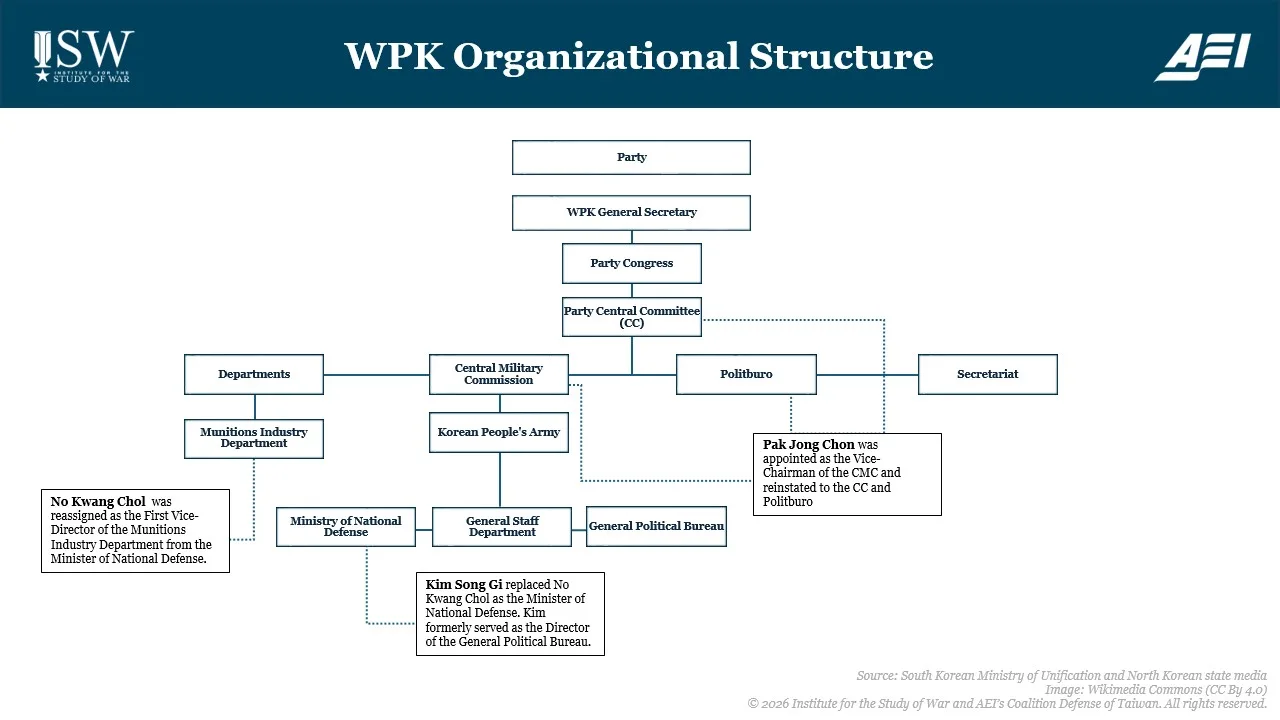
North Korea’s appointment of a new defense minister may indicate efforts to strengthen the WPK’s political oversight over the military. North Korean state media reported on August 30 that North Korea demoted No Kwang Chol from the Minister of National Defense to the First Vice-Director of the Munitions Industry Department during the Ninth Central Military Commission’s (CMC) Second Meeting.[13] North Korea appointed Kim Song Gi, former Director of the Korean People’s Army (KPA) General Political Bureau, to be the new Minister of National Defense.[14] North Korea reappointed Pak Jong Chon, former advisor to the Ministry of National Defense, to the position of CMC Vice-Chairman and reinstated Pak’s membership to the party Central Committee and Politburo.[15]
No is a North Korean four-star general and a two-time defense minister.[16] No has primarily served as a defense industry specialist responsible for overseeing North Korea’s munitions industry and defense procurement and production.[17] No will likely continue managing North Korea’s national defense industry as director of the Munitions Industry Department, but the reassignment represents a hierarchical demotion.[18] Kim Song Gi, who is replacing No, has less publicly known career experience than No. Kim Song Gi’s previous role as a director of the KPA General Political Bureau suggests that Kim was responsible for reinforcing party ideology within the military.[19] The General Political Bureau is the WPK’s main mechanism for ideological control over the military.
Pak has held key military and political positions under WPK General Secretary Kim Jong Un and has undergone repeated promotion-demotion cycles, likely as part of Kim Jong Un’s efforts of military elite management. Pak’s reinstatement likely reflects this previously established pattern.[20]
Kim Song Gi’s promotion may indicate an attempt to strengthen the WPK’s political oversight of the KPA. Kim Jong Un convened the first party-government-military joint meeting on July 11 to publicly reprimand large-scale corruption within the military, specifically calling out Deputy Director of the KPA General Political Bureau Pak Hui Chol for corruption.[21]
North Korean Military Developments
Nothing significant to report.
North Korean Foreign Relations
Nothing significant to report.
North Korean Cognitive Warfare
Nothing significant to report.
Inter-Korean Relations
The Lee Jae Myung administration is working to expand its diplomatic and economic relations with Russia, likely aiming to leverage Russia’s ties with North Korea to help facilitate inter-Korean dialogue. The South Korean Ministry of Foreign Affairs (MOFA) announced on August 31 that South Korean Ambassador to Russia Lee Suk-bae will attend the Eastern Economic Forum (EEF) in Vladivostok from September 1 to 4.[22] The EEF is a Russian-led annual event promoting Asia-Pacific regional economic cooperation.[23] Lee Suk-bae’s participation would be South Korea’s first senior-level representation at the EEF since the 2022 outbreak of the Russia-Ukraine War.[24] Seoul downgraded its delegations to the EEF following the outbreak of war, sending delegations at the general or minister-counselor level.[25] Former South Korean Presidents Park Geun-hye and Moon Jae-in attended the EEF in 2016 and 2017, respectively, and sent deputy prime minister- or minister-led delegations in following years.[26] The South Korean Ministry of Unification (MOU) conversely announced on August 31 that it will not attend the EEF.[27] Minister of Unification Chung Dong-young advocated in July for leveraging North Korea-Russia relations to facilitate future inter-Korean dialogue by participating in the EEF.[28]
The Lee administration’s decision to attend the EEF aims to restore bilateral relations toward pre-war levels and ultimately leverage Moscow’s diplomatic influence to induce Pyongyang’s participation in dialogue. Russia was South Korea’s 10th-largest trading partner in 2019, maintaining extensive economic and political exchanges.[29] Russian-South Korean trade has significantly decreased since. ISW-CDOT previously assessed that the Lee administration and the MOU are prioritizing multilateral discussions to maximize the likelihood of North Korean engagement.[30] The South Korean delegation at the EEF will likely engage with Russian officials to discuss a role for Moscow in future multilateral discussions. The MOU, however, stated that the ministry does not believe North Korean officials would attend the EEF.[31] Pyongyang has not sent delegations to the EEF since 2023.[32] A North Korean delegation will very likely reject any engagement from Seoul if it attended the EEF or other similar events.
South Korean Domestic Politics
South Korean President Lee Jae Myung appointed General (Ret.) Kang Shin-chul as the Minister of National Defense, replacing Ahn Gyu-baek. Kang’s appointment is likely intended to help facilitate Lee’s military objectives, including operational control (OPCON) transfer and the integration of South Korean military academies. Lee nominated Kang, the current South Korean Ambassador to Saudi Arabia and former Deputy Commander of the South Korea-US Combined Forces Command (CFC), to the ministerial position on August 30.[33] Ahn’s replacement is likely not intended as a disciplinary action or dismissal but rather reflects a broader cabinet and presidential staff reshuffle.[34] Kang is a graduate of the Korea Military Academy (KMA) with 36 years of military service. Kang served at the CFC from 2023 to 2025, during which he worked alongside current CFC Commander US General Xavier Brunson for approximately 10 months.[35] Kang will succeed Ahn upon receiving the National Assembly’s approval. Ahn was South Korea’s first civilian defense minister since 1961.[36] The opposition People Power Party (PPP) and South Korean conservative bloc consistently voiced concerns over Ahn’s insufficient military experience and controversial aspects of Ahn’s personal military service.[37]
Seoul’s decision to replace a civilian defense minister with an individual with an extensive military background and extensive combined operations experience with the US Forces Korea (USFK) could be intended to signal that South Korea seeks to enhance operational coordination with the USFK and Washington while accelerating bilateral consultations on OPCON transfer and nuclear-powered attack submarine (SSN) procurement. Kang’s established relationship with Brunson could also mitigate inter-alliance friction that emerged during Ahn’s tenure, including disagreements on downscaling combined exercises and over US Air Force drills around the Yellow Sea.[38]
The Lee administration is also likely aiming to mitigate strong political and public opposition to integrating South Korea’s military academies for the Army, Navy, and Air Force.[39] Ahn claimed the integration would help prepare for future warfare and foster joint-force interoperability.[40] Ahn’s integration plan triggered severe pushback from opposition parties and military veterans, however. South Korean survey firm Gallup Korea reported on August 27 that 58 percent of respondents opposed the integration and only 30 percent supported it. Opposition among conservative respondents reached 77 percent.[41] Gallup reported that public opposition prevailed across all demographics except core ruling party supporters.[42] Lee likely seeks to restore credibility to South Korea’s defense ministry, reconcile resistance to his policy proposals, and build public consensus around his defense reform agenda by appointing Kang as Defense Minister.
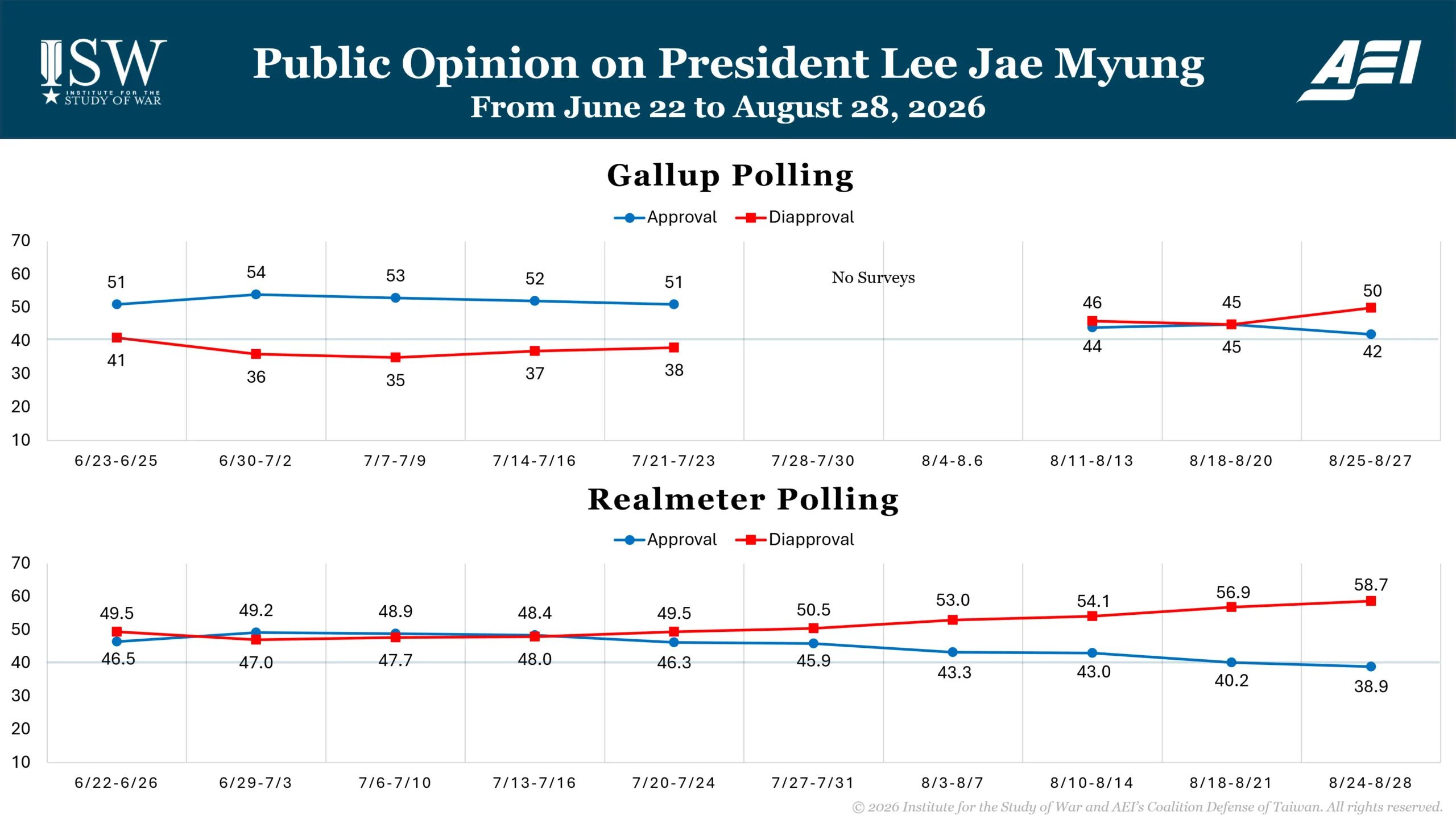
South Korean President Lee Jae Myung may shift to prioritizing South Korean domestic politics over foreign due to receiving his lowest-ever approval rating since his inauguration. South Korean polling agency Realmeter reported that Lee received a 58.7 percent disapproval rating, his highest ever, in the fourth week of August.[43] Realmeter first reported that Lee’s disapproval rating had risen higher than his approval rating in the third week of June; it remained around 48 to 49 percent throughout July.[44] Realmeter also reported that Lee’s disapproval rating remained higher than his approval rating throughout August.[45] Realmeter attributed the decline in approval rating to increasing real estate prices, the lack of a Supreme Court Justice appointment, and a general lack of public trust in the police due to recent criminal cases.[46] Gallup also reported that Lee received an approval rating of 42 percent and his highest disapproval rating since his inauguration, 50 percent, in the fourth week of August.[47] Gallup reported a steady decline in Lee’s approval ratings and an increase in Lee’s disapproval ratings throughout August, with his disapproval ratings surpassing the approval ratings in the second week of August.[48] Gallup reported that ongoing concerns over South Korea’s self-defense due to US President Donald Trump’s order to reduce the US-South Korea combined exercises, increasing real estate prices, and a worsening economy led to Lee’s increasing disapproval ratings.[49] Realmeter and Gallup also reported the South Korean political parties’ approval ratings for the Lee administration. Realmeter reported that 43.1 percent of ruling Democratic Party (DP) supporters surveyed and 37.7 percent of opposition PPP supporters surveyed approved of the Lee administration.[50] Gallup reported that 39 percent of DP supporters and 25 percent of PPP supporters approved of the Lee administration in August.[51]
Lee stated that he will work to address the South Korean public’s concerns through new government policies on August 13.[52] August is the first month that Gallup reported that the Lee administration’s disapproval ratings were higher than its approval ratings.[53] Realmeter and Gallup reported on the consistent decline of the Lee administration’s approval rating throughout June and July. Gallup reported that most of Lee’s disapproval ratings came from people aged 21-39 due to the worsening South Korean economy.[54] Lee recently responded to the growing public discontent with changes in his cabinet and policy measures. Lee accepted the Chief Presidential Policy Advisor Kim Yong-beom’s resignation on September 1 and nominated a new Minister of Finance and Economy on August 30.[55] Lee also announced the South Korean Blue House will supply more than 230,000 housing units and discussed policy changes to address the rising housing prices with Blue House officials on August 13.[56] Lee also increased funding for programs aimed at increasing youth education and employment opportunities on August 28.[57] Lee may continue to shift his priorities in policies toward improving South Korean domestic and economic policies to raise his approval ratings. Lee’s shift in policy priorities will not hinder Lee’s policies to expand South Korean defense programs, however, as the Lee administration increased the 2027 defense budget by 8.2 percent.[58]
Several Russian military jets entered South Korea’s Air Defense Identification Zone (KADIZ), provoking a South Korean military response. The South Korean Joint Chiefs of Staff (JCS) said that multiple Russian military jets entered KADIZ over the East Sea/Sea of Japan near the Ulleungdo and Dokdo (Takeshima) islands on August 25. JCS said it scrambled fighter jets after Russian aircraft entered KADIZ.[59] JCS reported that the Russian aircraft did not enter South Korean sovereign airspace.[60] The incursion comes after more than 10 Russian and People’s Republic of China (PRC) military aircraft entered KADIZ on June 27 as part of a “strategic air patrol.”[61] This latest incursion may signal greater Russian will to encroach upon South Korean airspace, particularly amid a period of increasingly heightened military, commercial, and high-level diplomatic coordination between Russia and North Korea.[62]
Counter-North Korean Coalition Building Efforts
The United States, South Korea, and Japan are continuing to prioritize trilateral deterrence operations against the PRC even as Washington proposes engagement with North Korea. The United States, South Korea, and Japan will conduct the trilateral combined Freedom Edge exercise from September 7 to 11 in international waters southeast of South Korea’s Jeju Island.[63] Freedom Edge has occurred annually since 2024, following the trilateral agreement reached at the August 2023 Camp David Summit.[64] US Indo-Pacific Command (INDOPACOM) stated that the exercise enhances interoperability against regional threats, integrating maritime and aviation capabilities alongside air defense, medical evacuation, and maritime interdiction operations.[65] South Korea’s JCS also emphasized that Freedom Edge is a defensive exercise designed to counter North Korean nuclear and missile threats while preserving regional peace and stability.[66] The North Korean MFA released a statement criticizing the Freedom Edge exercise on August 31, saying that the United States was demonstrating its “consistent hostile policy” toward Pyongyang.[67]
The trilateral partners are executing collective deterrence operations to deny the PRC’s power projection beyond the First Island Chain. Seoul is likely seeking to expand its regional security contributions in alignment with the Trump administration’s calls for strategic flexibility. US Under Secretary of Defense for Policy Elbridge Colby stated on August 10 that US regional allies must expand their sovereign defense capabilities and burden-sharing to maintain a credible deterrence posture against the PRC along the First Island Chain.[68] The Lee Jae Myung administration also seeks to reinforce operational coordination with Washington to fulfill the requirements for OPCON transfer and facilitate US cooperation on SSN procurement.

[1] https://www.yna.co.kr/view/AKR20260827000651071?section=nk/news/all
[2] https://www.yna.co.kr/view/AKR20260827000651071?section=nk/news/all
[3]
https://www.yna.co.kr/view/AKR20260827000651071?section=nk/news/all
[4] https://www.news1.kr/nk/politics-diplomacy/6274817
[5] https://www.reuters.com/world/asia-pacific/north-korea-denounces-us-south-korea-joint-military-drills-kcna-says-2026-08-18/
[6] https://www.wsj.com/world/asia/trump-pushes-for-kim-jong-un-meeting-this-year-2a9f9ae0
[7] https://www.reuters.com/world/asia-pacific/north-koreas-kim-yo-jong-denies-zelenskiys-claim-additional-troops-deployment-2026-08-19/
[8] https://www.yna.co.kr/view/AKR20260827099751504?section=nk/news/all
[9] https://www.yna.co.kr/view/AKR20260827099751504?section=nk/news/all
[10] https://www.yna.co.kr/view/MYH20260121014600038; https://www.news1 dot kr/politics/president/6193775
[11] https://understandingwar.org/research/china-taiwan/north-koreas-constitutional-amendments-cement-the-regimes-strategic-posture/; https://www.koreaherald dot com/article/10732176
[12] https://understandingwar.org/research/china-taiwan/korean-peninsula-update-august-26-2026/
[13] https://kcnawatch.org/newstream/1788037516-372281579/%ec%a1%b0%ec%84%a0%eb%a1%9c%eb%8f%99%eb%8b%b9-%ec%a4%91%ec%95%99%ea%b5%b0%ec%82%ac%ec%9c%84%ec%9b%90%ed%9a%8c-%ec%a0%9c%ef%bc%99%ea%b8%b0-%ec%a0%9c%ef%bc%92%ec%b0%a8%ed%9a%8c%ec%9d%98-%ec%a7%84/
[14] https://kcnawatch.org/newstream/1788037516-372281579/%ec%a1%b0%ec%84%a0%eb%a1%9c%eb%8f%99%eb%8b%b9-%ec%a4%91%ec%95%99%ea%b5%b0%ec%82%ac%ec%9c%84%ec%9b%90%ed%9a%8c-%ec%a0%9c%ef%bc%99%ea%b8%b0-%ec%a0%9c%ef%bc%92%ec%b0%a8%ed%9a%8c%ec%9d%98-%ec%a7%84/
[15] https://kcnawatch.org/newstream/1788037516-372281579/%ec%a1%b0%ec%84%a0%eb%a1%9c%eb%8f%99%eb%8b%b9-%ec%a4%91%ec%95%99%ea%b5%b0%ec%82%ac%ec%9c%84%ec%9b%90%ed%9a%8c-%ec%a0%9c%ef%bc%99%ea%b8%b0-%ec%a0%9c%ef%bc%92%ec%b0%a8%ed%9a%8c%ec%9d%98-%ec%a7%84/
[16] https://nkinfo.unikorea.go dot kr/nkp/prsn/view.do;jsessionid=aQXbqbDkwQcFr5zT5jOddoWX4FN2ca1wfyzj1TzV.ins22?menuId=PEOPLE_86&prsnMngNo=44376
[17] https://nkinfo.unikorea.go dot kr/nkp/prsn/view.do;jsessionid=aQXbqbDkwQcFr5zT5jOddoWX4FN2ca1wfyzj1TzV.ins22?menuId=PEOPLE_86&prsnMngNo=44376
[18] https://nkinfo.unikorea.go dot kr/nkp/prsn/view.do;jsessionid=aQXbqbDkwQcFr5zT5jOddoWX4FN2ca1wfyzj1TzV.ins22?menuId=PEOPLE_86&prsnMngNo=44376
[19] https://www.donga dot com/news/Politics/article/all/20260831/134572654/2
[20] https://nkinfo.unikorea.go dot kr/nkp/prsn/view.do;jsessionid=XAzWoJHhoJR7pGBYQ_JCOZrmi2QtFeEDWGt9jpwe.ins12?menuId=PEOPLE_86&prsnMngNo=30443
[21] https://news.kbs.co dot kr/news/pc/view/view.do?ncd=8613952
[22] https://www.yna.co.kr/view/AKR20260831126600504
[23] https://www.donga dot com/news/Politics/article/all/20260831/134576723/1
[24] https://www.yna.co.kr/view/AKR20260831126600504
[25] https://www.yna.co.kr/view/AKR20260831126600504
[26] https://www.donga dot com/news/Politics/article/all/20260831/134576723/1
[27] https://news.kbs.co.kr/news/pc/view/view.do?ncd=8650242
[28] https://www.chosun.com/politics/north_korea/2026/07/23/WKBAKH3ZXBADNKTOAFKZKA75SE/
[29] https://tongsangnews.kr/webzine/1902011/sub1_1.html
[30] https://understandingwar.org/research/china-taiwan/korean-peninsula-update-august-19-2026/
[31] https://news.kbs.co.kr/news/pc/view/view.do?ncd=8650242
[32] https://www.donga dot com/news/Politics/article/all/20260831/134576723/1
[33] https://www.yna.co.kr/view/AKR20260830031000504
[34] https://www.yna.co.kr/view/AKR20260830037900001
[35] https://www.yna.co.kr/view/AKR20260830031000504
[36] https://www.joongang.co.kr/article/25345894; https://www.yna.co.kr/view/AKR20260614017900504; https://www.munhwa dot com/article/11587579; https://www.joongang.co.kr/article/25345894; https://www.yna.co.kr/view/AKR20260614017900504; https://www.munhwa dot com/article/11587579; https://www.joongang.co.kr/article/25418488
[37] https://weekly.chosun.com/news/articleView.html?idxno=54824; https://imnews.imbc dot com/news/2026/politics/article/6836788_36911.html; https://www.donga dot com/news/Politics/article/all/20260806/134429974/1 https://weekly.chosun.com/news/articleView.html?idxno=54824; https://imnews.imbc.com/news/2026/politics/article/6836788_36911.html;
[38] https://www.segye dot com/newsView/20260422515798
[39] https://www.donga dot com/news/Politics/article/all/20260701/134216650/1
[40] https://www.donga dot com/news/Politics/article/all/20260701/134216650/1
[41] https://www.gallup.co dot kr/gallupdb/reportContent.asp?seqNo=1656#F
[42] https://www.gallup.co dot kr/gallupdb/reportContent.asp?seqNo=1656#F
[43] http://www.realmeter dot net/%ec%97%90%eb%84%88%ec%a7%80%ea%b2%bd%ec%a0%9c%ec%8b%a0%eb%ac%b8-%eb%a6%ac%ec%96%bc%eb%af%b8%ed%84%b0-8%ec%9b%94-4%ec%a3%bc-%ec%b0%a8-%ec%a3%bc%ea%b0%84-%eb%8f%99%ed%96%a5-%e6%9d%8e-%eb%8c%80-2/?ckattempt=1
[44] http://www.realmeter dot net/%ec%97%90%eb%84%88%ec%a7%80%ea%b2%bd%ec%a0%9c%ec%8b%a0%eb%ac%b8-%eb%a6%ac%ec%96%bc%eb%af%b8%ed%84%b0-8%ec%9b%94-4%ec%a3%bc-%ec%b0%a8-%ec%a3%bc%ea%b0%84-%eb%8f%99%ed%96%a5-%e6%9d%8e-%eb%8c%80-2/?ckattempt=1
[45] http://www.realmeter dot net/%ec%97%90%eb%84%88%ec%a7%80%ea%b2%bd%ec%a0%9c%ec%8b%a0%eb%ac%b8-%eb%a6%ac%ec%96%bc%eb%af%b8%ed%84%b0-8%ec%9b%94-4%ec%a3%bc-%ec%b0%a8-%ec%a3%bc%ea%b0%84-%eb%8f%99%ed%96%a5-%e6%9d%8e-%eb%8c%80-2/?ckattempt=1
[46] http://www.realmeter dot net/%ec%97%90%eb%84%88%ec%a7%80%ea%b2%bd%ec%a0%9c%ec%8b%a0%eb%ac%b8-%eb%a6%ac%ec%96%bc%eb%af%b8%ed%84%b0-8%ec%9b%94-4%ec%a3%bc-%ec%b0%a8-%ec%a3%bc%ea%b0%84-%eb%8f%99%ed%96%a5-%e6%9d%8e-%eb%8c%80-2/?ckattempt=1
[47] https://www.gallup dot co.kr/gallupdb/reportContent.asp?seqNo=1656
[48] https://www.gallup dot co.kr/gallupdb/reportContent.asp?seqNo=1656
[49] https://www.gallup dot co.kr/gallupdb/reportContent.asp?seqNo=1656
[50] http://www.realmeter dot net/%ec%97%90%eb%84%88%ec%a7%80%ea%b2%bd%ec%a0%9c%ec%8b%a0%eb%ac%b8-%eb%a6%ac%ec%96%bc%eb%af%b8%ed%84%b0-8%ec%9b%94-4%ec%a3%bc-%ec%b0%a8-%ec%a3%bc%ea%b0%84-%eb%8f%99%ed%96%a5-%e6%9d%8e-%eb%8c%80-2/?ckattempt=1
[51] https://www.gallup dot co.kr/gallupdb/reportContent.asp?seqNo=1656
[52] https://www.hani dot co.kr/arti/politics/bluehouse/1272730.html
[53] https://www.gallup dot co.kr/gallupdb/reportContent.asp?seqNo=1656
[54] https://www.gallup dot co.kr/gallupdb/reportContent.asp?seqNo=1656
[55] https://www.reuters.com/world/asia-pacific/south-koreas-lee-accepts-resignation-policy-adviser-following-cabinet-reshuffle-2026-09-01/ , https://www.yna.co.kr/view/AKR20260901140500001?section=politics/president , https://www.yna.co.kr/view/AKR20260901140500001?section=politics/president
[56] https://www.hani dot co.kr/arti/politics/bluehouse/1272730.html
[57] https://www.newsis dot com/view/NISX20260828_0003767307 , https://biz.chosun.com/policy/politics/president_office/2026/08/28/MWYEGBAMQBA2FBYCFYDCLLJV3M/
[58] https://www.yna.co.kr/view/AKR20260901092951504?section=politics/defense
[59] https://www.yna dot co.kr/view/AKR20260826043900504?section=politics/defense; https://www.kyivpost dot com/post/83109; https://www.kommersant dot ru/doc/8908320
[60] https://www.yna dot co.kr/view/AKR20260826043900504?section=politics/defense; https://www.kyivpost dot com/post/83109; https://www.kommersant dot ru/doc/8908320
[61] https://understandingwar.org/research/china-taiwan/korean-peninsula-update-july-7-2026/; https://www.yna dot co.kr/view/AKR20260826043900504?section=politics/defense; https://www.kyivpost dot com/post/83109; https://www.kommersant dot ru/doc/8908320
[62] https://understandingwar.org/research/china-taiwan/korean-peninsula-update-august-26-2026/
[63] https://www.yna.co.kr/view/AKR20260828041800504
[64] https://www.joongang.co.kr/article/25457214
[65] https://www.joongang.co.kr/article/25457214; https://www.usfj.mil/Media/Press-Releases/Article-View/Article/4585127/japan-rok-us-announce-trilateral-exercise-freedom-edge-2026/
[66] https://imnews.imbc dot com/news/2026/politics/article/6848819_36911.html
[67] https://kcnawatch.org/newstream/1788152574-114259985/%ec%99%b8%eb%ac%b4%ec%84%b1-%eb%8c%80%eb%b3%80%ec%9d%b8-%eb%8b%b4%ed%99%94-%eb%b0%9c%ed%91%9c/
[68] https://www.yna.co.kr/view/AKR20260811000600071; https://understandingwar.org/research/china-taiwan/korean-peninsula-update-august-19-2026/