
The Institute for the Study of War (ISW) and The Critical Threats Project (CTP) at the American Enterprise Institute are publishing daily updates to provide analysis on the war with Iran. The updates cover events from the past 24-hour period.
Note: ISW-CTP has revised its update structure due to the resumption of war between the United States and Iran. Iran is currently engaged in an information effort to frame its attacks on US bases and regional states as retaliatory and defensive. Iran is not merely responding to US strikes on Iran, however, but is engaged in proactive military operations to achieve discrete objectives. The revised update structure reflects some of these key objectives.
Key Takeaways
- The factional nature of Iranian decisionmaking is likely slowing Tehran’s approval of the draft Iran-Oman agreement covering vessel traffic in the Strait of Hormuz. There are conflicting reports of whether the regime has finalized the draft agreement.
- Iran is likely linking any lifting of restrictions on traffic through the strait to both US economic and strait-related concessions. Lifting restrictions on the strait without US concessions would weaken Iran’s bargaining position in negotiations while leaving the US blockade, sanctions, and other economic pressure in place.
Toplines
The factional nature of Iranian decisionmaking is likely slowing Tehran’s approval of the draft Iran-Oman agreement covering vessel traffic in the Strait of Hormuz. There are conflicting reports of whether the regime has finalized the draft agreement. Axios reported on August 4 that Iran’s leadership approved the agreement.[1] Two unspecified regional officials told the Associated Press on August 5, however, that Supreme Leader Mojtaba Khamenei had not approved the agreement.[2] This round of negotiations — like the others before it — has reportedly taken place without the presence of the Islamic Revolutionary Guards Corps (IRGC).[3] A faction of anti-concessions Iranian leaders, likely from the IRGC and led by IRGC Commander Major General Ahmad Vahidi, are close to the supreme leader and have consistently won policy arguments since the war began. One of the few times the IRGC did not win this argument was when Iranian President Masoud Pezeshkian successfully convinced the supreme leader to accept the Memorandum of Understanding (MoU) in June by offering his resignation as president. The repeated insistence of Iranian officials that the Iran-Oman talks only cover technical transit arrangements further indicates that the regime has not yet reached consensus on the agreement.[4]
This lack of consensus on the agreement likely reflects the regime’s internal divisions over negotiations.[5] ISW-CTP assessed on July 28 that three groups are competing to shape Iran’s negotiations policy: an anti-concessions faction likely led by Vahidi that supports talks but rejects any agreement that limits Iranian control over the strait; a pro-concessions faction that includes Iranian President Masoud Pezeshkian, Foreign Affairs Minister Abbas Araghchi, and Parliament Speaker Mohammad Bagher Ghalibaf and is more willing to compromise to reduce economic pressure; and the ultra-hardline Paydari (Stability) Front, which opposes negotiations with the United States altogether.[6] All these factions agree that Iran must maintain a certain level of control over the strait; their differences are related to tactics, not strategic objectives.
The emerging Iran-Oman arrangement will reportedly give Iran a greater role in controlling traffic through the strait than Iran had before the war. Axios reported on August 4 that the agreement stipulates that inbound vessels will travel through Iranian waters, while outbound vessels will use a route through Omani waters “in coordination with Iran” for sixty days while mines are cleared from the recognized transit scheme.[7] Iranian Deputy Foreign Affairs Minister for Legal and International Affairs Kazem Gharibabadi described a broader Iranian role on August 5, however.[8] Gharibabadi stated that vessels would also travel through Iranian waters during part of their outbound passage before continuing through Omani waters.[9] Gharibabadi added that the new arrangement would replace both existing temporary routes, referring to the US-facilitated southern route through Omani waters and the route through Iranian waters that Iran has coerced vessels by force to use in recent months.[10] Gharibabadi’s description therefore suggests that Iran is seeking more direct control over outbound traffic than what Axios described on August 4.[11] A regional source told Reuters on August 5 that the unspecified ”parties” had already accepted some form of Iranian control over the strait but did not provide further detail.[12] Iran is likely seeking to convert the temporary leverage it gained by disrupting maritime traffic into a lasting role in managing the waterway, which would allow the Iranian regime to monitor vessel traffic, pressure adversaries, and threaten renewed disruption of the strait during future crises. ISW-CTP previously assessed that Iranian control of the strait is detrimental to global commercial interests because it enables Iran to selectively determine which vessels may pass through the strait and at what cost.[13]
Iran is likely linking any lifting of restrictions on traffic through the strait to both US economic and strait-related concessions. Lifting restrictions on the strait without US concessions would weaken Iran’s bargaining position in negotiations while leaving the US blockade, sanctions, and other economic pressure in place. Unidentified Iranian sources told Iranian media on August 5 that Iran would not reopen the strait unless the United States ended its attacks on Iran, addressed the alleged US MoU “violations,” met Iran’s conditions, and provided guarantees that the United States military would not attack Iran.[14] Iran notably viewed any strait transit that crossed without its approval as a violation of the MoU, which suggests that Iran is seeking even more significant strait-related concessions. Iran likely calculates that restoring normal traffic through the strait before securing economic benefits and its concessions to its control of the strait would reduce the costs that the conflict imposes on the United States and regional states and thus weaken the US incentive to make concessions. The Financial Times reported on August 4 that the United States would lift its naval blockade and ease restrictions on Iranian oil exports if Iran agreed to reopen the strait, according to a person briefed on the recent talks.[15] Axios also reported on August 4 that the temporary Iran-Oman arrangement concerning the strait could facilitate renewed ceasefire and nuclear negotiations.[16] The regime likely views the strait agreement as an initial step as part of a broader and more comprehensive agreement related to the strait and will not give up substantive leverage without a broader agreement.
US and Partner Military Operations
Nothing significant to report.
Iranian Strike Campaign
Assessed Iranian War Aims:
- Secure international recognition of Iranian control over the Strait of Hormuz
- Degrade the US ability and willingness to continue the war
- Restore deterrence vis-à -vis the United States and its regional partners
- Divide the United States and Israel from the Arab states
Nothing significant to report.
US-Iran Negotiations
See topline section.
Iranian Domestic Affairs
Nothing significant to report.
Lebanon
The Israel Defense Forces (IDF) issued an evacuation order ahead of conducting airstrikes in Mansouri, Tyre District, on August 5, after announcing that Hezbollah violated the ceasefire.[17] The IDF has not issued evacuation orders ahead of strikes in southern Lebanon since July 11.[18] The IDF did not provide details of the reported Hezbollah ceasefire violation.[19] Hezbollah-aligned Lebanese media reported on August 5 that an improvised explosive device killed two IDF soldiers operating in Majdal Zoun, Tyre District, which neighbors Mansouri, however.[20] Hezbollah has not claimed this attack at the time of this writing.
Iraq
Iraqi Prime Minister Ali al Zaydi’s anti-corruption and militia disarmament efforts are reportedly deepening divisions within the Shia Coordination Framework. An Iraqi political source told Saudi media on August 5 that unspecified Iraqi officials who initially supported Zaydi’s disarmament and anti-corruption initiatives have “begun to back down” in recent weeks.[21] The source claimed that some framework leaders have withdrawn support for Zaydi’s efforts out of concern that Iraqi authorities will investigate and hold their own political networks and associates accountable.[22] Unidentified framework leaders also reportedly refused Zaydi’s request to arrest senior Iranian-backed Iraqi militia leaders as part of the campaign.[23] ISW-CTP previously assessed on July 8 that some framework members may be attempting to limit the scope of Zaydi’s anti-corruption campaign by making “settlements” with individuals accused of corruption and manipulating prosecution procedures.[24] Iraqi authorities have primarily arrested Sunnis and allies of former Prime Minister Mohammed Shia al Sudani during the campaign as of the time of this writing.[25] The Iraqi political source claimed that some framework members have begun to assert conditions and reservations concerning their militias’ disarmament amid regional tensions and claimed threats to Iraqi internal security.[26] Multiple Iraqi militias, including groups closest ideologically to Iran and most kinetically active in recent months, have continued to refuse to disarm.[27] Unspecified Iraqi militias are also attempting to circumvent the disarmament process, including by handing over “scrap” missiles and inoperable drones.[28]
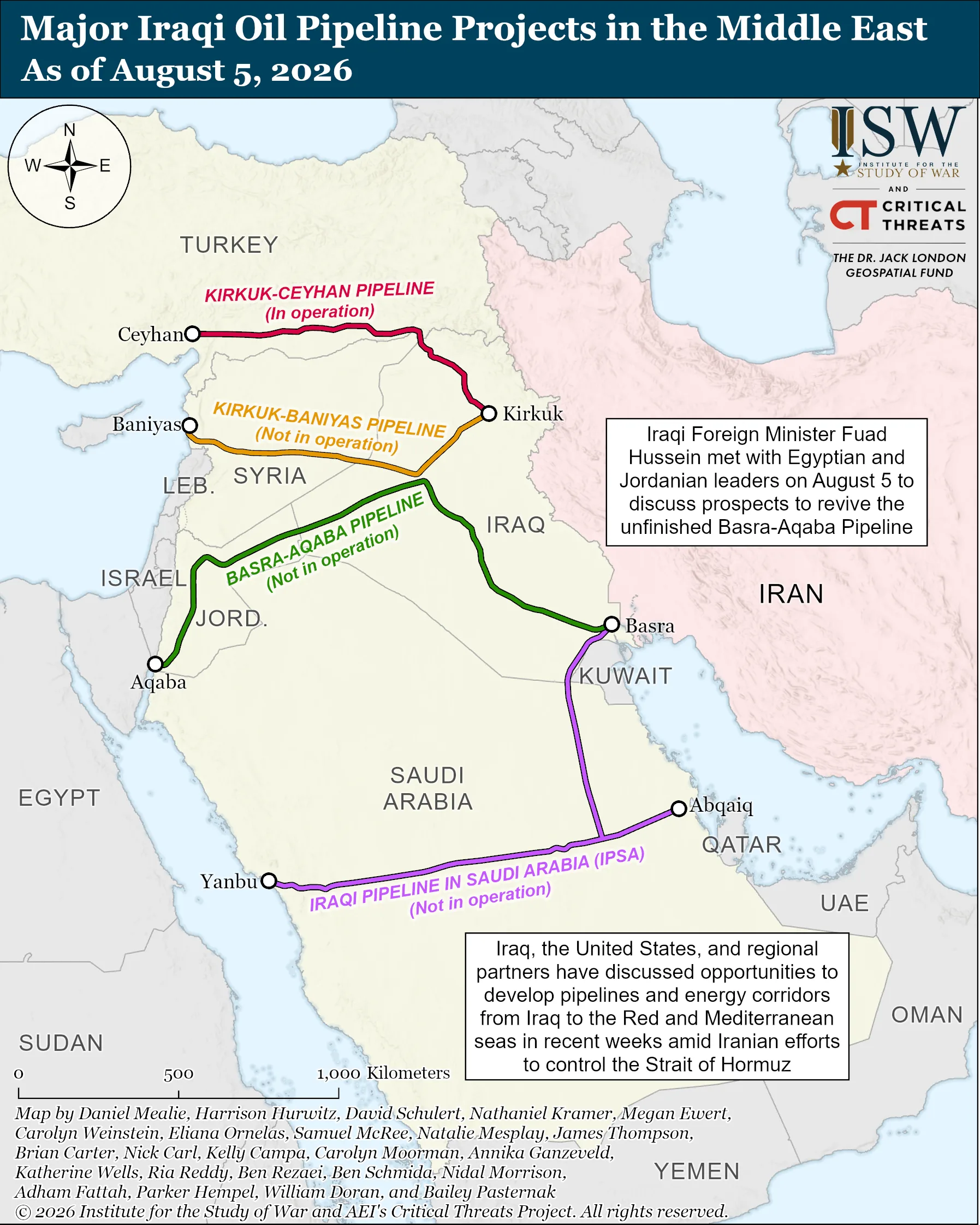
Iraqi Foreign Minister Fuad Hussein discussed prospects to develop a pipeline that would link Iraq with the Red Sea during meetings with Egyptian and Jordanian leaders in Amman, Jordan, on August 5.[29] Hussein held separate meetings with Jordanian Foreign Minister Ayman Safadi and Egyptian Foreign Minister Badr Abdelatty, in which the ministers discussed the possibility of developing a planned oil pipeline that would extend from Basra to the Jordanian Red Sea port of Aqaba.[30] Iraq and Jordan began planning the Basra-Aqaba Pipeline in 2013 but never completed the project.[31] Iraq, the United States, and regional partners have discussed proposals in recent weeks to develop alternative routes to the Strait of Hormuz for Iraqi oil exports, amid Iranian efforts to control traffic in the Strait and the Persian Gulf.[32] A US State Department official told Reuters on July 14 that the United States supports joint Iraqi-Syrian efforts to redevelop and operate the defunct Kirkuk-Baniyas Pipeline between northern Iraq and Syria’s Mediterranean coast, for example.[33] Gulf and regional states have increasingly relied on alternative energy export corridors toward the Red and Mediterranean Seas during the war in order to circumvent Iran’s controls on maritime traffic. Saudi Arabia in particular has depended on its Red Sea port at Yanbu and the East-West Pipeline, which extends from Saudi oilfields and refineries in eastern Arabia to Yanbu, to avoid exporting oil through the Persian Gulf.[34]
Arabian Peninsula
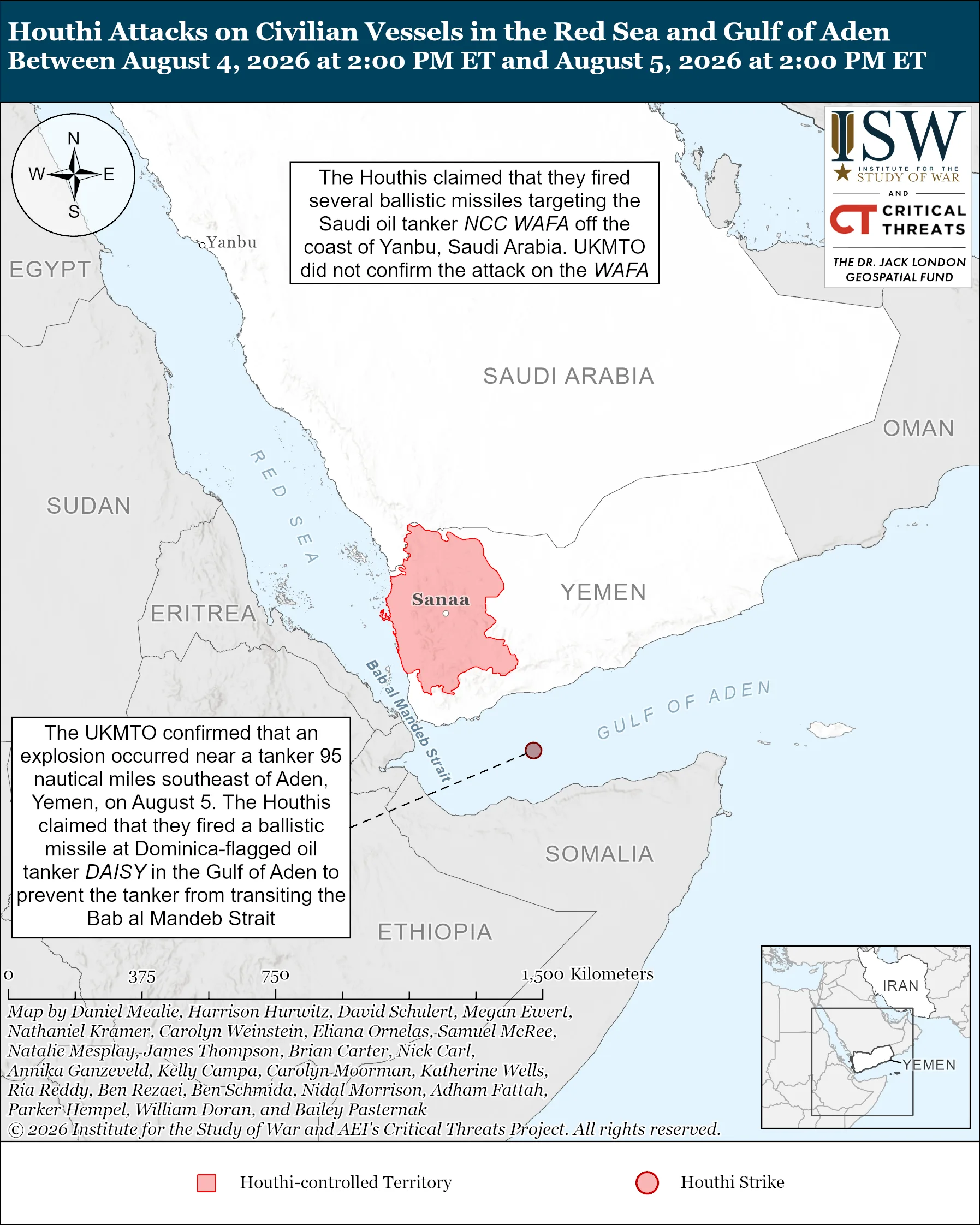
The Houthis claimed attacks against two Saudi oil tankers in the Red Sea and Gulf of Aden on August 5.[35] Houthi military spokesperson Yahya Sarea claimed on August 5 that the Houthis fired several ballistic missiles targeting the Saudi-flagged, Saudi-owned NCC Wafa oil tanker off the coast of Yanbu in the Red Sea.[36] United Kingdom Maritime Trade Operations (UKMTO) has not confirmed the attack on the NCC Wafa at the time of this writing. The Houthis also claimed on August 5 that they fired one ballistic missile targeting the Dominica-flagged, Saudi-operated Daisy oil tanker in the Gulf of Aden to prevent the vessel from transiting the Bab al Mandeb Strait.[37] UKMTO confirmed on August 5 that an unspecified tanker master reported hearing an explosion near the vessel in the Gulf of Aden.[38] These attacks follow a likely Houthi one-way naval drone attack against an Indian-flagged cargo tanker near the Bab al Mandeb Strait on August 4.[39] The Houthis have claimed several attacks on Saudi vessels since July 22 as part of their efforts to enforce a blockade on Saudi ports.[40]

[1] https://www.axios.com/2026/08/05/us-iran-strait-of-hormuz-deal-nears
[2] https://apnews.com/article/iran-war-us-hormuz-trump-august-5-2026-ecdbd96f2b46c70beb5926d8508f9c55
[3] https://www.cnn.com/2026/08/05/world/live-news/iran-war-trump
[4] https://t.me/Nournews_ir/381938 ;
https://t.me/farsna/454509 ;
https://t.me/Tasnimnews/436494
[5] https://understandingwar.org/research/middle-east/iran-update-special-report-july-28-2026/
[6] https://understandingwar.org/research/middle-east/iran-update-special-report-july-28-2026/
[7] https://www.axios.com/2026/08/05/us-iran-strait-of-hormuz-deal-nears
[8] https://t.me/farsna/454628 ;
https://t.me/farsna/454629
[9] https://t.me/farsna/454629 ;
https://t.me/farsna/454628
[10] https://t.me/farsna/454628
[11] https://www.axios.com/2026/08/05/us-iran-strait-of-hormuz-deal-nears
[12] https://www.reuters.com/world/middle-east/us-iran-having-very-good-discussions-trump-says-2026-08-05/
[13] https://understandingwar.org/research/middle-east/iran-update-special-report-july-5-2026/ ;
https://understandingwar.org/research/middle-east/iran-update-special-report-may-30-2026/
[14] https://t.me/farsna/454509 ;
https://t.me/Tasnimnews/436494 ;
[15] https://www.ft.com/content/87b039cf-7eb0-4cf6-b536-0c2929424dc5?syn-25a6b1a6=1
[16] https://www.axios.com/2026/08/05/us-iran-strait-of-hormuz-deal-nears
[17] https://x.com/captainella1/status/2084981914373390610?s=46&t=vAB6sPPgAElLnZFQUkyKmg ; https://x.com/idfonline/status/2084989120183476484
[18] https://x.com/ALJADEEDNEWS/status/2075982537524957473?s=20
[19] https://x.com/idfonline/status/2084989120183476484
[20] https://t.me/alakhbar_news/92698 ; https://t.me/alakhbar_news/92701
[21] https://aawsat dot com/العالم-العربي/المشرق-العربي/5303697-قوى-حليفة-للحكومة-العراقية-تتراجع-عن-حصر-السلاح-ومكافحة-الفساد
[22] https://aawsat dot com/العالم-العربي/المشرق-العربي/5303697-قوى-حليفة-للحكومة-العراقية-تتراجع-عن-حصر-السلاح-ومكافحة-الفساد
[23] https://understandingwar.org/research/middle-east/iran-update-special-report-july-1-2026/ ; https://www.alaraby dot co.uk/politics/علي-الزيدي-يطلب-غطاء-الإطار-لملاحقة-جهات-مسلحة-متورطة-بالفساد
[24] https://understandingwar.org/research/middle-east/iran-update-special-report-july-8-2026/
[25] https://x.com/LizHurra/status/2071281219405336922 ; https://www.kurdistan24 dot net/ckb/story/922625/چوارچێوەی-هەماهەنگی-بۆ-بەرەنگاربوونەوەی-گەندەڵی-گلۆپی-سەوزی-بۆ-عەلی-زەیدی-هەڵکردووە ; https://understandingwar.org/research/middle-east/iran-update-special-report-july-14-2026/
[26] https://aawsat dot com/العالم-العربي/المشرق-العربي/5303697-قوى-حليفة-للحكومة-العراقية-تتراجع-عن-حصر-السلاح-ومكافحة-الفساد
[27] https://rudaw dot net/english/categories/iraq/958915 ; https://www.washingtoninstitute.org/policy-analysis/profile-islamic-resistance-iraq ; https://t.me/ElamAlmoqawama/1625 ; https://t.me/ElamAlmoqawama/1612 ; https://understandingwar.org/research/middle-east/iran-update-special-report-august-4-2026/
[28] https://almadapaper dot net/442723/ ; https://www.alaraby dot co.uk/politics/العراق-لماذا-تتم-عملية-حصر-سلاح-الفصائل-سراً
[29] https://ina dot iq/ar/political/270101-.html ; https://ina dot iq/ar/political/270113-.html
[30] https://ina dot iq/ar/political/270101-.html ; https://ina dot iq/ar/political/270113-.html ; https://www.rudaw dot net/english/categories/middleeast/1078690
[31] https://www.wsj.com/articles/SB10001424127887324662404578332253495395968?msockid=377117e0f0686a0e3bc400fef1486b89
[32] https://understandingwar.org/research/middle-east/iran-update-special-report-july-15-2026/
[33] https://www.reuters.com/business/energy/us-supporting-efforts-revive-iraq-syria-crude-oil-pipeline-us-official-says-2026-07-14/
[34] https://understandingwar.org/research/middle-east/iran-update-special-report-july-27-2026/ ; https://www.wsj.com/world/middle-east/saudi-arabias-vast-oil-supplies-now-increasingly-depend-on-a-single-exit-d8033082
[35] https://x.com/MMY1444/status/2084897649467986298 ; https://x.com/MMY1444/status/2085066984690188700
[36] https://t.me/army21ye/3619 ; Starboard Maritime Intelligence. Available by subscription at https://www.starboardintelligence.com/
[37] https://x.com/MMY1444/status/2085066984690188700 ; Starboard Maritime Intelligence. Available by subscription at https://www.starboardintelligence.com/
[38] https://x.com/UK_MTO/status/2085034763048354122
[39] https://understandingwar.org/research/middle-east/iran-update-special-report-august-4-2026/
[40] https://understandingwar.org/research/middle-east/iran-update-special-report-july-28-2026/ ; https://x.com/MMY1444/status/2082152059734995159 ; https://t.me/army21ye/3588 ; https://x.com/UK_MTO/status/2080043376351535532 ; https://understandingwar.org/research/middle-east/iran-update-special-report-july-23-2026/