
Key Takeaways
- A Kremlin-appointed Russian occupation official admitted that Russia has continued to place Ukrainian children up for fostering and adoption with Russian families in 2026.
- Russian officials continue to fund and facilitate the temporary deportation and transfer of Ukrainian children to summer camps in occupied Ukraine and Russia.
- Enrollment in Yunarmia (Russian Young Army Cadets National Movement) appears to be increasing in occupied Ukraine.
- The municipal and regional stages of the Zarnitsa 2.0 military-patriotic competition continue in occupied Ukraine.
- Russian occupation officials continue to use social benefit incentives to increase the birth rates in occupied areas.
- Russian occupation officials continue to downplay the severity of fuel shortages and present a facade of an effective government response in order to obscure the wartime challenges of their illegitimate occupation of Ukraine.
- Russia continues to illegally prosecute Ukrainian prisoners of war (POWs) under “terrorism” charges in clear violation of international humanitarian law.
- Occupation courts throughout occupied Ukraine continue to sentence Ukrainians to extensive prison terms on tenuous treason and espionage allegations.
- Russian Deputy Prime Minister for Construction and Regional Development Marat Khusnullin visited occupied Ukraine in late May.
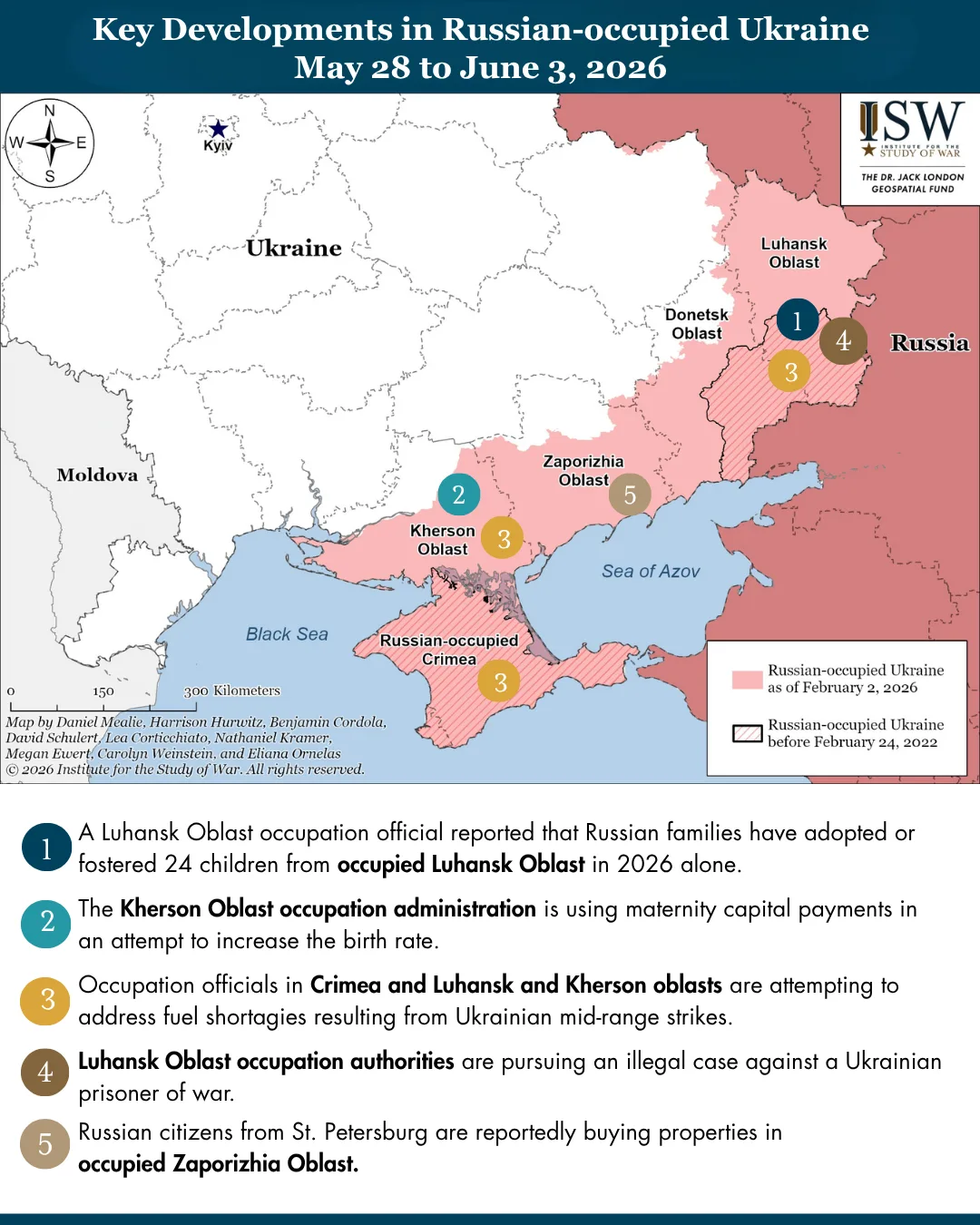
Deportation and Forcible Transfer of Ukrainian Citizens, Including Children
A Kremlin-appointed Russian occupation official admitted that Russia has continued to place Ukrainian children up for fostering and adoption with Russian families in 2026. The Luhansk Oblast occupation Commissioner for Children’s Rights Inna Shvenk, a regional-level subordinate of federal Commissioner for Children’s Rights Maria Lvova-Belova, gave an interview to occupied Luhansk Oblast-based outlet Luhansk Information Center on May 27 on the occasion of International Children’s Day.[1] Shvenk claimed during the interview that the Office of the Children’s Rights Commissioner has placed 24 children from occupied Luhansk Oblast in families “in other regions in Russia” in 2026 alone. Shvenk noted that according to the Presidential Decree, her office must decrease the number of children in orphanages by 30 percent in 2030, suggesting that the occupation administration is incentivized to facilitate adoptions in order to meet the quota for 2030. Shvenk also noted that occupied Luhansk Oblast is not yet connected to the Russian federal adoption database, but that the oblast-based database is functional and effective in facilitating adoptions. ISW has previously reported on an adoption database maintained by the Luhansk People’s Republic (LNR) Ministry of Education and Science in August 2025.[2] Shvenk also confirmed that her office placed 30 orphans with Russian families in 2025.
Shvenk’s interview and admission of the adoption of 24 Ukrainian children into Russian families is noteworthy in part because it contradicts claims made by the federal Office of the Children’s Rights Commissioner in a recent report. The Russian federal-level Commissioner for Children’s Rights released a report entitled “Activities of the Presidential Commissioner for Children’s Rights Maria Lvova-Belova to protect children during a special military operation” on May 7, which reiterated several long-standing Russian narratives meant to deflect from Russia’s well-documented deportation and adoption of Ukrainian children.[3] A predominant narrative claim made multiple times in the report is that Russia “does not have a program for adopting children from [occupied areas].” Shvenk’s interview, alongside ample open-source reporting and statements from other Russian and occupation officials, directly contradicts this false narrative and provides evidence that Russia continues, in violation of international law, to deport and adopt Ukrainian children.[4] Russia’s deportation and adoption of Ukrainian children likely constitutes war crimes, crimes against humanity, an act of genocide, and a violation of the United Nations Convention on the Rights of the Child.[5]
Russian officials continue to facilitate and finance the temporary deportation of Ukrainian children to Russia for summer camp programs. The Rostov Oblast Ministry of Health claimed on May 27 that 5,625 children from occupied Donetsk, Luhansk, Kherson, and Zaporizhia Oblasts will attend summer camps in Rostov Oblast in 2026 as part of a broader program hosting 9,000 children from 14 regions of Russia and occupied Ukraine.[6] The Rostov Oblast administration allocated over 1.37 billion rubles ($19 million) for children’s recreation, including vouchers, compensation payments, and food provision, in its regional budget for 2026.[7] Rostov Oblast’s Deputy Minister of Education Ekaterina Sakovnikova claimed that the summer program will involve approximately 16,000 staff, including counselors, educators, and educational psychologists.[8] Russian officials utilize summer camps to re-educate Ukrainian children and integrate them into the Russian society and the Russian sphere of influence.[9]Zaporizhia Oblast occupation officials continue to temporarily transfer Ukrainian children to occupied Crimea for summer vacation programs. Zaporizhia Oblast occupation head Yevgeny Balitsky claimed on May 31 that the Zaporizhia Oblast occupation administration will temporarily transfer thousands of children from occupied Zaporizhia Oblast to occupied Crimea for summer vacation as part of an agreement with the Crimea occupation head Sergei Aksyonov.[10] Occupation officials utilize Russian-run summer camps in occupied Crimea to facilitate the cultural education and indoctrination of Ukrainian children from other Oblasts in occupied Ukraine.[11]
Sociocultural Control
Nothing significant to report.
Militarization of Occupied Areas
Enrollment in Yunarmia (Russian Young Army Cadets National Movement) appears to be increasing in occupied Ukraine as Russian youth militarization programs continue to become more normalized and institutionalized. Yunarmia’s occupied Donetsk Oblast branch head Viktor Pudak claimed on May 28 that Yunarmia membership in occupied Donetsk Oblast has risen to around 7,000 participants.[12] Donetsk People’s Republic (DNR) Head Denis Pushilin claimed that there were around 5,500 youth from Donetsk Oblast in Yunarmia as of May 2025 — suggesting that Yunarmia has acquired over 1,000 new members in occupied Donetsk Oblast over the past year.[13] Pushilin and Luhansk People’s Republic (LNR) Head Leonid Pasechnik signed agreements with Chief of the General Staff of Yunarmia Captain Vladislav Golovin in May 2025 to increase the number of youth from occupied Donetsk and Luhansk oblasts who enroll in Yunarmia.[14] Yunarmia is a critical component of Russia’s broader militarization and indoctrination toolkit in occupied Ukraine, normalizing the illegal occupation and preparing youth for potential future service in the Russian military.[15]
The municipal and regional stages of the Zarnitsa 2.0 military-patriotic competition continue in occupied Ukraine. The Kherson Oblast occupation administration claimed on May 27 that 319 students on 29 teams participated in the municipal stage of Zarnitsa 2.0 in occupied Kherson Oblast.[16] The Luhansk Oblast occupation administration claimed on May 27 that 300 students participated in the regional (oblast-level) stage of Zarnitsa 2.0 at a military training center in occupied Luhansk Oblast.[17] Participants competed in exercises including military formation, drone operation, firearms handling, political instruction, chemical and biological defense, survival, and tactical medicine.[18] Zarnitsa 2.0 is a revived Soviet-era war game designed to indoctrinate and prepare youth for future service in the Russian military, which Russian occupation officials use to entrench military values in youth in occupied Ukraine.[19]
Russia’s hyper-militarized internal security force Rosgvardia continues to interact with young children in occupied Ukraine. Occupied Donetsk Oblast-based media reported on June 1 that Rosgvardia officers participated in a series of events related to International Children’s Day, including sports, music, and cultural events.[20] Servicemembers of the Vostok-Donetsk and Ratnik-Donbas special rapid response (SOBR) units oversaw and took part in a youth festival. Rosgvardia’s press service posted images of masked Rosgvardia fighters participating in these activities alongside young children. Rosgvardia functions as a law enforcement and repressive element in occupied Ukraine, and its apparent proximity to children and youth spaces highlights the scale of militarization in occupied areas.
Administrative and Bureaucratic Control
Russian occupation officials continue to use social benefit incentives to increase the birth rates in occupied areas. Acting Kherson Oblast occupation Minister of Labor and Social Protection Marina Ostrovska announced on May 30 that the Kherson Oblast occupation administration plans to introduce a 100,000-ruble ($1,300) maternity capital payment for families upon the birth of their third and subsequent child.[21] Ostrovska explicitly stated that this new maternity capital policy aims to increase the birth rate in occupied Kherson Oblast and support large families. The Russian state makes a one-time maternity capital payment to women upon the birth or adoption of a child beyond their first and has historically used maternity capital to encourage families to have more children and increase Russia’s declining birthrate.[22] Occupied Kherson Oblast’s new policy specifically caters to families who have three or more children — even more heavily incentivizing higher birthrates. Maternity capital benefits are only available to parents with Russian citizenship, so the issuance of maternity capital is an avenue for coerced passportization in occupied areas.[23] Higher birthrates in occupied areas also mean a higher number of registered Russian citizens in occupied areas, aiding Russia’s attempts to manipulate the demographics of occupied Ukraine to its ultimate benefit.[24]
Occupation Administration Mismanagement and Internal Dynamics
Russian occupation officials are struggling to address ongoing fuel shortages in occupied Ukraine, resulting from Ukrainian strikes against Russian energy infrastructure. ISW previously reported on recent gas and diesel deficits in occupied Crimea and the Sevastopol occupation administration’s introduction of a fuel sale limit of 20 liters per person as a result of recent Ukrainian intermediate- and long-range strikes on Russian fuel transportation logistics and energy assets.[25] The Crimea occupation administration has further tightened restrictions on the sale of fuel and fuel coupons in the first days of June. Russian opposition media outlets Krym Realii and Meduza reported on May 31 and June 1 respectively that major gas companies ATAN and TES suspended the sale of fuel coupons to individuals and restricted access to contracted customers.[26] Sevastopol occupation head Mikhail Razvozhaev claimed on June 2 that from the evening of June 2 to the morning of June 3, gas stations in occupied Sevastopol only distributed fuel to emergency services supporting the city’s operations.[27] Occupied Luhansk and Kherson Oblasts are also experiencing fuel shortages. The Luhansk Oblast occupation Ministry of Fuel and Energy claimed on June 2 that it introduced a temporary fuel sale limit of 20 liters per person.[28] The Kherson Oblast occupation administration claimed on June 3 that occupation officials introduced temporary restrictions on fuel sales to the public due to inventory levels.[29]
Russian occupation officials continue to downplay the severity of fuel shortages and present the facade of an effective government response in order to obscure the wartime challenges of their illegitimate occupation of Ukraine. The Kherson Oblast occupation administration claimed on June 3 that the current fuel situation is still characterized as “normal” despite recent fuel sale restrictions.[30] Luhansk Oblast occupation Minister of Fuel, Energy, and Coal Industry Konstantin Rogovenko claimed on June 2 that increased demand from the population is one of the reasons that occupied Luhansk Oblast is “at risk” of a fuel shortage.[31] Russian occupation officials avoid describing the situation as a fuel crisis and falsely cite rising demand or other market factors to obfuscate the true cause of the shortage: the failure of Russian air defense systems to prevent Ukrainian strikes on Russian oil infrastructure and logistics routes, including in occupied Ukraine. Russian occupation officials highlight their ongoing efforts to address shortages instead of addressing or acknowledging the military situation directly. Crimea occupation head Sergei Aksyonov claimed on June 2 that the Crimea occupation administration is coordinating its efforts to address fuel issues with Russian President Vladimir Putin.[32] Razvozhaev claimed on June 3 that the Sevastopol occupation administration is consistently monitoring the situation and working with the Crimea occupation administration and the Russian Ministry of Energy.[33] Occupation administrations are attempting to balance the wartime consequences of Ukrainian strikes while also posturing as a legitimate and capable governing body.[34]
Physical and Legal Repressions
Russia continues to illegally prosecute Ukrainian prisoners of war (POWs) under “terrorism” charges in clear violation of international humanitarian law. The Luhansk Oblast occupation Prosecutor claimed on May 27 that it approved an indictment against 50-year-old Valeriy Osochenko for allegedly “participating in a terrorist organization and undergoing training for terrorist purposes.” The Luhansk Oblast occupation Prosecutor accused Osochenko of participating in Ukraine’s Aidar Battalion (of the 5th Assault Brigade), which is part of Ukraine’s regular ground forces. Russia unilaterally deemed the Aidar Battalion a “terrorist” organization in 2023 and has since used this designation to charge Aidar servicemembers under Russian terrorism laws, as opposed to the internationally mandated laws on cases against prisoners of war.[35] Osochenko is a soldier of Ukraine’s 157th Separate Mechanized Brigade — not of the Aidar Battalion — and went missing in action during combat operations in Donetsk Oblast in August 2025.[36] The Luhansk Oblast occupation Prosecutor appears to have fabricated the details of Osochenko’s case in order to pursue illegal terrorism charges against him. Osochenko, as a lawful Ukrainian combatant, should not face criminal trial or terrorist charges under international law. The Russian case against him therefore appears to be a violation of the Third Geneva Convention on POWs.[37] Russia has previously illegally charged Ukrainian POWs under domestic terrorism legislation.[38]
Occupation courts throughout occupied Ukraine continue to sentence Ukrainians to extensive prison terms on tenuous treason and espionage allegations. The Luhansk Oblast occupation Supreme Court issued a verdict on May 27 in a criminal espionage case against 57-year-old Ukrainian citizen Kostyantyn Miroshnichenko.[39] The court sentenced Miroshnichenko to 13 years and six months in a maximum-security penal colony on the allegation that he transmitted information about Russian military deployments to Ukrainian intelligence in September 2022. The Luhansk Oblast occupation Prosecutor’s Office also approved an indictment in an espionage case against a 46-year-old resident on the allegation that he collected and transmitted information on Russian deployment locations to Ukrainian intelligence between August and October 2022.[40] The Luhansk Oblast occupation Supreme Court will consider the case.
The Zaporizhia Oblast occupation court announced on May 27 that it sentenced a female resident of occupied Berdyansk to 14 years in prison for espionage on the allegation that she provided intelligence to Ukrainian forces between May 2023 and October 2024.[41] The court alleged that the woman was living with a Ukrainian servicemember who died during the battle for Mariupol in May 2022, after which she “developed a persistent negative attitude” towards the war and the Russian military. The Ukrainian Kharkiv Human Rights Group responded to the case and named the woman as 34-year-old Anna Beiliaieva, whose husband was killed fighting in Mariupol in 2022.[42] The Kharkiv Human Rights Group reported that Russian law enforcement actually detained Beiliaieva in September 2023, disputing the allegation that she was actively passing information to Ukraine until October 2024. The Zaporizhia Oblast occupation court also sentenced a resident of occupied Enerhodar to 14 years in a strict-regime penal colony for treason on May 28 on the allegation that he transferred 5,000 hryvnias ($112) via a Ukrainian banking application to support the Ukrainian military in November 2024.[43]
Economic and Financial Control
Nothing significant to report.
Information Space Control
Nothing significant to report.
Infrastructure and Development Projects
Russian Deputy Prime Minister for Construction and Regional Development Marat Khusnullin visited occupied Ukraine in late May, highlighting the ways in which the Russian government has weaponized construction projects as a means of forcibly integrating occupied Ukraine into Russia. Khusnullin, who spearheads the Kremlin’s infrastructure and integration efforts in occupied Ukraine, visited occupied Luhansk, Donetsk, Kherson, and Zaporizhia oblasts between May 27 and 29.[44] Khusnullin visited sites of major Russian construction projects in occupied Mariupol, Melitopol, Henichesk, and Luhansk City, and appraised the development of new housing projects in occupied Kherson and Zaporizhia oblasts.[45] During his visit to occupied Zaporizhia Oblast, Khusnullin notably claimed that buyers from St. Petersburg and from occupied Crimea are actively purchasing housing in occupied Zaporizhia Oblast, and attributed these purchases to the active two percent preferential mortgage program.[46] These statements serve as further confirmation that Russian citizens from Russia are buying real estate in occupied Ukraine in support of Russia’s broader effort to repopulate these areas with Russian citizens.[47] The Russian government’s persistent focus and investment in housing, infrastructure, and public utility construction in occupied Ukraine are a critical part of its occupation strategy, as they create dependencies on the federal government, facilitate the resettlement of Russians in occupied areas, and increase the profitability of occupied areas for Russian businesses and the Russian state.

[1] https://lug-info dot ru/comments/detskij-ombudsmen-lnr-inna-shvenk-v-respublike-dejstvuet-semesberegajuschij/; https://lug-info dot ru/news/bolee-20-detej-sirot-iz-lnr-s-nachala-goda-obreli-semi-v-drugih-regionah-rossii/
[2] https://understandingwar.org/research/russia-ukraine/russian-occupation-update-august-12-2025/
[3] https://deti.gov dot ru/Deyatelnost/documents/436; https://understandingwar.org/research/russia-ukraine/russian-occupation-update-may-14-2026/
[4] https://understandingwar.org/research/russia-ukraine/russia-is-turning-deported-ukrainian-children-into-bargaining-chips/
[5] https://www.justsecurity.org/wp-content/uploads/2024/12/Russias_Systematic_Program_of_Coerced_Adoption_and_Fostering_of_Ukraines_Children.pdf; https://www.bbc.com/news/articles/cz7g5xnvl2eo
[6] https://tass dot ru/obschestvo/27543249
[7] https://tass dot ru/obschestvo/27543249
[8] https://tass dot ru/obschestvo/27543249
[9] https://understandingwar.org/research/russia-ukraine/russian-occupation-update-may-7-2026/
[10] https://tass dot ru/obschestvo/27592879; https://crimea.ria dot ru/20260601/krym-primet-na-otdykh-1150-detey-iz-novykh-regionov-i-prigranichya-1156487444.html
[11] https://understandingwar.org/research/russia-ukraine/russian-occupation-update-may-14-2026/
[12] https://dan-news dot ru/exclusive/kolichestvo-junarmejcev-v-dnr-priblizilos-k-7-tysjacham/
[13] https://t.me/PushilinDenis/6466
[14] https://t.me/glava_lnr_info/3713 ; https://t.me/PushilinDenis/6466
[15] https://war-sanctions.gur dot gov.ua/en/kidnappers/companies/6081; https://understandingwar.org/research/russia-ukraine/russian-occupation-update-may-15-2025/
[16] https://tass dot ru/obschestvo/27550257
[17] https://www.lugansk.kp dot ru/online/news/6996723/
[18] https://tass dot ru/obschestvo/27550257; https://www.lugansk.kp dot ru/online/news/6996723/
[19] https://understandingwar.org/research/russia-ukraine/russian-occupation-update-may-14-2026/; https://understandingwar.org/research/russia-ukraine/russian-occupation-update-may-7-2026/
[20] https://www.donetsk dot kp.ru/online/news/6999139/
[21] https://tass dot ru/obschestvo/27586159
[22] https://sfr.gov dot ru/en/matcap/; https://www.garant dot ru/ actual/posobiya/posob_deti/1020053/
[23] https://tass dot ru/obschestvo/19623813; https://t.me/tass_agency/22413; https:// www.understandingwar.org/backgrounder/ russian-offensive-campaign-assessment-december-26-2023; https://sfr.gov dot ru/branches/lugansk/news/~2025/05/13/272112; https://understandingwar.org/research/russia-ukraine/russian-occupation-update-may-15-2025/
[24] https://understandingwar.org/wp-content/uploads/2024/03/24-210-0120ISW20Occupation20playbook.pdf
[25] https://understandingwar.org/research/russia-ukraine/russian-occupation-update-may-29-2026/
[26] https://ua dot krymr.com/a/krym-krym-palyvna-kryza-pereprodazh-benzynu/33770317.html; https://meduza dot io/news/2026/06/01/krupneyshie-seti-zapravok-kryma-perestali-prodavat-talony-na-benzin-na-poluostrove-toplivnyy-krizis
[27] https://t.me/razvozhaev/21224
[28] https://t.me/mintopenergoLPR/2315
[29] https://t.me/VGA_Kherson/38824
[30] https://t.me/VGA_Kherson/38824
[31] https://t.me/mintopenergoLPR/2315
[32] https://t.me/Aksenov82/9645
[33] https://t.me/razvozhaev/21233
[34] https://understandingwar.org/research/russia-ukraine/russian-occupation-update-may-29-2026/;
[35] https://khpg dot org//en/1608814498
[36] https://www.facebook.com/groups/327507759373344/posts/1070327175091395/
[37] https://ihl-databases.icrc.org/en/ihl-treaties/gciii-1949
[38] https://understandingwar.org/research/russia-ukraine/russian-occupation-update-april-3-2025/; https://tacticsinstitute.com/europe/russias-terrorism-trials-of-ukrainian-pows-political-persecution-or-justice/; https://archive.khpg dot org/en/1608814879 ; https://united24media dot com/war-in-ukraine/russias-sham-trials-send-ukrainian-prisoners-of-war-to-brutal-penal-colonies-5042
[39] https://t.me/proclnr/966
[40] https://www.lugansk.kp dot ru/online/news/6990410/
[41] https://tass dot ru/proisshestviya/27544945
[42] https://khpg dot org/en/1608815786
[43] https://tass dot ru/proisshestviya/27559121
[44] http://government dot ru/news/58872/; http://government dot ru/news/58871/; http://government dot ru/news/58853/; http://government dot ru/news/58844/
[45] http://government dot ru/news/58871/; https://tass dot ru/obschestvo/27575175
[46] https://www.zap.kp dot ru/online/news/6995117/
[47] https://understandingwar.org/research/russia-ukraine/russias-resettlement-strategy-in-occupied-ukraine/


