
Toplines
Ukrainian forces have successfully contested the initiative at both the strategic and operational levels starting in late 2025 and persisting throughout 2026 for the first time since the August 2024 Kursk Offensive. Ukrainian forces have held Russian forces to near-zero net gains since March 2026, and have conducted successful counterattacks in the Kupyansk, Oleksandrivka, and now Lyman directions.[1] Ukrainian counterattacks defeated Russian efforts to push into Dnipropetrovsk Oblast, regained lost ground in and around Kupyansk and have defeated subsequent Russian efforts to regain it, and now have destroyed a significant Russian salient that threatened the northern flank of Slovyansk and the entire Donetsk Oblast Fortress Belt. Russian forces have made limited but significant gains in and around Kostyantynivka and east of Slovyansk and Kramatorsk but are fighting to maintain momentum in these areas and elsewhere along the front line. The situation remains dynamic, and Russian commanders are reportedly pressing Russian President Vladimir Putin for a massive mobilization likely aimed at restoring their ability to seize and hold the initiative. It remains unclear how such a mobilization, if Putin actually orders it, will change the theater dynamics in the face of Ukraine’s current advantages in both tactical and operational drone operations and drone-infantry integration.
Ukrainian successes in eliminating the Russian salient north of Lyman over the past several months have disrupted the Russian military command’s plans to conduct a wide encirclement of the Fortress Belt in Donetsk Oblast from the Lyman and Dobropillya areas. Russian forces have been advancing toward Slovyansk, Kramatorsk, and Druzhkivka from the east and Kostyantynivka and Druzhkivka from the south while also trying to encircle the entire Fortress Belt from the north and southwest. Russian forces on the southern flank of the Fortress Belt have been trying to seize Dobropillya and advance from the Pokrovsk-Dobropillya sector northward to the area west of Druzhkivka and Kramatorsk, while Russian forces on the northern flank of the Fortress Belt similarly have been trying to seize Lyman, cross the Siverskyi Donets River, and advance west-southwest to the area west of Slovyansk. The Russian military command aimed for these two prongs to eventually encircle the entire Fortress Belt and the Ukrainian forces defending the cities. Ukrainian forces have eliminated the Russian salient north of Lyman in recent months and have long defended against Russian efforts to seize Lyman itself, however, disrupting this two-pronged encirclement effort.
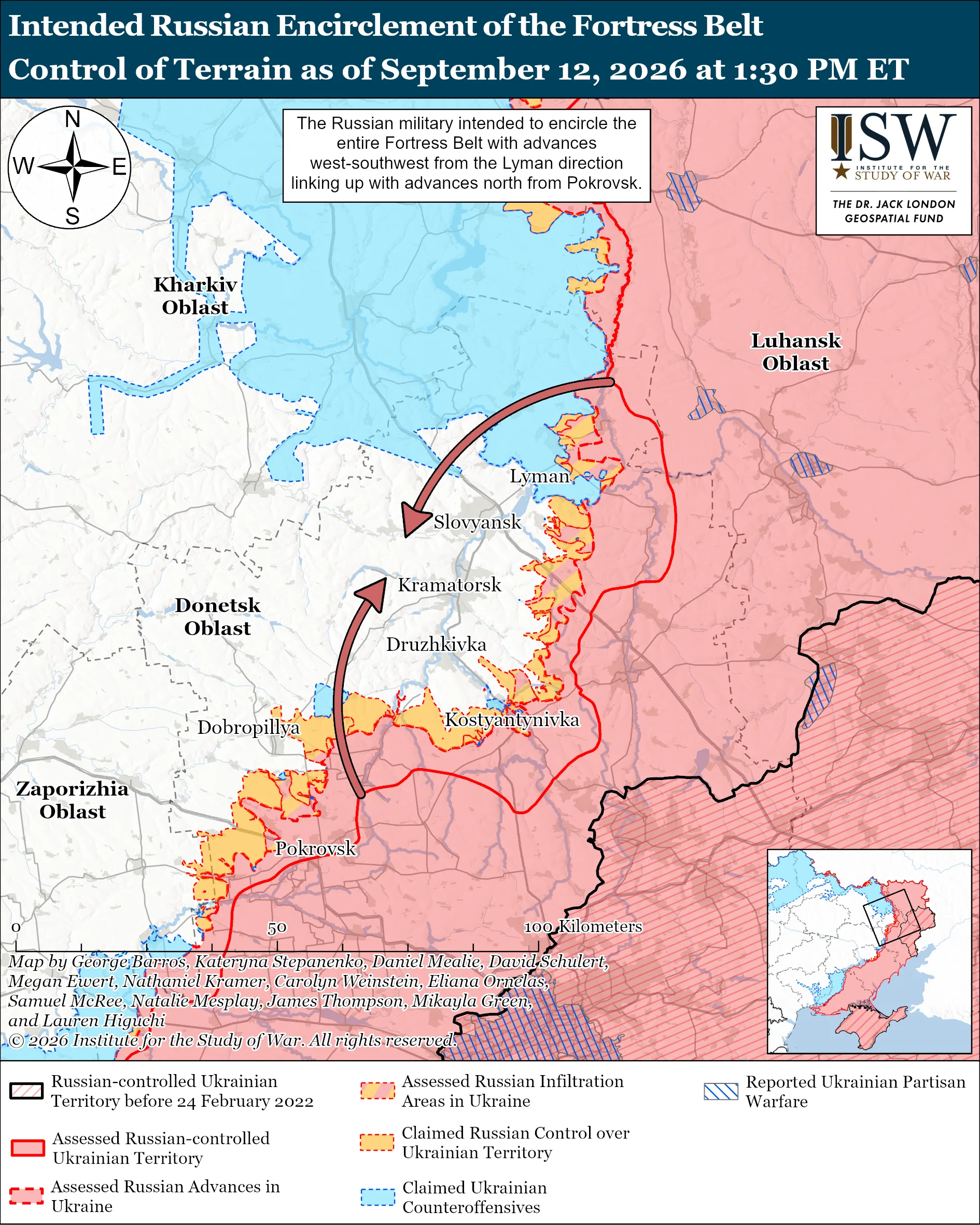
The Russian military command will likely need to reassess its campaign designs for the southern and northern flanks of the Fortress Belt given the elimination of its salient north of Lyman and particularly if Ukrainian forces are able to fully push Russian forces back to the Zherebets River and use the canalizing terrain to create a stable defensive line. Elements of Russia’s 25th Combined Arms Army (CAA, Central Military District [CMD]) have been engaged in the effort to seize Lyman, and elements of the 20th CAA (Moscow Military District [MMD]) have been primarily focused on advancing north of Lyman, although the exact seam between the two formations’ areas of responsibility (AoRs) is unclear.[2] It is also unclear how much damage to these two formations Ukrainian forces have inflicted in the course of their months-long counterattack. The Russian military command may redeploy surviving elements of these two armies away from the Lyman area to other areas of the front if it assesses that Russian forces will be unable to resume their efforts to encircle Slovyansk or the Fortress Belt from the north and if it is confident that it can prevent Ukrainian forces from making further advances with a reduced force presence in the area. It is unclear if the Russian military command will also adjust the objective for the forces fighting, largely without success, in the Dobropillya area now that Ukrainian forces have essentially eliminated the northern half of the encirclement effort.
The Russian military command may alternatively double down on efforts to seize Lyman, possibly with some forces that had been attacking within the former salient north of Lyman, in order to try to recreate the northern prong of the envisioned encirclement. Russian forces have failed to seize Lyman since Fall 2022, however, and have had to resort to infiltration tactics in and near the town in 2026 due to Ukrainian fortifications and drone-based defenses. Russian forces are unlikely to be able to leverage reinforcements to conduct successful larger-scale infantry or mechanized assaults in the foreseeable future, however, following this dramatic setback.
Many Russian milbloggers are acknowledging that Ukrainian forces have largely eliminated the Russian salient north of Lyman and that fighting is mainly ongoing along the Zherebets River in the area. Russian milbloggers claimed on September 9 through 11 that Ukrainian forces had effectively cut the Russian salient north of Lyman and pushed Russian forces to the Zherebets River.[3] One milblogger claimed on September 11 and 12 that Ukrainian forces forded the river.[4] Ukraine’s Strategic Communications Center amplified this milblogger claim on September 12, but Ukrainian officials have not publicly confirmed Ukrainian advances in the area as of this writing.[5] One prominent milblogger noted that Ukrainian forces have been counterattacking in the area for months and complained that the Russian military command did not pay enough attention to the area during that time.[6]
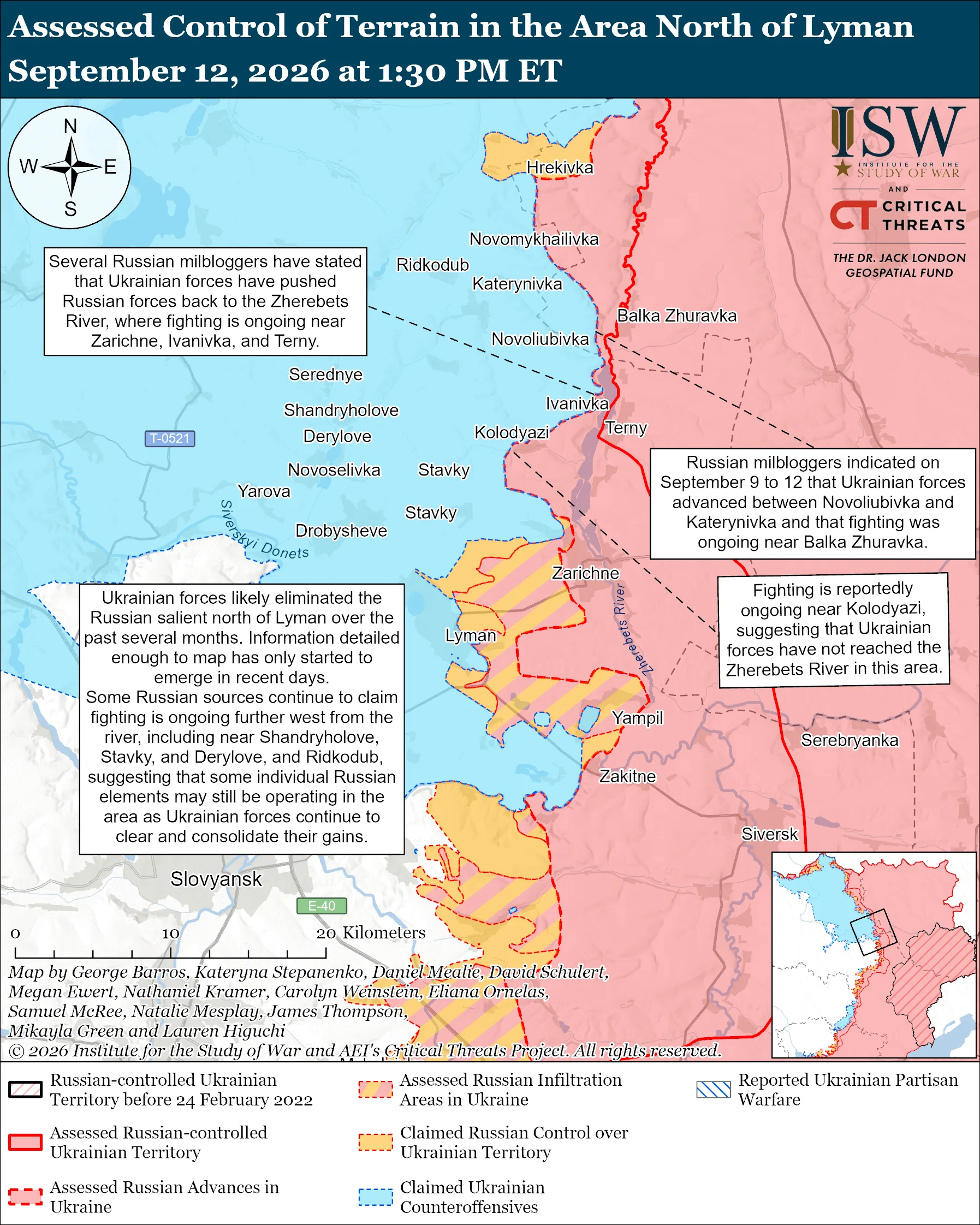
Russian milbloggers have reported in recent days that fighting was ongoing along the Zherebets River near Ivanivka (on the western bank of the river) and Terny (on the eastern bank), with one source adding that Ukrainian forces likely surrounded Russian forces in Ivanivka.[7] Russian milbloggers stated from September 9 to 12 that Ukrainian forces advanced between Novoliubivka and Katerynivka and that fighting was ongoing near Balka Zhuravka (just east of Novoliubivka on the other side of the Zherebets River), indicating that Ukrainian forces advanced to the river in the northern part of the former salient.[8] Russian milbloggers stated that fighting is ongoing near Kolodyazi (roughly two kilometers west of the river), suggesting that Ukrainian forces have not advanced to the river in the southern part of the salient yet. One Russian milblogger, who acknowledged that the Russian salient was essentially gone, claimed that fighting is still ongoing in some areas within the salient, including near Shandryholove, Stavky, Derylove, and Ridkodub.[9] Some individual Russian elements may still be operating within the former salient as Ukrainian forces continue to clear the area. The full extent of Ukrainian advances in the Lyman direction and the shape of the frontline in the area remains unclear, due to limited open-source evidence about the salient. ISW will continue to update its assessment as more open-source evidence becomes available.
Russian generals have reportedly asked Russian President Vladimir Putin for an additional 800,000 troops to sustain and likely expand Russian offensive operations in the face of enormous Russian casualty rates. Ukraine’s Main Military Intelligence Directorate (GUR) Head Lieutenant General Oleh Ivashchenko stated in an interview with The Times published on September 10 that Ukrainian intelligence suggests that Russian generals have asked Putin to mobilize an additional 800,000 troops above current recruitment levels after the September 2026 State Duma elections.[10] Ivashchenko added that Russia’s current casualty rate exceeds its daily recruitment rate, with about 60 percent of casualties being killed in action, an extraordinarily high ratio of killed to wounded when the standard ratio in modern war is 1:3.
Russia does not have the training and administrative capabilities to absorb, integrate, and train 800,000 recruits at one time, particularly if Russian authorities try to do so alongside the semi-annual conscription cycle that normally starts in October. Putin signed a law in November 2026 allowing Russian military conscription administrative processes to occur year-round in an effort to avoid the challenges the Russian military faced in 2022 when attempting to institute a large-scale involuntary reserve call-up at the same time as the semi-annual fall conscription process.[11] The law aimed to mitigate bureaucratic bottlenecks that complicated Russia’s force generation efforts during large-scale involuntary call-ups, but Ivashchenko stated that the Russian military can simultaneously absorb, including mobilizing, equipping, feeding, training, and integrating, no more than 300,000 to 500,000 recruits.[12] Russian forces are already suffering from administrative and training bottlenecks for their ground forces and drone operators at their current recruitment rate, and the mobilization of hundreds of thousands of additional recruits would almost certainly exacerbate those challenges.[13] Putin is more likely to choose a more gradual and covert mobilization due to the constraints in Russia’s training and bureaucratic capabilities and concerns about public reception than to order a sudden, massive involuntary reserve call-up like the one he ordered in 2022.[14]
The increasing Russian casualty rates and declining recruitment rate will likely force Russia to conduct some form of mobilization in the near term, but the type and scope of mobilization Putin may choose is unclear at this time. Putin and other Russian officials have repeatedly denied that Russia was preparing for mobilization in the weeks leading up to the September 18-20 State Duma elections.[15] Ivashchenko reported that Russia is currently recruiting around 1,000 to 1,200 people every day, and Ukrainian General Staff data shows that Russian forces suffered an average of 1,374 casualties per day since the beginning of July 2026.[16] Russia’s current force generation system based on volunteer recruitment continues to struggle to recruit enough soldiers to replace current losses, and it remains unclear how long Russian forces will be able to sustain their current footpace offensive tempo without some form of mobilization.[17] ISW has observed indicators that suggest that Russian authorities have been preparing multiple courses of action for conducting mobilization, allowing them to execute whichever sort of mobilization Putin might order.[18] Russia’s most likely course of action is to conduct rolling call-ups that in the short term help replace Russia’s battlefield casualties. Russia’s least likely course of action is a sudden large call-up that would allow Russian forces to temporarily flood the battlefield with poorly trained servicemembers in a short time span but would be very unpopular with the Russian population and would likely yield diminishing returns due to Russia’s existing training, administrative, and logistical constraints.
The Russian General Staff likely wants to use the additional 800,000 troops to implement its offensive plans throughout the front rather than only in Donetsk, and the scope of any potential mobilization likely depends on what operations Putin authorizes. Ukrainian officials have repeatedly reported that the Russian General Staff has made plans for additional offensive operations throughout the whole theater of war, including in the Chernihiv-Kyiv direction, very likely aiming to extend the front line and exploit Ukraine’s manpower limitations.[19] The Russian General Staff likely asked Putin for 800,000 troops to be able to execute all of its planned offensive operations, not just to support a focused deployment to priority efforts in Donetsk Oblast. The type and scope of a possible Russian mobilization will thus very likely depend on what operations Putin authorizes. Any compulsory mobilization is a personal decision for Putin and is contingent on his perception of battlefield realities and regime stability.[20]
Ukrainian President Volodymyr Zelensky continues to support a future trilateral Ukrainian-Russian-US meeting and to suggest efforts to restart peace talks with Russia. Zelensky on September 11 called for Ukraine, Russia, and the United States to move to a trilateral meeting.[21] Zelensky stated that he is willing to travel to the Group of 20 (G20) leaders’ summit in Miami in December 2026 if Russian President Vladimir Putin also attends.[22] Kremlin Spokesperson Dmitry Peskov responded that Zelensky could come to Moscow if he wants to meet with Putin.[23] Zelensky also called for Russia and Ukraine to find ways to “unblock” the Black Sea and to discuss moratoriums on long-range strikes against energy and grain infrastructure, efforts that Zelensky said could act as a starting point for peace negotiations.[24]
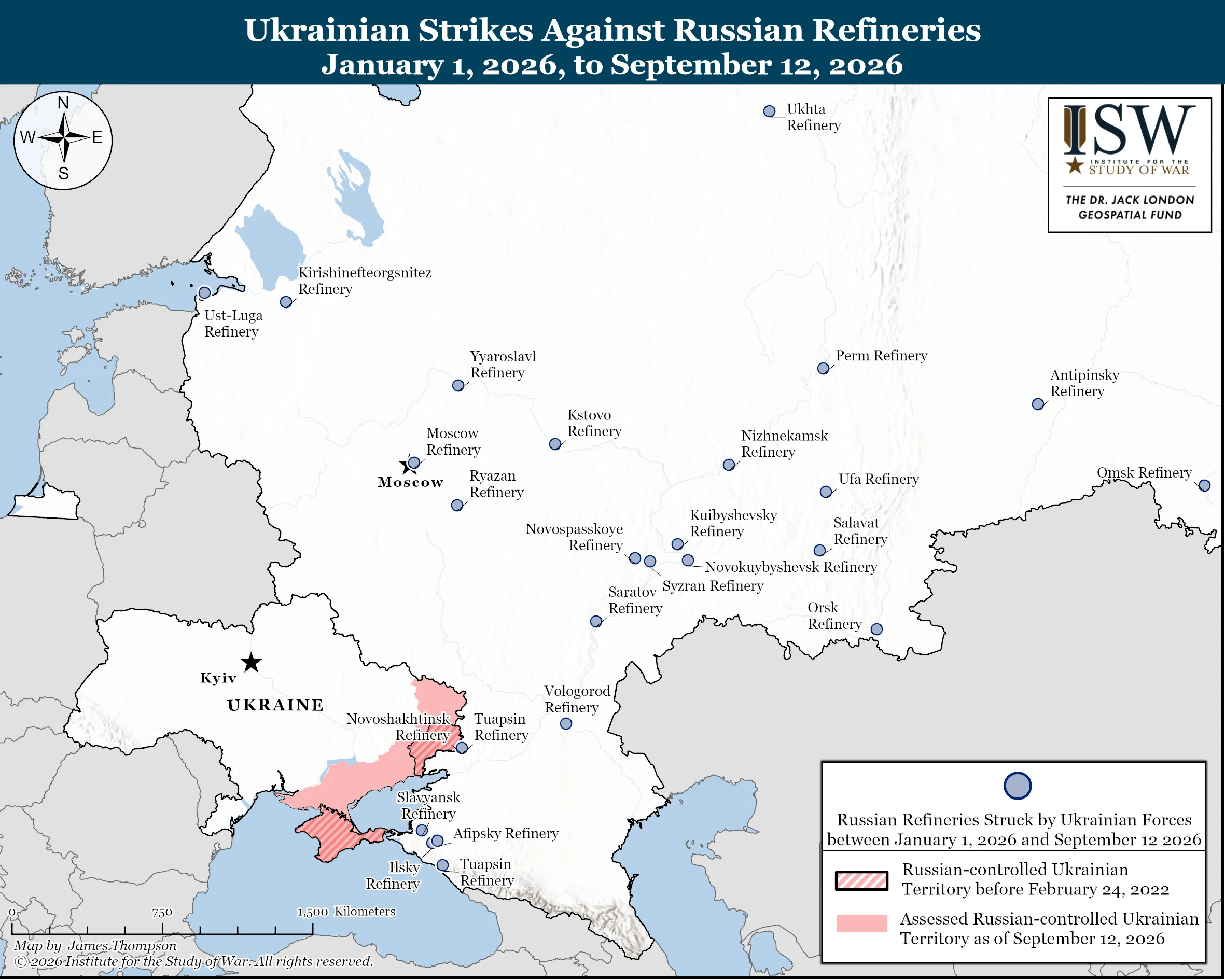
Ukraine’s ongoing long-range strike campaign and Western sanctions are actively preventing the Russian oil industry from recovering its processing capacity and oil exports. The International Energy Agency (IEA) reported on September 11 that it has revised its baseline outlook for Russian oil processing over the next 18 months to around four million barrels a day, a 30 percent decrease from pre-2022 levels but noted that even this latest assessment may understate the Russian refining industry’s problems.[25] The IEA reported that Ukrainian strikes caused disruptions to Russia’s oil refining system and a near halt to product exports, adding that the approach of colder weather could compound the stress on the Russian energy system. The IEA reported that Ukrainian forces are conducting more precise strikes against the refineries’ secondary-processing units that require up to eight months to repair and are using multiple drone waves against single sites that overwhelm Russia’s passive and active air defenses. The IEA assessed that international sanctions against the Russian energy industry are limiting Russia’s access to replacement equipment, complicating efforts to repair facilities that Ukrainian forces have struck. The IEA report follows Russian Central Bank Chairwoman Elvira Nabiullina’s September 11 acknowledgement that Russia’s fuel market shortages — the effects of Ukraine’s long-range strike campaign against Russian energy infrastructure — were the primary cause of Russia’s accelerated price growth over the summer and are constraining Russia’s economy.[26]
Ukraine has intensified the tempo of its refinery strike campaign and improved its targeting to cause maximum pain to the Russian oil industry. Ukraine has struck at least 26 different Russian oil refineries since the beginning of 2026, mainly targeting combined electric desalination and atmospheric and vacuum distillation units (ELOU-AVT). Crude oil desalting and distillation are essential steps in treating and separating crude oil into various fractions, such as refinery gases or naphtha, making ELOU-AVT units critical components for refinery operations that function as the heart of the facility.[27]
Key Takeaways
- Ukrainian forces in late 2025 and throughout 2026 have successfully contested the initiative at both the strategic and operational levels for the first time since the August 2024 Kursk Offensive.
- Ukrainian successes in eliminating the Russian salient north of Lyman over the past several months have disrupted the Russian military command’s plans to conduct a wide encirclement of the Fortress Belt in Donetsk Oblast from the Lyman and Dobropillya areas.
- The Russian military command will likely need to reassess its campaign designs for the southern and northern flanks of the Fortress Belt given the elimination of its salient north of Lyman and particularly if Ukrainian forces are able to fully push Russian forces back to the Zherebets River and use the canalizing terrain to create a stable defensive line.
- Many Russian milbloggers are acknowledging that Ukrainian forces have largely eliminated the Russian salient north of Lyman and that fighting is mainly ongoing along the Zherebets River in the area.
- Russian generals have reportedly asked Russian President Vladimir Putin for an additional 800,000 troops to sustain and likely expand Russian offensive operations in the face of enormous Russian casualty rates.
- Russia does not have the training and administrative capabilities to absorb, integrate, and train 800,000 recruits at one time, particularly if Russian authorities try to do so alongside the semi-annual conscription cycle that normally starts in October.
- The increasing Russian casualty rates and declining recruitment rate will likely force Russia to conduct some form of mobilization in the near term, but the type and scope of mobilization Putin may choose is unclear at this time.
- The Russian General Staff likely wants to use the additional 800,000 troops to implement its offensive plans throughout the front rather than only in Donetsk, and the scope of any potential mobilization likely depends on what operations Putin authorizes.
- Ukrainian President Volodymyr Zelensky continues to support a future trilateral Ukrainian-Russian-US meeting and to suggest efforts to restart peace talks with Russia.
- Ukraine’s ongoing long-range strike campaign and Western sanctions are actively preventing the Russian oil industry from recovering its processing capacity and oil exports.
- Neither Russian nor Ukrainian forces advanced on September 11.
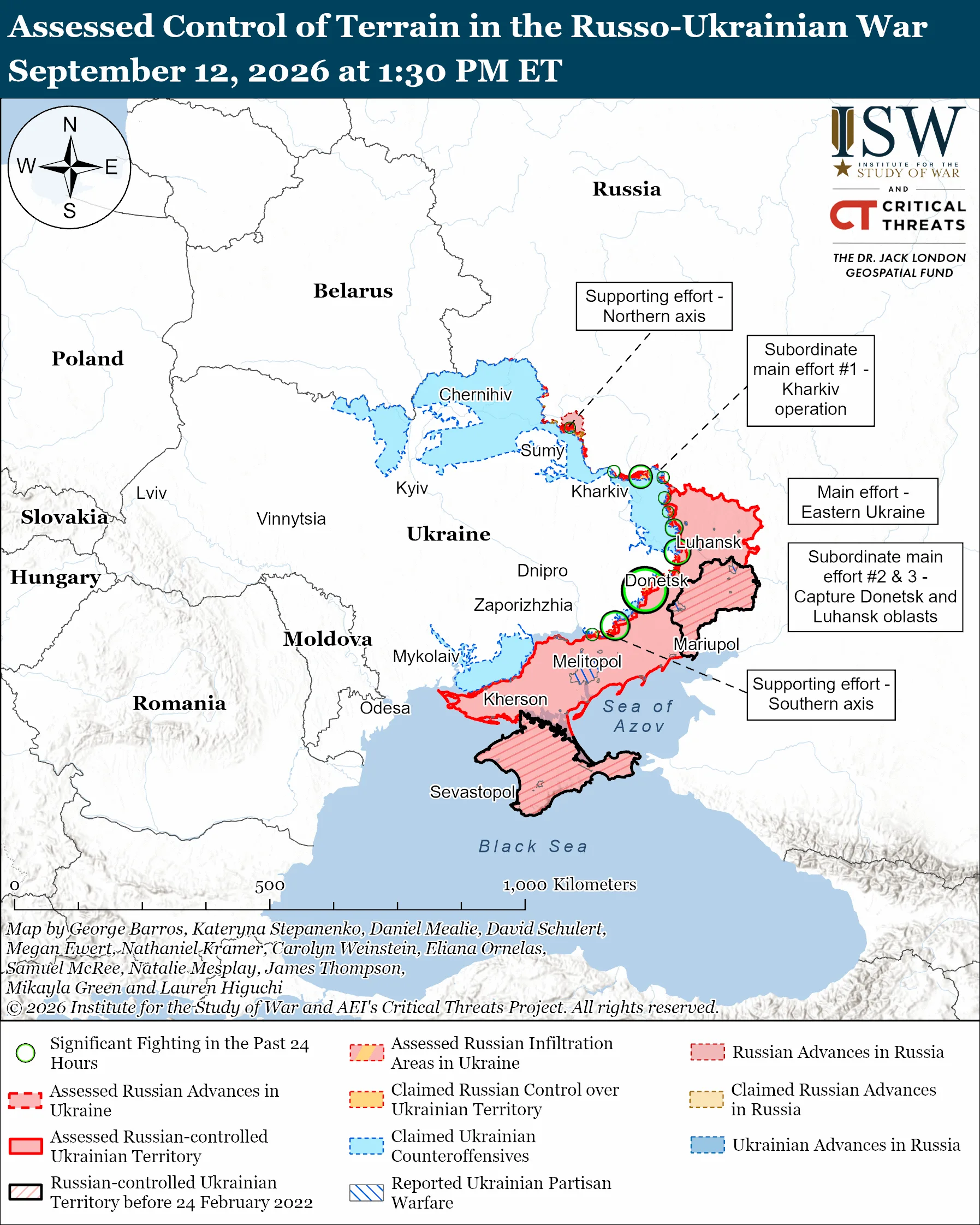
SW has reorganized its axes in Donetsk and Dnipropetrovsk oblasts to better reflect the Russian campaign to seize Ukraine’s Donetsk Oblast Fortress Belt. ISW will analyze the Russian campaign in Donetsk Oblast in more detail in a forthcoming special edition.
We do not report in detail on Russian war crimes because these activities are well-covered in Western media and do not directly affect the military operations we are assessing and forecasting. We will continue to evaluate and report on the effects of these criminal activities on the Ukrainian military and the Ukrainian population and specifically on combat in Ukrainian urban areas. We utterly condemn Russian violations of the laws of armed conflict and the Geneva Conventions and crimes against humanity even though we do not describe them in these reports.
Ukrainian Operations in the Russian Federation
Ukrainian forces struck chemical production facilities and military infrastructure in Russia on the night of September 11 to 12. Ukrainian President Volodymyr Zelensky stated that Ukrainian forces struck two chemical industry enterprises in Perm Krai and Samara Oblast; an unspecified target in the Black Sea; a first-person view (FPV) drone production facility; drone storage sites; an oil products tank; a radar station; and a Pantsir-S2 air defense system in Taganrog, Rostov Oblast (approximately 165 kilometers from the frontline) in the past day.[28] Ukrainian forces struck a chemical plant in Perm Krai on the night of September 10 to 11, and it is unclear if Zelensky is referring to another more recent strike.[29] A fire broke out near the Taganrog Airbase following the strikes, according to geolocated footage published on September 11.[30] The Ukrainian General Staff specified that Ukrainian forces overnight struck the Tolyattikauchuk petrochemical plant in Tolyatti, Samara Oblast (approximately 885 kilometers from the frontline), which produces ingredients for the production of solid rocket fuel for ballistic missiles.[31] Imagery published on September 12 shows a fire at the KuibyshevAzot chemical plant (near the Tolyattikachuk plant) in Tolyatti, according to open sources.[32] Tolyatti Mayor Ilya Sukhikh acknowledged that Ukrainian forces struck Tolyatti.[33]
Russian Supporting Effort: Northern Axis
Russian objective: Create defensible buffer zones in Sumy Oblast along the international border
Russian forces continued offensive operations in northern Sumy Oblast on September 11 and 12 but did not make confirmed advances.[34] A Russian milblogger claimed on September 12 that Russian forces advanced west of Myropilske (east of Sumy City), but ISW has not observed evidence of any Russian positions west of the settlement.[35] A source reporting on the Russian Northern Grouping of Forces claimed on September 12 that Russian forces do not control Ryzhivka (northwest of Sumy City), Sadky, or Myropillya (both northeast of Sumy City), all of which the Russian Ministry of Defense has claimed Russian forces seized.[36]
Russian forces attempted to infiltrate Sumy Oblast through a pipeline from Kursk Oblast. A Ukrainian brigade reported on September 12 that Ukrainian forces struck roughly 10 Russian personnel after they emerged from a pipeline leading to Ukrainian territory in Sumy Oblast from Kursk Oblast.[37] The brigade stated that its forces control the pipeline route and that Russian forces cannot safely pass through it. Russian forces used pipes to make significant advances in Avdiivka, Kursk Oblast, and Kupyansk in January 2024, March 2025, and September 2025, respectively.[38]
Russian Supporting Effort: Kharkiv Oblast
Russian objective: Push Ukrainian forces back from the international border to create a defensible buffer zone with Belgorod Oblast and approach Kharkiv City
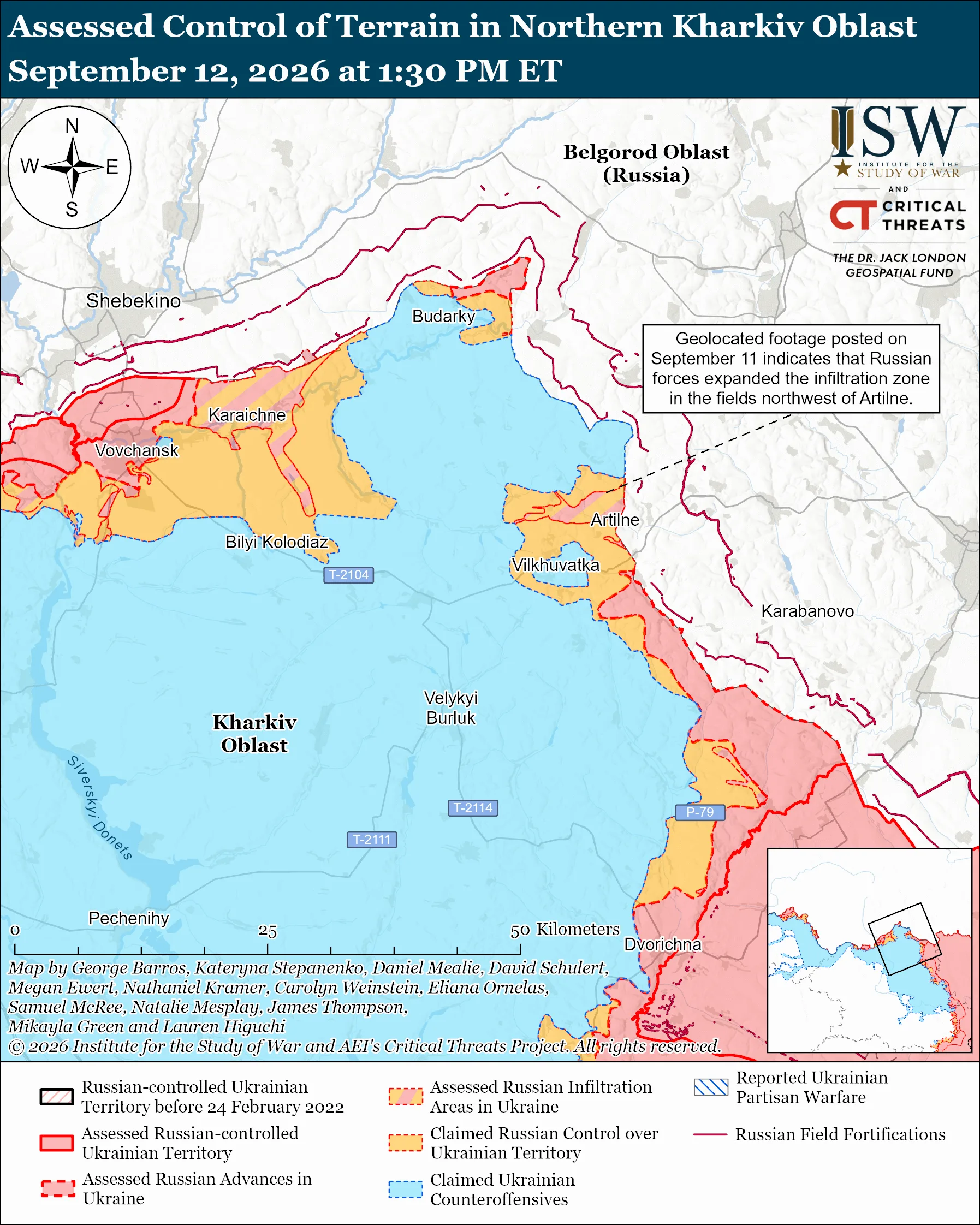
Russian forces continued offensive operations in northern Kharkiv Oblast on September 11 and 12 but did not make confirmed advances as Ukrainian forces counterattacked near Lyptsi (north of Kharkiv City).[39]
Russian sources continue to contest the official Russian narrative that Russian forces have encircled Ukrainian forces northeast of Kharkiv City. A Russian milblogger claimed on September 12 that Russian forces advanced into western Vasylivka (northeast of Kharkiv City), but posted a map that showed a roughly 11-kilometer-wide gap between Vasylivka and the nearest Russian position to the east, acknowledging that Russian forces have not completed an encirclement in the area.[40] The commander of the Russian 71st Guards Motorized Rifle Division (14th Army Corps, Leningrad Military District [LMD]), Colonel Roman Shkroba, claimed on September 12 that the claimed Russian encirclement covers over 400 square kilometers and has surrounded 10 Ukrainian battalions.[41] ISW continues to assess that Russian forces have not encircled any Ukrainian forces in the area north of Vasylivka.[42]
Russian forces recently conducted an infiltration mission in northern Kharkiv Oblast. Russian forces likely conducted an infiltration mission northwest of Artilne (northeast of Velykyi Burluk), based on geolocated footage published on September 11 that shows Ukrainian forces striking a Russian position in the area.[43]
Russian Supporting Effort: Oskil River
Russian objective: Cross the Oskil River in Kharkiv Oblast and push westward into eastern Kharkiv Oblast and northern Donetsk Oblast
Russian forces continued offensive operations in the Kupyansk direction on September 11 and 12 but did not advance as Ukrainian forces counterattacked near Zapadne and Dvorichna (both north of Kupyansk).[44]
A source reporting on the Russian Western Grouping of Forces claimed on September 12 that Russian forces continued offensive operations in the Borova direction, but ISW has not observed evidence that Russian forces advanced.[45]
Ukrainian forces continued their intermediate-range strike campaign against Russian military assets in occupied Luhansk Oblast. The Ukrainian General Staff reported that Ukrainian forces struck a Russian logistics warehouse and weapons and equipment storage area in Alchevsk (roughly 72 kilometers from the frontline), on September 11 or on the night of September 11 to 12.[46]
Russian Main Effort: Capture Ukraine’s Fortress Belt and complete the seizure of Donetsk Oblast
Russian Subordinate Main Effort #1 – Encircle the Fortress Belt from the northwest
Russian objective: Seize Lyman and cross the Siverskyi Donets River to support a wide encirclement of the Fortress Belt – assessed objective of the Russian 25th Combined Arms Army and Western Grouping of Forces elements
See topline text for further information on Ukrainian counterattacks north of Lyman.
Russian Subordinate Main Effort #2 – Advance on the Fortress Belt from the east
Russian objective: Advance on Slovyansk, Kramatorsk, and Druzhkivka from the east – assessed objective of the Russian 3rd Combined Arms Army and Southern Grouping of Forces elements
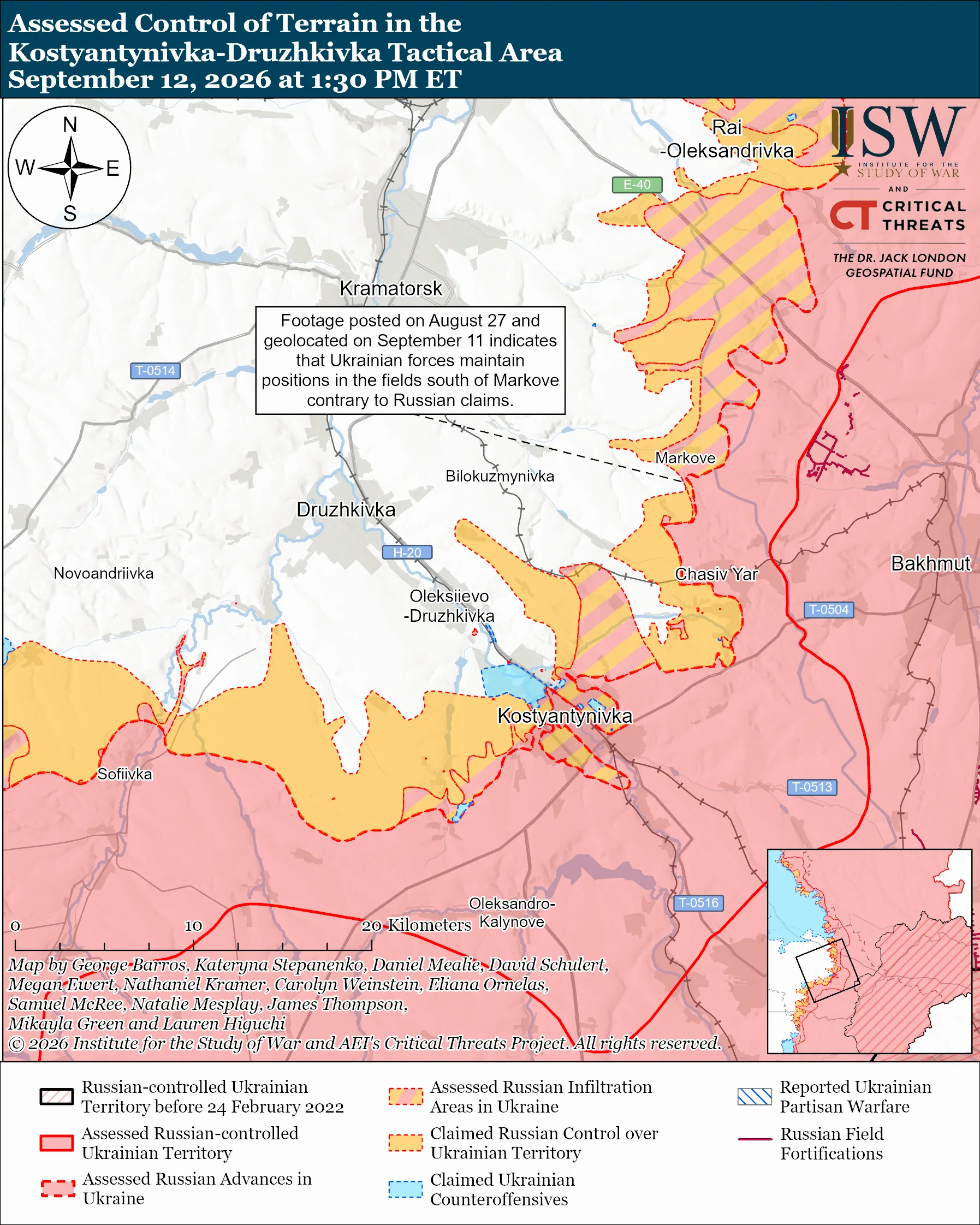
Ukrainian forces advanced or maintained positions southeast of Slovyansk. Ukrainian forces hold positions south of Markove (southeast of Slovyansk) — an area where Russian sources previously claimed Russian forces maintained positions — according to geolocated footage published on August 27.[47]
Russian forces continue infiltration attempts in the Kramatorsk direction despite an expanding kill zone in the area. The spokesperson of a Ukrainian brigade operating in the Kramatorsk direction reported on September 12 that Russian forces continue sending servicemembers to conduct costly infiltrations in the Kramatorsk direction.[48] The spokesperson noted that Russian forces are increasingly using FPV drones, fixed-wing drones, and KAB guided glide bombs to intimidate the local population and force them to leave frontline settlements. The spokesperson added that Russian forces attempt to use unmanned ground vehicles (UGVs) for frontline logistics missions as the kill zone continues to expand.
The Donetsk Oblast State Emergency Service reported that Russian forces conducted a “double-tap” strike in Kramatorsk overnight on September 11 to 12, injuring a rescue worker responding to an earlier strike.[49]
Russian Subordinate Main Effort #3 – Advance on the Fortress Belt from the south
Russian objective: Advance on Kostyantynivka and Druzhkivka from the south and southwest, east of the Kazenyi Torets River – assessed objective of the Russian 8th Combined Arms Army and Southern Grouping of Forces elements
Russian forces continued offensive operations in the Kostyantynivka-Druzhkivka direction on September 11 and 12 but did not advance.[50] Russian milbloggers claimed on September 12 that Russian forces are attempting to advance towards Druzhkivka from Raiske (southwest of Druzhkivka) while conducting systematic glide bomb strikes against Ukrainian positions in southern Druzhkivka.[51]
Russian Subordinate Main Effort #4 – Encircle the Fortress Belt from the southwest
Russian objective: Conduct a wide encirclement of the Fortress Belt from near Dobropillya and Pokrovsk west of the Kazenyi Torets River – assessed objective of the Russian 51st Combined Arms Army and Central Grouping of Forces elements
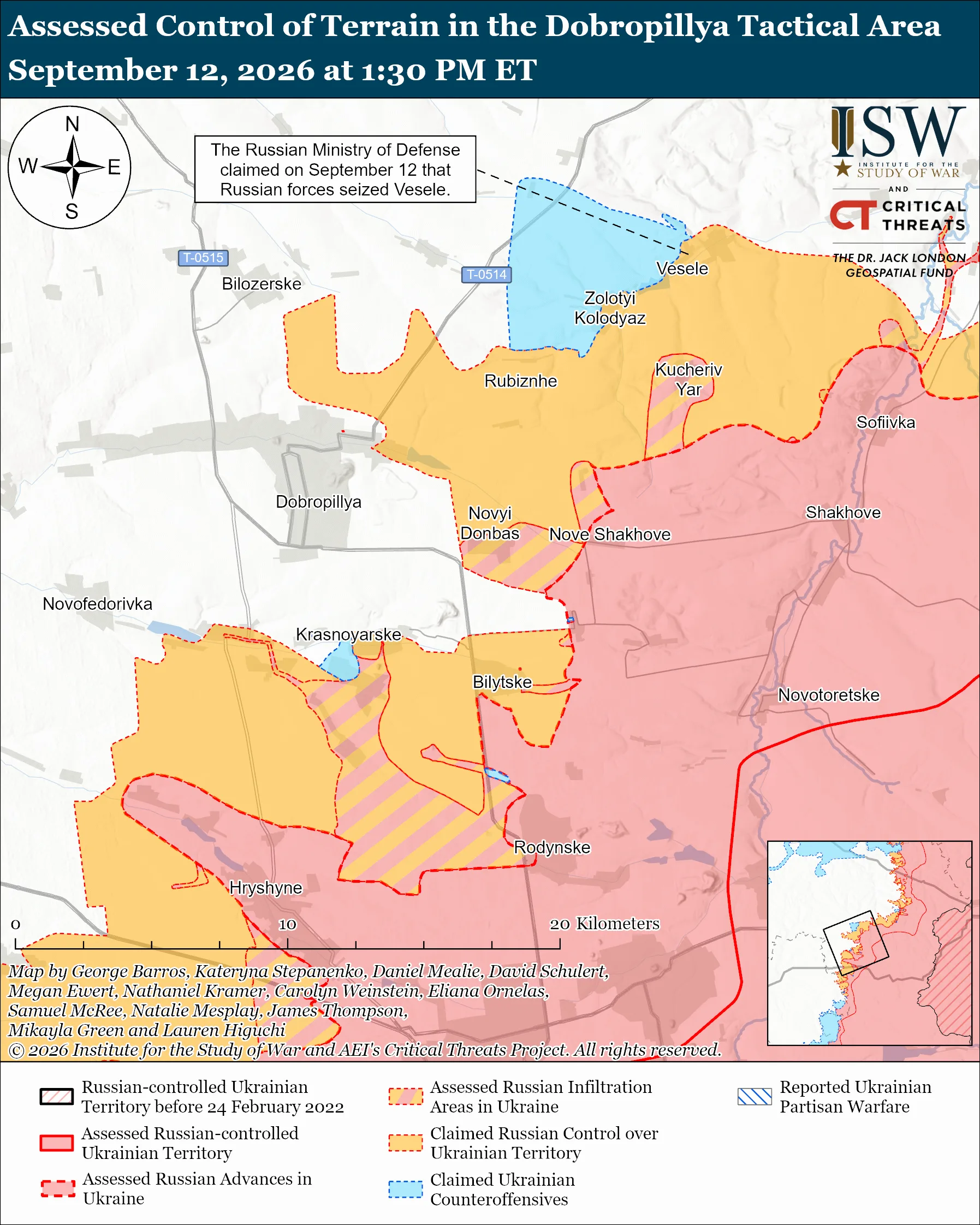
Russian forces continued offensive operations in the Dobropillya area on September 11 and 12 but did not make confirmed advances.[52] The Russian Ministry of Defense (MoD) claimed on September 12 that Russian forces seized Vesele (northeast of Dobropillya).[53] Russian forces conducted a glide bomb strike against Ukrainian positions east of Kurytsyne (northwest of Dobropillya), according to geolocated footage published on September 11.[54]
Ukrainian forces continued their intermediate-range strike campaign against Russian military assets and infrastructure in Donetsk Oblast. The Ukrainian General Staff reported on September 12 that Ukrainian forces struck Russian drone warehouses in occupied Donetsk City (roughly 70 kilometers from the front line), Maly Kermenchyk (likely referring to the settlement in Donetsk Oblast roughly 40 kilometers from the front line), and Kurakhivka (roughly 35 kilometers from the front line) on September 11 or on the night of September 11 to 12.[55] Ukrainian forces struck a Russian Shahed launcher at the Donetsk City Airport (roughly 60 kilometers from the front line) based on geolocated footage published on September 12.[56] Ukrainian forces also struck an electrical substation in occupied Snizhne (roughly 92 kilometers from the front line) according to additional geolocated footage published on September 12.[57]
Ukrainian electronic warfare (EW) systems appear to be deterring Russian drone activity near the frontline as Russian forces continue to develop countermeasures. The deputy commander of a Ukrainian EW company reported on September 12 that Russian reconnaissance drones rarely fly beyond the frontline in Donetsk Oblast due to the saturation of Ukrainian EW systems and air defenses.[58] The deputy commander added that Ukrainian manufacturers are engaged in an offensive-defensive technological race to improve and innovate drones and EW systems, noting that Russian forces are constantly adapting their systems, and Ukrainian and Russian forces continue inventing countermeasures. The deputy commander added that FPV drones pose one of the greatest threats to Ukrainian forces and that EW systems must focus on countering them but noted that EW possibilities are not limitless because fiber-optic FPV drones capable of evading EW require separate countermeasures.
Russian Supporting Effort: Advance into Dnipropetrovsk Oblast
Russian objective: Interdict Ukrainian ground lines of communication that support Ukrainian positions in Donetsk Oblast and envelop Ukrainian positions in southwestern Donetsk Oblast – assessed objective of elements of the Russian Central and Eastern groupings of forces
Russian forces continued offensive operations in the Novopavlivka direction on September 11 and 12 but did not advance.[59]
Neither Russian nor Ukrainian forces reported ground activity in the Oleksandrivka direction on September 12.
Russian Supporting Effort: Southern Axis
Russian objective: Maintain frontline positions, secure rear areas against Ukrainian strikes, and advance within tube artillery range of Zaporizhzhia City – assessed objective of the Russian Eastern and Dnepr grouping of forces
Russian forces continued offensive operations in the Hulyaipole direction on September 11 to 12 but did not advance.[60]
Ukrainian forces continued their intermediate-range strike campaign against Russian military assets in eastern Zaporizhia Oblast. The Ukrainian General Staff reported that Ukrainian forces struck a Russian drone control station near occupied Polohy (roughly 18 kilometers from the frontline) on September 11 or on the night of September 11 to 12.[61]
Russian forces continued limited offensive operations in western Zaporizhia Oblast on September 11 and 12 but did not advance.[62] The Ukrainian State Emergency Service reported that Russian forces conducted glide bomb strikes against Zaporizhzhia City on the night of September 11 to 12, damaging a fire station.[63]
Ukrainian forces continued their frontline strike campaign against Russian military assets in occupied Zaporizhia Oblast. A Ukrainian FPV drone struck a Russian truck carrying BM-21 Grad ammunition northeast of Stepove (roughly 12 kilometers from the frontline and southwest of Orikhiv), based on geolocated footage published on September 11.[64] Zaporizhia Oblast occupation administration council member Vladimir Rogov claimed on September 12 that Ukrainian forces launched a large number of Hornet drones over the M-14 Rostov Oblast-occupied Crimea highway (which Russian occupation officials denote as the R-280 highway) and criticized Zaporizhia Oblast occupation head Yevgeny Balitsky for claiming that the highway is safe.[65] ISW has observed Russian milbloggers repeatedly rejecting Russian occupation officials’ claims that the M-14 highway is safe from Ukrainian drones.[66]
Neither Russian nor Ukrainian sources reported ground activity in the Kherson direction on September 12.
Ukrainian forces continued their intermediate-range strike campaign against Russian military assets in occupied Kherson Oblast. The Ukrainian General Staff reported that Ukrainian forces struck a Russian drone ground station near occupied Zaliznyi Port (roughly 41 kilometers from the frontline) on September 11 or on the night of September 11 to 12.[67]
Ukrainian forces have conducted a series of strikes against Russian oil tankers in the Black Sea since July 2026. A Ukrainian FP-1 or FP-2 drone struck the Russian Armada Leader oil tanker in the Black Sea, according to footage published on September 12.[68] Ukrainian Unmanned Systems Forces (USF) Commander Major Robert “Magyar” Brovdi reported on September 12 that Ukrainian forces struck 285 oil tankers in the Black and Azov seas over the past 10 weeks, including nine in July 2026, 54 in August 2026, and 16 between September 1 and 11.[69]
Russian Air, Missile, and Drone Campaign
Russian Objective: Target Ukrainian military and civilian infrastructure in the rear and on the frontline
Note: The Ukrainian military ceased regularly reporting the numbers of Russian missiles fired and the number of missiles intercepted as of August 11.[70]
Russian forces conducted a series of missile and drone strikes against Ukraine on the night of September 11 to 12. The Ukrainian Air Force reported that Russian forces launched an unspecified number of Iskander-M/KN-23 ballistic missiles from Voronezh and Rostov oblasts and occupied Crimea; eight Kalibr cruise missiles from the Black Sea; and six Kh-59/69 cruise missiles from the airspace over the Black Sea.[71] Russian forces also launched 129 Shahed-type strike drones (about half of which were jet-powered drones), S8000 Banderol loitering munitions, and Parodiya-type decoy drones from the directions of Kursk and Oryol cities; occupied Donetsk City; and occupied Hvardiiske, Crimea. The Ukrainian Air Force reported that Russian forces primarily targeted Odesa Oblast; that Ukrainian forces downed six Kalibrs, one Banderol, two Kh-59/69s, and 101 drones; that missiles and drones hit 20 locations; and that debris fell at four locations. Ukrainian officials reported that Russian forces struck residential, industrial, educational, and commercial infrastructure in Chernihiv, Zaporizhia, Odesa, Kyiv, Zhytomyr, Rivne, and Dnipropetrovsk oblasts.[72] President Zelensky reported that a Russian missile strike against a residential building in Odesa City injured at least 37 people; that a drone strike against a hotel in Chornomorsk, Odesa Oblast, injured at least 11; and that drone and missile strikes against residential and industrial infrastructure in Zaporizhia Oblast and critical infrastructure in Kryvyi Rih, Dnipropetrovsk Oblast, killed at least three and injured at least three.[73] Ukrainian steel manufacturing company ArcelorMittal reported that Russian forces conducted a missile strike against its facility in Kryvyi Rih, killing two employees, injuring two others, and damaging production and auxiliary facilities.[74] The Russian MoD stated that Russian forces struck a Ukrainian metallurgical enterprise in Kryvyi Rih and claimed that Russian forces also struck metallurgical enterprises in Zaporizhia and Dnipro cities; port and transport infrastructure in Odesa Oblast; and logistics and data processing centers in Dnipro and Kyiv cities and Hostomel, Kyiv Oblast.[75]
Russian forces continued on September 12 their recent pattern of launching daytime drone strikes but launched a larger number of older drone variants than they have been in recent weeks, suggesting that the purpose of the strike was to disrupt and scare ordinary Ukrainians. The Ukrainian Air Force reported that Russian forces launched 410 strike drones, including 37 jet-powered drones, during the day on September 12.[76] Ukrainian forces downed 336 drones, including 23 jet-powered drones, and 21 drones struck an unspecified number of locations. The Ukrainian Air Force reported that the strike series was not completed as of 1800 local time on September 12, with 55 strike drones still in Ukrainian airspace and more groups of drones entering.
Russian forces have been consistently launching daily packages of about 100-200 drones in overnight strike packages in recent weeks — a departure from their previous pattern of occasionally launching a strike package with multiple hundreds of drones in one night. Russian forces have not launched over 400 drones in one strike series since the night of July 1 to 2.[77] This shift away from occasional very large drone strike packages stems from Russia’s increased use of the faster jet-powered drones that Ukrainian forces have been struggling to intercept at high rates and that therefore can cause significant damage in smaller quantities.[78] That the September 12 daytime strike predominantly used the older, slower drone variants that Ukrainian forces have consistently intercepted at high rates suggests that the goal of the daytime strike was to cause significant disruptions in daily life and the Ukrainian economy and to demoralize Ukraine’s population.[79]
Russia’s ongoing campaign targeting Ukrainian passenger trains is disrupting rail traffic in northern Ukraine. Ukrainian railway operator Ukrzaliznytsia reported on September 12 that Russian forces struck trains in Lutsk, Volyn Oblast and Fastiv, Kyiv Oblast.[80] Ukrzaliznytsia stated that it will temporarily restrict rail service to Sumy City due to intensified Russian strikes against trains.[81] Trains will stop at Konotop, Sumy City (west of Sumy City), and buses will then transfer passengers to Sumy City.
Significant Activity in Belarus
Russian efforts to increase its military presence in Belarus and further integrate Belarus into Russian-favorable frameworks
Belarus reportedly continues to operate signal repeaters along the Belarusian-Ukrainian border. Ukrainian GUR Head Oleh Ivashchenko stated on September 12 in an interview with The Times that Ukraine has identified six repeater stations currently located in Belarus that Russian forces employ to relay video streams from strike drones.[82] Ivashchenko noted that Belarus briefly halted deploying repeaters but has since started operating them again and added that Ukraine has sufficient capabilities to “deal” with the repeater issue. Former Ukrainian Commander-in-Chief General Oleksandr Syrskyi reported on June 30 that Belarus had not dismantled the Russian-installed signal repeaters along the Belarusian-Ukrainian border and turned on one of the signal repeaters on June 29.[83] Belarusian signal repeaters along the Belarusian-Ukrainian border briefly ceased operations around June 22 following President Zelensky’s warning that Belarus must disable the repeaters no later than June 26.[84]
Note: ISW does not receive any classified material from any source, uses only publicly available information, and draws extensively on Russian, Ukrainian, and Western reporting and social media as well as commercially available satellite imagery and other geospatial data as the basis for these reports. References to all sources used are provided in the endnotes of each update.

[1] https://understandingwar.org/research/russia-ukraine/russian-offensive-campaign-assessment-june-1-2026/; https://understandingwar.org/research/russia-ukraine/russian-offensive-campaign-assessment-september-1-2026/
[2] https://t.me/zvizdecmanhustu/3555; https://t.me/epoddubny/28532; https://understandingwar.org/research/russia-ukraine/russian-offensive-campaign-assessment-august-15-2026/; https://understandingwar.org/research/russia-ukraine/russian-offensive-campaign-assessment-may-23-2026/; https://understandingwar.org/research/russia-ukraine/russian-offensive-campaign-assessment-june-29-2026/; https://understandingwar.org/research/russia-ukraine/russian-offensive-campaign-assessment-september-4-2026/; https://understandingwar.org/research/russia-ukraine/russian-offensive-campaign-assessment-july-29-2026/; https://understandingwar.org/research/russia-ukraine/russian-offensive-campaign-assessment-august-18-2026/; https://understandingwar.org/research/russia-ukraine/russian-offensive-campaign-assessment-april-27-2026/; https://understandingwar.org/research/russia-ukraine/russian-offensive-campaign-assessment-may-30-2026/
[3] https://t.me/milinfolive/179361; https://t.me/swodki/618334; https://t.me/apwagner/67611; https://t.me/swodki/618676; https://t.me/DnevnikDesantnika/47401; https://t.me/russkii_dom/89424; https://t.me/russkii_dom/89443; https://t.me/russkii_dom/89451; https://t.me/russkii_dom/89476 ; https://t.me/russkii_dom/89497;
[4] https://t.me/russkii_dom/89443; https://t.me/russkii_dom/89476;
[5] https://x.com/StratcomCentre/status/2098683242505253256
[6] https://t.me/dva_majors/98751
[7] https://t.me/swodki/618676; https://t.me/russkii_dom/89424; https://t.me/russkii_dom/89443; https://t.me/russkii_dom/89451; https://t.me/russkii_dom/89476 ; https://t.me/dva_majors/98889
[8] https://t.me/DnevnikDesantnika/47401; https://t.me/russkii_dom/89497; https://t.me/swodki/618676
[9] https://t.me/russkii_dom/89497
[10] https://www.thetimes.com/world/russia-ukraine-war/article/ukraine-spy-chief-russia-putin-war-gjk6w0h86
[11] https://understandingwar.org/research/russia-ukraine/russian-offensive-campaign-assessment-november-4-2025/; https://understandingwar.org/research/russia-ukraine/russian-offensive-campaign-assessment-july-28-2026/
[12] https://www.thetimes.com/world/russia-ukraine-war/article/ukraine-spy-chief-russia-putin-war-gjk6w0h86
[13] https://understandingwar.org/research/russia-ukraine/russian-offensive-campaign-assessment-july-17-2026/; https://understandingwar.org/research/russia-ukraine/russian-offensive-campaign-assessment-march-25-2026/; https://understandingwar.org/research/russia-ukraine/russian-offensive-campaign-assessment-may-27-2026/; https://understandingwar.org/research/russia-ukraine/russian-offensive-campaign-assessment-june-11-2026/
[14] https://understandingwar.org/research/russia-ukraine/russian-offensive-campaign-assessment-august-31-2026/
[15] https://t.me/tass_agency/394960; https://t.me/tass_agency/394961; https://understandingwar.org/research/russia-ukraine/russian-offensive-campaign-assessment-september-10-2026/; https://understandingwar.org/research/russia-ukraine/russian-offensive-campaign-assessment-july-29-2026/; https://understandingwar.org/research/russia-ukraine/russian-offensive-campaign-assessment-september-4-2026/
[16] https://www.thetimes.com/world/russia-ukraine-war/article/ukraine-spy-chief-russia-putin-war-gjk6w0h86
[17] https://understandingwar.org/research/russia-ukraine/russian-offensive-campaign-assessment-september-1-2026/; https://understandingwar.org/research/russia-ukraine/russian-offensive-campaign-assessment-may-8-2026/ ; https://understandingwar.org/research/russia-ukraine/russian-offensive-campaign-assessment-april-1-2026/; https://understandingwar.org/research/russia-ukraine/russian-offensive-campaign-assessment-april-21-2026/; https://understandingwar.org/research/russia-ukraine/russian-offensive-campaign-assessment-july-1-2026/
[18] https://understandingwar.org/research/russia-ukraine/russian-offensive-campaign-assessment-september-1-2026/; https://understandingwar.org/research/russia-ukraine/russian-offensive-campaign-assessment-february-24-2026/ ; https://understandingwar.org/research/russia-ukraine/russian-offensive-campaign-assessment-october-13-2025/ ; https://understandingwar.org/research/russia-ukraine/russian-offensive-campaign-assessment-october-28-2025/ ; https://understandingwar.org/research/russia-ukraine/russian-offensive-campaign-assessment-november-4-2025/; https://understandingwar.org/research/russia-ukraine/russian-offensive-campaign-assessment-february-18-2026/; https://understandingwar.org/research/russia-ukraine/russian-offensive-campaign-assessment-december-9-2025/; https://understandingwar.org/research/russia-ukraine/russian-offensive-campaign-assessment-april-25-2026/; https://understandingwar.org/research/russia-ukraine/russian-offensive-campaign-assessment-july-25-2026/; https://understandingwar.org/research/russia-ukraine/russian-offensive-campaign-assessment-august-28-2026/
[19] https://x.com/ZelenskyyUa/status/2057070633167581510; https://www.reuters.com/world/top-ukrainian-commander-says-readying-possible-new-russian-attack-north-2026-06-30/
[20] https://understandingwar.org/research/russia-ukraine/russian-offensive-campaign-assessment-september-1-2026/; https://understandingwar.org/research/russia-ukraine/russian-offensive-campaign-assessment-august-31-2026/ ; https://understandingwar.org/research/russia-ukraine/russian-offensive-campaign-assessment-july-9-2026/ ; https://understandingwar.org/research/russia-ukraine/russian-offensive-campaign-assessment-august-12-2026/ ; https://understandingwar.org/research/russia-ukraine/russian-offensive-campaign-assessment-july-29-2026/
[21] https://x.com/ZelenskyyUa/status/2098474006445801478; https://t.me/V_Zelenskiy_official/20822;
[22] https://www.dw dot com/en/dw-exclusive-zelenskyy-offers-to-meet-putin-at-g20-in-miami/a-79241703?maca=en-rss-en-all-1573-rdf
[23] https://ria dot ru/20260912/peskov-2117349686.html
[24] https://t.me/V_Zelenskiy_official/20822; https://www dot dw.com/en/dw-exclusive-zelenskyy-offers-to-meet-putin-at-g20-in-miami/a-79241703?maca=en-rss-en-all-1573-rdf
[25] https://www.bloomberg.com/news/articles/2026-09-11/ukraine-strikes-degrade-russian-oil-refining-industry-iea-says; https://www.iea.org/reports/oil-market-report-september-2026
[26] https://understandingwar.org/research/russia-ukraine/russian-offensive-campaign-assessment-september-11-2026/
[27] https://www.kyivpost.com/post/60390; https://www.eia.gov/energyexplained/oil-and-petroleum-products/refining-crude-oil-the-refining-process.php
[28] https://x.com/ZelenskyyUa/status/2098750096124850684
[29] https://understandingwar.org/research/russia-ukraine/russian-offensive-campaign-assessment-september-11-2026/
[30] https://x.com/neonhandrail/status/2098612513038647361; https://x.com/Exilenova_plus/status/2098605804823961903
[31] https://t.me/GeneralStaffZSU/42209
[32] https://t.me/exilenova_plus/30850; https://t.me/astrapress/124990
[33] https://t.me/ilya_suhih/3260
[34] https://t.me/GeneralStaffZSU/42203 ; https://t.me/GeneralStaffZSU/42206 ; https://t.me/wargonzo/36874 ; https://t.me/dva_majors/98889 ; https://t.me/severnnyi/9295
[35] https://t.me/z_arhiv/33873
[36] https://t.me/severnnyi/9300 ; https://understandingwar.org/research/russia-ukraine/russian-offensive-campaign-assessment-may-2-2026/ ; https://understandingwar.org/research/russia-ukraine/russian-offensive-campaign-assessment-august-5-2026/ ; https://understandingwar.org/research/russia-ukraine/russian-offensive-campaign-assessment-august-30-2026/
[37] https://t.me/brygada47/2568 ; https://armyinform dot com.ua/2026/09/12/%c2%abportal-do-pekla%c2%bb-okupanty-sprobuvaly-vidnovyty-svij-%c2%abtayemnyj%c2%bb-marshrut-na-sumshhynu/
[38] https://understandingwar.org/research/russia-ukraine/russian-offensive-campaign-assessment-september-13-2025/ ; https://istories dot media/en/stories/2025/09/18/pipes/; https://www.pravda dot com.ua/eng/news/2025/03/08/7501875/
[39] https://t.me/GeneralStaffZSU/42203 ; https://t.me/GeneralStaffZSU/42206 ; https://t.me/wargonzo/36874 ; https://t.me/severnnyi/9295 ;
[40] https://t.me/creamy_caprice/12933 ; https://t.me/DPSUkr/34983
[41] https://t.me/SolovievLive/384798
[42] https://understandingwar.org/research/russia-ukraine/russian-offensive-campaign-assessment-september-11-2026/ ; https://understandingwar.org/research/russia-ukraine/russian-offensive-campaign-assessment-september-9-2026/
[43] https://t.me/creamy_caprice/12933 ; https://t.me/DPSUkr/34983
[44] https://t.me/GeneralStaffZSU/42203; https://t.me/GeneralStaffZSU/42206; https://t.me/grvZapad/19745; https://t.me/grvZapad/19745
[45] https://t.me/grvZapad/19745
[46] https://t.me/GeneralStaffZSU/42210
[47] https://x.com/meowqai/status/2098520872575492103; https://t.me/DobroKor/3788
[48] https://armyinform dot com.ua/2026/09/12/gotovi-vkladaty-desyatkamy-svij-osobovyj-sklad-na-kramatorsku-napryamku-tryvaye-rosijska-myasna-infiltracziya/; https://www.youtube.com/watch?v=XFL_nHXOBgY
[49]
https://www.facebook.com/DSNSDon/posts/pfbid0G5xEbc78HTsnUcqmZwUZhD5upCJB96XNB5UDRGhFdEpPTgfdj11fMZb1MfGvgyJNl
[50] https://t.me/GeneralStaffZSU/42203; https://t.me/GeneralStaffZSU/42206;
[51] https://t.me/dva_majors/98889; https://t.me/wargonzo/36874
[52] https://t.me/GeneralStaffZSU/42203; https://t.me/GeneralStaffZSU/42206; ttps://t.me/wargonzo/36874 ; https://t.me/dva_majors/98889
[53] https://t.me/mod_russia/67246
[54] https://t.me/Osintpen/3524; https://t.me/dva_majors/98884
[55] https://t.me/GeneralStaffZSU/42210
[56] https://x.com/sternenko/status/2098726046543601908; https://x.com/meowqai/status/2098757515869622539/history
[57] https://x.com/neonhandrail/status/2098583889078038762; https://t.me/exilenova_plus/30813
[58] https://armyinform dot com.ua/2026/09/12/na-kozhne-yihnye-rishennya-my-vydayemo-svoye-fahivecz-z-reb-pro-tehnologichni-peregony-z-vorogom/
[59] https://t.me/GeneralStaffZSU/42203; https://t.me/GeneralStaffZSU/42206
[60] https://t.me/GeneralStaffZSU/42203; https://t.me/GeneralStaffZSU/42206; https://t.me/wargonzo/36874
[61] https://t.me/GeneralStaffZSU/42210
[62] https://t.me/GeneralStaffZSU/42206; https://t.me/voin_dv/21077; https://t.me/wargonzo/36874 ; https://t.me/dva_majors/98889
[63] https://t.me/dsns_telegram/74553
[64] https://x.com/neonhandrail/status/2098592704561377283; https://t.me/ssternenko/63544
[65] https://t.me/vrogov/25990
[66] https://understandingwar.org/research/russia-ukraine/russian-offensive-campaign-assessment-august-3-2026/ ; https://understandingwar.org/research/russia-ukraine/russian-offensive-campaign-assessment-july-20-2026/ ; http://kremlin dot ru/events/president/news/80309 ; https://t.me/milinfolive/177025
[67] https://t.me/GeneralStaffZSU/42210
[68] https://t.me/robert_magyar/2811 ; https://x.com/bayraktar_1love/status/2098661498419573232?s=20; https://x.com/Osinttechnical/status/2098666681975398793; https://x.com/Osinttechnical/status/2098666977078149478;
[69] https://t.me/robert_magyar/2811
[70] https://www.bloomberg.com/news/articles/2026-08-11/ukraine-stops-reporting-russia-missile-data-as-defenses-struggle?srnd=homepage-americas; https://understandingwar.org/research/russia-ukraine/russian-offensive-campaign-assessment-august-11-2026/
[71] https://t.me/kpszsu/77891
[72] https://t.me/chernigivskaODA/31736; https://t.me/vilkul/17897; https://t.me/mykola_lukashuk/28625; https://t.me/dnipropetrovskaODA/32020; https://t.me/dnipropetrovskaODA/32022; https://t.me/dnipropetrovskaODA/32035; https://t.me/V_Zelenskiy_official/20829; https://t.me/kyivoda/56928; https://t.me/tkachenkotymur/2868
[73] https://t.me/V_Zelenskiy_official/20829
[74] https://www.facebook.com/story.php?story_fbid=pfbid0BskzeSX4T5MQLP4QaFL3pF9erATHoyEucdo5ToEBbbFfm7xMZe1Q7ipUYNqTewPpl&id=100075656808098&_rdr
[75] https://t.me/mod_russia/67241; https://t.me/mod_russia/67245; https://t.me/mod_russia/67244; https://t.me/mod_russia/67243; https://t.me/mod_russia/67247
[76] https://t.me/kpszsu/77970
[77] https://t.me/kpszsu/67095
[78] https://understandingwar.org/research/russia-ukraine/russian-offensive-campaign-assessment-september-1-2026/; https://understandingwar.org/research/russia-ukraine/russian-offensive-campaign-assessment-september-4-2026/; https://understandingwar.org/research/russia-ukraine/russian-offensive-campaign-assessment-august-10-2026/
[79] https://understandingwar.org/research/russia-ukraine/russian-offensive-campaign-assessment-april-1-2026/
[80] https://t.me/UkrzalInfo/8482
[81] https://unn dot ua/en/amp/trains-to-sumy-will-no-longer-run-ukrzaliznytsia-will-stop-them-in-konotop
[82] https://www.thetimes dot com/world/russia-ukraine-war/article/ukraine-spy-chief-russia-putin-war-gjk6w0h86 ; https://archive.ph/LcNgk ; https://t.me/DIUkraine/9463
[83] https://understandingwar.org/research/russia-ukraine/russian-offensive-campaign-assessment-july-1-2026/
[84] https://understandingwar.org/research/russia-ukraine/russian-offensive-campaign-assessment-june-24-2026/