
Toplines
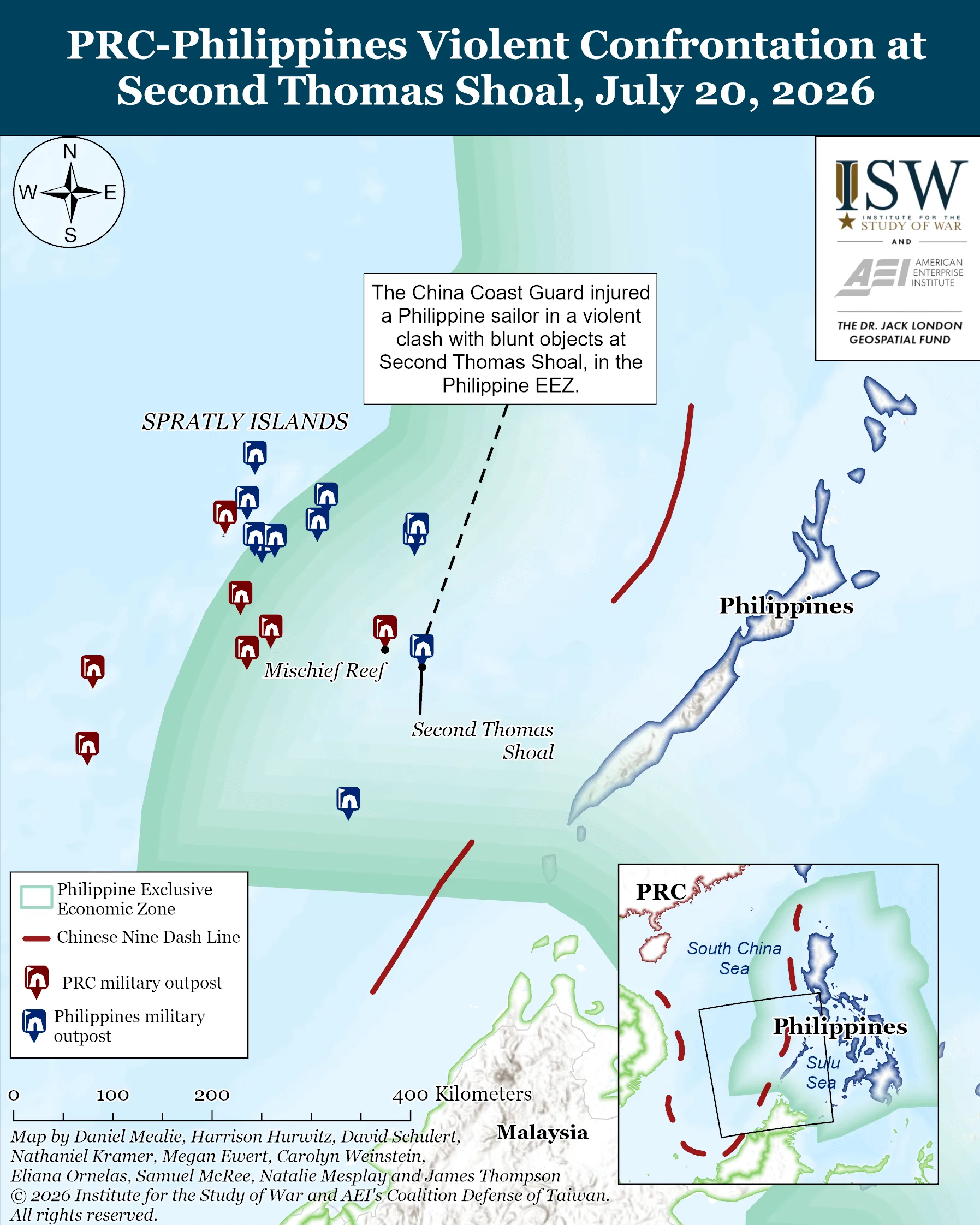
China Coast Guard (CCG) personnel injured a Philippine service member in a clash near the Philippine-occupied Second Thomas Shoal. PRC-Philippine hostilities in the South China Sea have escalated around the tenth anniversary of the 2016 arbitral ruling that found the PRC’s “historic claims” in the sea to have no basis in international law. PRC and Philippine authorities both released footage of a confrontation on July 20 involving the CCG and Armed Forces of the Philippines (AFP) personnel stationed on the grounded Philippine warship Sierra Madre, which the Philippines uses as an outpost on Second Thomas Shoal. A CCG ship in the area deployed the small boat to approach the Sierra Madre at close range and take photos and video.[1] The Sierra Madre launched two rigid-hull inflatable boats (RHIBs) to intercept the CCG boat.[2] Video from both sides showed the CCG boat and Philippine RHIBs colliding with each other and personnel hitting each other with oars and batons, leaving one Philippine soldier with a head wound.[3] The CCG claimed its boat was conducting a legitimate “routine patrol” in PRC territory and that the Philippine forces were the aggressors, while the AFP claimed the CCG attacked the AFP boats as they approached to escort it away.[4] Both countries summoned each other’s ambassadors to protest the incident.[5] Second Thomas Shoal is a submerged reef within the Philippines’ internationally recognized Exclusive Economic Zone (EEZ), but the PRC claims it, and most other South China Sea features, as PRC territory.
The confrontation occurred amid a wave of PRC-Philippine tensions and right before Philippine and PRC officials met for bilateral talks on the sidelines of the China-Association of Southeast Asian Nations (ASEAN) Foreign Ministers’ Summit in Manila. PRC Foreign Minister Wang Yi met with Philippine Foreign Secretary Maria Theresa Lazaro on July 22, their first meeting in two years.[6] Lazaro protested the PRC’s “unacceptable actions against Filipino personnel” at Second Thomas Shoal and also called for the PRC to remove all remaining structures from the disputed Scarborough Shoal.[7] Wang protested the Philippines supposedly ramming the CCG vessel and accused “some people in the Philippines,” especially in the military and police, of deliberately creating incidents whenever the PRC and the Philippines are about to have a dialogue.[8] Wang also claimed Beijing was willing to manage disputes through bilateral dialogue, but criticized the Philippines for escalating the disputes to an arbitral tribunal that the PRC considers illegal and invalid.[9] The Philippines filed a suit with the Permanent Court of Arbitration in 2013 after the CCG seized the Philippine-administered Scarborough Shoal, resulting in a 2016 ruling that the PRC’s “historical claims” in the South China Sea were invalid. The Philippines marked the tenth anniversary of the ruling on July 12.[10]
The Philippine Foreign Ministry nonetheless described the Wang-Lazaro meeting as “candid, comprehensive and constructive” and said the two sides underscored the importance of maintaining peace, stability, and dialogue and reducing the risk of miscalculation.[11] The PRC has shown a willingness to deescalate its aggressive territorial confrontations with the Philippines when the level of violence reaches an intensity that may draw in the United States, a Philippine treaty ally. A violent clash in June 2024 near Second Thomas Shoal led the PRC to agree on new escalation management mechanisms and suspend attempts to block Philippine resupply missions to Second Thomas Shoal.[12]
Taiwan’s opposition parties have proposed funding models for Taiwan’s drone procurements that may hinder their military effectiveness. Enhancing Taiwan’s capacity for unmanned systems warfare is critical to Taiwan’s defense and deterrence against the PRC. Taiwan’s ruling Democratic Progressive Party (DPP) and opposition Kuomintang (KMT) and Taiwan People’s Party (TPP) have each proposed their own plan for drone procurement funding, all three of which advanced to legislative review on July 16.[13] The KMT and TPP, which jointly hold a majority in the legislature, cut funding for drone procurements and Taiwan’s domestic drone industry from Taiwan’s special budget for asymmetric warfare that passed in May. The DPP then pursued a separate six-year, NT$210 billion ($6.6 billion) special budget to procure over 200,000 unmanned systems.[14] The KMT version of the bill allocates NT$240 billion ($7.4 billion) over six years, but combines funding for military procurements with civilian drone industry development.[15] Taiwanese Minister of Defense Wellington Koo urged the legislature to separate funding for military systems and civilian development to ensure the military’s requirements are met.[16] The KMT version of the bill also does not provide stable funding, funding the budget using the annual budget system rather than a special budget. Including drone procurements in the general budget means that they would have to compete yearly with domestic spending initiatives due to legal constraints on the size of Taiwan’s annual general budget.[17] The TPP bill does not provide significant funding for new procurements and instead advocates for developing clear regulations for how to fund drone procurement.[18]
DPP-aligned Taiwanese newspaper Liberty Times reported on July 17 that an unnamed source familiar with cross-strait relations claimed that PRC officials gave detailed instructions to the KMT to derail Taiwan’s drone procurement efforts.[19] The unnamed source stated that the director of the PRC’s Taiwan Affairs Office (TAO), Song Tao, told KMT members during a cross-strait exchange event in May that the PRC was disappointed that Taiwan passed a NT$ 780 billion special defense budget and urged them to oppose any further special defense budget initiatives.[20] KMT vice chairman Chang Jung-kung led a delegation to the cross-strait event where Song allegedly made this comment, but Chang has not publicly commented on the reporting.[21] The unnamed source also claimed that a pro-Beijing businessperson met with an opposition politician in June to instruct the politician to hinder the DPP’s special budget for drone procurements by focusing on civilian funding and to oppose Taiwan’s efforts to create a PRC-free drone supply chain.[22] KMT Caucus Secretary-General Lin Pei-hsiang categorically denied the newspaper’s claims on July 17.[23] ISW-CDOT cannot independently confirm the veracity of Liberty Times’ reporting or the quality of its source.
The PRC has engaged in a major information campaign to frame Taiwanese military modernization as politically problematic and an obstacle to cross-strait stability, despite Beijing continuing its own military buildup and regional deployments.[24] Liberty Times’ report could indicate that the PRC is particularly concerned about Taiwan’s efforts to adapt to changes in modern war centered on unmanned systems. The PRC could seek to increase pressure on Taiwan and its political parties to ensure that Taiwan’s military modernization efforts do not diminish the PRC’s ability to coerce Taiwan militarily, though the Liberty Times report suggests that Beijing is dissatisfied with its efforts to influence the KMT so far. The PRC’s reported alarm toward Taiwanese drone procurement plans further highlights the importance of Taiwan’s efforts to develop an asymmetric warfare capability to deter a cross-strait invasion.
Taiwan’s Coast Guard Administration (CGA) is aiming to procure unmanned systems to counter PRC gray zone coercion. Taiwan could use unmanned systems to make up for disparities in materiel between its forces and the PRC’s. Nikkei reported on July 15 that an anonymous high-ranking Taiwanese official stated that the CGA has awarded contracts for 25 unmanned surface vessels (USV) and two unmanned underwater vessels (UUV).[25] The official stated that Taiwan’s National Chung-Shan Institute of Science and Technology (NCSIST) would produce the systems jointly with the US defense company Maritime Tactical Systems (MARTAC).[26] NCSIST and Taiwan’s partially state-owned shipbuilder CSBC are both aiming to collaborate with US defense companies to develop USVs.[27] The unnamed official cited recent PRC patrols east of Taiwan and near Taiwan’s outlying islands as evidence that the CGA requires unmanned systems to supplement its traditional platforms.[28] Taiwan could use the unmanned systems to enhance maritime awareness, including around its undersea cable infrastructure, without straining its inventory of manned vessels.
Taiwan could also use unmanned systems to prosecute a sea-denial campaign during a PLA invasion or blockade. Ukraine has used a range of unmanned assets to deny the Russian Black Sea Fleet control of the Black Sea despite lacking any crewed surface combatants.[29] Ukraine has successfully paired long-range unmanned aerial vehicles (UAVs) with long-range USVs to keep Russian vessels in port and largely unable to contribute to Russia’s offensive campaign in Ukraine.[30] Taiwan could significantly disrupt a PLA invasion with a large number of USVs to prevent the PLA from securing sea control of the Taiwan Strait. Taiwan would likely need significantly more USVs and UUVs to execute such a strategy than what the CGA reportedly plans to procure, however. The DPP’s version of the special budget for unmanned systems would provide funding for 1,320 USVs but is currently under legislative review.[31]
Key Takeaways
- PRC-Philippine Tensions: The China Coast Guard injured a Philippine navy service member during a small boat confrontation near the Philippine outpost at Second Thomas Shoal. The violent incident is part of a trend of elevated hostilities around the tenth anniversary of the 2016 arbitration ruling that found PRC territorial claims in the South China Sea to be invalid.
- Taiwan Drone Procurement: Taiwan’s opposition parties proposed drone procurement plans that offer less stable funding than the government drone funding plan. The PRC has tried to undermine Taiwanese efforts to acquire unmanned systems necessary for modern warfare. Taiwan’s coast guard is separately planning to acquire maritime drones to counter PRC coercion while reducing strain on personnel.
Cross-Strait Relations
Taiwan
The TPP sent its first delegation to the PRC. The delegation did not meet with PRC officials, reflecting differences in the TPP and CCP’s views of cross-strait relations, even though Beijing wishes to foster relationships with Taiwanese opposition parties. TPP Central Review Committee Chairman Lee Wei-hwa led an eight-member delegation to Shanghai from July 14-17, including three TPP staff and five members of the party’s youth wing.[32] The TPP portrayed the trip as an important milestone for the party to promote goodwill and mutual trust across the Taiwan Strait.[33] The delegation visited economic and historical sites in Shanghai and also had a discussion with students and professors at Shanghai Jiao Tong University. A PRC Taiwan Affairs Office (TAO) spokesperson said that the PRC welcomed the TPP visit and generally encouraged “Taiwan compatriots,” especially youth, to visit the PRC.[34] The TPP delegation did not meet any PRC government officials or participate in official TAO-organized youth events, however, despite the TAO holding several major cross-strait youth events around the same time as the TPP visit.[35] Former Taiwanese KMT chairwoman Hung Hsiu-chu attended the Ninth Cross-Strait Youth Development Forum in Hangzhou and met with TAO Director Song Tao on July 17.[36]
The CCP and TPP may have kept a distance from each other during the trip because of the parties’ divergent views on cross-strait relations, despite both parties advocating for cross-strait dialogue. PRC state-owned tabloid Global Times cited director of Shanghai Jiao Tong University’s Center for Taiwan Studies Sheng Jiuyuan, who acknowledged that there is a gap between the TPP’s ambiguous cross-strait policy and the CCP’s insistence on the 1992 Consensus as a baseline for cross-strait political exchanges.[37] The 1992 Consensus is an alleged verbal agreement between the CCP and the KMT that Taiwan is part of “China,” leaving unresolved whether the PRC or the Republic of China (ROC) is the true representative of “China.” It is distinct from the incumbent DPP’s view that Taiwan is an independent country and that the two sides of the Strait are mutually non-subordinate, a stance that Beijing equates to separatism.[38] TPP founder Ko Wen-je remarked during his 2023 presidential campaign that the 1992 Consensus had been “stigmatized” in Taiwan and that the only option was to maintain the status quo through a combination of deterrence and communication.[39] The TPP may be using the trip to raise its national profile in Taiwan, portraying itself as capable of cross-strait engagement without appearing to be too PRC-friendly.
The PRC likely wants to encourage friendly relations with the TPP because the TPP opposes Taiwanese independence and has the power to block the DPP agenda. The TPP holds a crucial eight seats in Taiwan’s legislature, granting the opposition a majority. It largely aligned with the KMT in pushing a smaller special defense budget in 2026 than the DPP administration wanted.[40] It also briefly appointed a PRC-born lawmaker to the Legislative Yuan earlier in 2026.[41] PRC officials have sympathetically framed Taipei City’s corruption case against Ko Wen-je as an example of DPP suppression of more PRC-friendly voices in Taiwan, a narrative that aligns with the TPP’s own claims that Ko is being persecuted.[42] Beijing appears to be unwilling to openly relax its cross-strait stance to accommodate the TPP, however.
Taiwan’s Mainland Affairs Council (MAC) stated that PRC Ministry of State Security (MSS) agents detained and questioned two Taiwanese police officers travelling in the PRC in June. PRC authorities are likely targeting and interrogating Taiwanese civil servants to acquire sensitive information and recruit collaborators within Taiwan’s government. MAC Deputy Minister Liang Wen-chieh stated that several MSS agents forcibly removed a serving Taiwanese traffic police officer and a retired officer from Taiwan’s Second Special Police Corps immediately after they checked into their guesthouse in Quanzhou, in the PRC province of Fujian.[43] The Second Special Police Corps is tasked with providing security for Taiwanese critical infrastructure, including Taiwan’s four nuclear power plants and state-owned Taiwan Power Company facilities.[44] It is not clear why the two officers were traveling in the PRC, but Liang’s comments indicated that it may have been for tourism.[45] The MSS agents brought the police officers to another location and interrogated them for around six hours, questioning the officers about lists and organizational details of Taiwanese critical infrastructure.[46] The MSS agents also forcibly searched the two officers’ mobile phones and questioned them about their previous work at an unspecified Taiwanese government agency, their current jobs, and their families and children.[47] The MSS agents warned the officers not to report their detention to Taiwanese authorities when they returned to Taiwan.[48]
Liang stated that PRC authorities have also detained and questioned personnel from Taiwan’s Ministry of Justice Investigation Bureau, National Police Agency, National Immigration Agency, and Coast Guard Administration (CGA) visiting the PRC in recent years.[49] The MSS is likely seeking to identify vulnerabilities in Taiwan’s critical infrastructure that the PRC could exploit to coerce Taiwan during a short-of-war contingency or a full-scale invasion by the PLA.[50] MSS attempts to acquire organizational information on Taiwanese critical infrastructure may also indicate efforts to recruit Taiwanese personnel working on such infrastructure for espionage and infiltration.
China
CCP General Secretary Xi Jinping met with United Nations (UN) Secretary-General António Guterres in Shanghai on July 17 ahead of a global AI conference. The PRC seeks to advance its interests in shaping the UN and promoting its alternative world order at the expense of US global influence.[51] Xi said the PRC has supported the UN and remained committed to building world peace, contributing to global development, and defending the international order for 55 years.[52] Guterres reaffirmed his commitment to UN reform and to enhancing cooperation with the PRC along the three pillars of UN activities, including peace and security, sustainable development, and human rights.[53] A PRC readout of the meeting said that Guterres affirmed that the UN would strengthen cooperation with the PRC, “oppose unilateralism, protectionism, and bullying,” and “promote the process of multipolarization,” which did not appear in the UN readout.[54] Guterres’ reported rhetoric echoes language the PRC frequently uses to criticize the United States.
Xi’s meeting with Guterres is part of a PRC campaign to position itself as an advocate for the revitalization of the UN’s authority, with a broader aim to shape international law and the global order to the PRC’s own interests. The PRC released a white paper on June 17 laying out its vision for a “more just and equitable global governance,” following from Xi’s introduction of the Global Governance Initiative (GGI) in 2025.[55] The Global Governance Initiative couches the PRC’s aims of re-shaping global governance in language framed as support for the re-establishment of the UN’s authority and the rule of international law. It denounces economic protectionism – a veiled reference to US and European trade policies and “de-risking” from PRC supply chains – and promotes economic development and a greater voice for the Global South, with an eye to positioning the PRC as the leader of the Global South.[56] The Global Governance Initiative also enshrines principles of “sovereignty” and “non-interference” in domestic matters, which the PRC cites to shield itself from foreign criticism on its human rights violations and coercion of Taiwan. It promotes re-establishing the authority of the UN, likely because doing so would strengthen the impact of the PRC’s role and veto power on the UN Security Council while presenting the PRC as a voice for peace and diplomacy in global conflicts.
The PRC established the World Artificial Intelligence Cooperation Organization (WAICO) to further PRC interests in leading global AI governance and development, in competition with the United States and other rivals. PRC Foreign Minister Wang Yi signed an agreement with 28 other countries to establish WAICO in Shanghai on July 16.[57] The co-signatories included a mix of broadly PRC-aligned or non-aligned states, including BRICS members, Shanghai Cooperation Organization (SCO) members, socialist countries, Russia and Russia-friendly European states, as well as various Global South countries. No Western countries or US allies attended. Representatives from several international organizations also attended the signing ceremony, including the UN Secretary-General António Guterres.[58] Xi Jinping said at the WAICO opening ceremony that the PRC aims to keep AI open-source to drive development, remain risk-aware to ensure safety and controllability, ensure inclusiveness and promote global mutual learning, and advocate for continually improving AI global governance.[59] The PRC committed to providing 5,000 training places for AI special training in developing countries, building an international AI application cooperation center for ASEAN, the Arab League, the African Union, the Shanghai Cooperation Organization, and BRICS countries, according to a Ministry of Foreign Affairs (MFA) spokesperson.[60] The PRC is further promoting the application of its meteorological intelligent early warning program, “Mazu,” across 30 countries.[61]
The PRC seeks to lead AI development and bend its governance to its own interests through creating a dependence on PRC-developed technology while circumventing Western export controls.[62] The PRC seeks to develop its own indigenous AI systems and computing hardware to circumvent Western supply chains and technology export controls, while also vying for supply chain dominance with its own technology exports.[63] The PRC may seek to create dependencies on its AI exports that it can use for economic and political leverage, as it has done with rare earths, and may build backdoors into its technology to facilitate government access.[64] The PRC may build partnerships with developing countries in particular, which are at early stages in their adoption of AI, to integrate itself with their AI development, supply chains, and governance.[65]
Some of the PRC’s largest cities have imposed drone bans and restrictions that may be motivated by lessons from the Russia–Ukraine war, highlighting PRC fears over its vulnerability to small drone attacks. Hong Kong-based South China Morning Post reported that at least 15 major PRC cities, including Shanghai, Beijing, Fuzhou, and Guangzhou, have introduced new regulations restricting the use of drones in 2026.[66] The newspaper cited PRC military analysts who suggested that these regulations are motivated by Ukraine’s recent drone attacks against Russian cities, creating a sense of urgency in the PLA to secure the low-altitude domain of its urban areas.[67] The new rules require first-person view (FPV) drone operators to first register with their real names and connect drone controls to manufacturer apps that prevent them from taking off unless verified and activated.[68] The regulations also mandate the continuous transmission of identification, location, and speed data to government regulatory systems throughout each flight.[69] Tracking the identity and real-time location of civilian drones allows the PLA and local authorities to better distinguish legal civilian drones from hostile attack drones.[70] Traditional radar systems struggle to detect and identify low-altitude, small drones, especially in complex and crowded urban environments, but reducing the “clutter” of legal FPV drones in the environment can help reduce the amount of data that PLA air surveillance must process.[71]
The PRC is likely concerned about the dangers of hostile FPV drones in its cities because Ukraine has demonstrated how even short-range FPV drones can be smuggled close to target areas to conduct strikes. Ukraine’s June 2025 “Operation Spider Web” attack on Russian airbases demonstrated how large numbers of inexpensive, commercially derived drones can target heavily defended locations deep in enemy territory by exploiting surprise and concealment rather than advanced technology. Taiwan or its partners could potentially employ swarms of FPV drones launched from concealed positions, civilian vehicles, or commercial ships to target PLA air bases, logistics hubs, command-and-control nodes, ammunition depots, and naval facilities, including in cities.[72] The PLA could employ similar concepts offensively, however, smuggling swarms of FPV drones on ships into Taiwanese or other adversary ports to saturate air defenses, destroy high-value military assets, attack logistics infrastructure, and disrupt command-and-control in a surprise attack from unexpected directions.[73]
Northeast Asia
Nothing significant to report.
Southeast Asia
Philippines
PRC Foreign Minister Wang Yi met with US Secretary of State Marco Rubio on the sidelines of the China-ASEAN Foreign Ministers’ summit on July 22. Both sides emphasized the importance of maintaining bilateral communications despite tensions. Rubio stated in a press conference that the purpose of the meeting was to lay the groundwork for CCP General Secretary Xi Jinping’s upcoming visit to the United States on September 24, following US President Donald Trump’s visit to the PRC in May.[74] Rubio acknowledged concerns regarding CCG patrols around Taiwan but stressed the need to maintain communication with the PRC in spite of disagreement on the Taiwan issue.[75] Rubio also expressed concern over PRC-Philippine clashes in the South China Sea and rising PRC-Japan tensions and emphasized US treaty obligations to both the Philippines and Japan.[76] Wang called for the United States to abide by the “One China” policy and noted the PRC’s “solemn position on the recent series of negative words and actions by the US,” though the PRC readout did not specify what he was referring to specifically.[77] The PRC readout did not provide any details on specific topics covered, unlike the US readout.[78]
The meeting readouts are in line with previous rhetoric between the two this year. Wang and Rubio had a phone call on June 30, where the official PRC readout highlighted the importance of cooperation, but also said that the PRC also hoped that “the US side will handle Taiwan-related affairs with the utmost prudence.”[79]
Oceania
Papua New Guinea unilaterally closed the de facto Taiwanese embassy in the country, likely due to PRC pressure. Papua New Guinea Foreign Minister Justin Tkatchenko announced the immediate closure of the Taipei Economic Office in Port Moresby on July 15, reiterating its commitment to the “One China” policy in honor of the 50th anniversary of diplomatic relations between Papua New Guinea and the PRC.[80] Tkatchenko called the move a vital step toward elevating relations with Beijing and said that he had informed PRC ambassador to Papua New Guinea Yang Xiaoguang of the decision that week.[81] Taiwan’s Ministry of Foreign Affairs (MOFA) stated that Papua New Guinea did not discuss the decision with Taiwan prior to the announcement, and that the office will remain open in rejection of the decision.[82] PRC MFA spokesperson Lin Jian expressed appreciation for the decision and stated that the PRC wants to promote the development of the PRC-Papua New Guinea “comprehensive strategic partnership.”[83]
The US State Department issued a statement of concern, linking Port Moresby’s decision to the PRC’s “intimidation campaign against Taiwan and its supporters around the world.”[84] Papua New Guinea and Taiwan established reciprocal representative offices in 1990, though Papua New Guinea renamed Taiwan’s office in 2018 from the Trade Mission of the Republic of China to the Taipei Economic and Cultural Office and closed its office in Taiwan in 2023 amid PRC pressure.[85] Papua New Guinea’s closer alignment with the PRC comes as the PRC has led numerous infrastructure and economic projects in the country. The PRC has also constructed numerous public facilities, such as the Papua New Guinea National Court building and several regional airports.[86] Papua New Guinea also signed a defense treaty with Australia and a defense cooperation agreement with the United States in recent years, however, this indicates that PRC influence has not succeeded in fully aligning Papua New Guinea with Beijing and may have more narrowly focused on the Taiwan issue.[87] The Papua New Guinean and New Zealand defense ministers also signed a Statement of Intent on Defence Cooperation for 2026-2029 on July 22.[88]
Taiwanese Foreign Minister Lin Chia-lung stated that Taiwan will reassess its imports of liquefied natural gas (LNG) from Papua New Guinea in response to the Taipei Economic Office closure.[89] Papua New Guinea is the ninth largest LNG exporter in the world, with LNG accounting for roughly 40% of its export revenue.[90] Taiwan is Papua New Guinea’s fifth largest export market and buys roughly a third of its LNG, according to 2024 data. The PRC is the largest export market and fastest growing importer of Papua New Guinean LNG, however, purchasing over 50% more LNG than Taiwan ($1.6 billion vs. $941 million in 2024).[91] The PRC may help Papua New Guinea mitigate the economic fallout from a potential Taiwan divestment by absorbing the LNG supply that otherwise would have gone to Taiwan.
Russia
The Japanese Maritime Self-Defense Force (JMSDF) confirmed that a PLA Navy (PLAN) destroyer conducted a live fire drill in Japan’s Exclusive Economic Zone (EEZ) for the first time during an annual PRC-Russia combined military patrol. The JMSDF reported PLAN and Russian navy vessels sailing together in the waters near Japan toward the Pacific Ocean from July 15 to July 19. A PLA Navy Luyang III-class missile destroyer fired live small-caliber ammunition on July 19 in waters approximately 180 km southwest of Okinotori inside Japan’s exclusive economic zone (EEZ).[92]
The PRC Ministry of National Defense attempted to downplay the significance of these exercises and the PRC MFA disputed Japan’s claims to an EEZ around Okinotori.[93] The PRC argues that Okinotori is not a natural island and that Japan’s EEZ claim around it therefore violates international law.[94] The PRC has a history of operating vessels, including research ships and military vessels, in the Okinotori EEZ to demonstrate its rejection of Japan’s EEZ claims, but this is the first time it has conducted live-fire exercises there.[95] The naval patrol follows joint PRC-Russian aerial drills which encroached into South Korea’s air defense identification zone (ADIZ) and the Joint Sea-2026 exercise off the coast of Qingdao from July 6 to 13.[96] The exercises may contribute to PRC capabilities for an amphibious invasion of Taiwan by improving interoperability with the Russian military, which may play a peripheral role in deterring or diluting Japan’s involvement in defending Taiwan.[97]
Latin America
The PRC appears to be de-escalating its economic coercion of Panama, which it began to punish Panama for seizing two ports on the Panama Canal from their Hong Kong-based operator in February 2026. Panama’s Minister of Maritime Affairs Luis Roquebert led a delegation to Beijing on July 16 and 17 to discuss the PRC’s increased detention of Panama-flagged ships.[98] The two sides signed a deal to renew their bilateral Maritime Transport Agreement, which grants Panama-flagged ships preferential tariffs and lighter regulations in PRC ports.[99] The agreement was set to expire later in 2026. PRC authorities reported detaining 431 Panama-flagged ships between March and June 2026, a more than fourfold increase from the same period in 2025.[100] The detentions caused hundreds of ships, many of them PRC-owned, to leave Panama’s registry and take other flags, according to Lloyd’s List Intelligence.[101] Panama’s acting foreign minister Carlos Hoyos said on July 20 that PRC detentions of Panama-flagged ships have returned to “historical levels,” however.[102] Over 8,000 cargo ships – around 16 percent of the world’s shipping fleet – were registered in Panama in 2025, making Panama the most popular “flag of convenience” and bringing the country over $100 million in annual income from fees.[103]
The PRC used ship detentions to economically coerce Panama for cooperating with the US effort to reduce PRC influence in the Panama Canal.[104] The PRC central government directly intervened to block a subsidiary of CK Hutchison from selling two ports it operated on either end of the Panama Canal to the US firm BlackRock in early 2025.[105] Panama later voided CK Hutchison’s port operation contracts and took over the ports in February 2026, after a year of US pressure to remove the Hong Kong company.[106] The PRC central government threatened “all necessary measures” in retaliation.[107] Beijing likely sees PRC involvement in operating ports on the Panama Canal, even through a non-state-owned company such as CK Hutchison, as important to its economic security to ensure continued PRC access to the vital waterway. It is unclear what concessions the PRC extracted from Panama, if any, as a condition to de-escalate its economic coercion.

[1] https://x.com/TeamAFP/status/2079120155368640766/photo/1
[2] https://x.com/TeamAFP/status/2079120155368640766/photo/1
[3] https://news.usni.org/2026/07/20/philippine-sailor-injured-in-violent-clash-with-china-coast-guard-off-second-thomas-shoal ; https://www.stripes.com/theaters/asia_pacific/2026-07-21/china-philippines-sierra-madre-22324253.html
[4] https://x.com/ChinaMilBugle/status/2079203340865650867 ; https://x.com/TeamAFP/status/2079120155368640766/photo/1
[5] https://www.reuters.com/world/china/china-summons-philippine-ambassador-over-south-china-sea-encounter-2026-07-21/
[6] https://www.pna.gov dot ph/articles/1280065
[7] https://www.pna.gov dot ph/articles/1280065
[8] http://fmprc.gov dot cn/wjbzhd/202607/t20260722_11990013.shtml
[9] http://fmprc.gov dot cn/wjbzhd/202607/t20260722_11990013.shtml
[10] https://www.state.gov/releases/office-of-the-spokesperson/2026/07/joint-statement-on-the-tenth-anniversary-of-the-philippines-china-south-china-sea-arbitral-tribunal-award
[11] https://dfa.gov dot ph/secretary-lazaro-meets-with-china-foreign-minister-wang-yu-on-the-sidelines-of-asean-meetings/ ; https://www.scmp dot com/news/china/diplomacy/article/3361490/china-philippines-should-avoid-south-china-sea-miscalculation-top-diplomats
[12] https://understandingwar.org/research/china-taiwan/china-taiwan-weekly-update-june-21-2024/ ; https://understandingwar.org/research/china-taiwan/china-taiwan-weekly-update-july-25-2024/ ; https://understandingwar.org/research/china-taiwan/china-taiwan-weekly-update-july-19-2024/ ; https://understandingwar.org/research/china-taiwan/china-taiwan-weekly-update-august-2-2024/
[13] https://udn dot com/news/story/10930/9631577?from=udn-ch1_breaknews-1-cate1-news
[14] https://jamestown.org/taiwans-special-defense-budget-bill-passes-with-drastic-cuts/; https://news.usni.org/2026/07/21/taiwan-president-pushes-6-6b-attack-drone-plan
[15] https://www.taipeitimes dot com/News/taiwan/archives/2026/06/30/2003860002
[16] https://udn dot com/news/story/10930/9631577?from=udn-ch1_breaknews-1-cate1-news
[17] https://www.taipeitimes dot com/News/front/archives/2026/07/17/2003860882
[18] https://understandingwar.org/research/china-taiwan/china-taiwan-update-july-2-2026/
[19] https://news.ltn.com dot tw/news/politics/paper/1762922
[20] https://news.ltn.com dot tw/news/politics/paper/1762922
[21] https://news.cgtn dot com/news/2026-05-12/Top-political-advisor-urges-cross-strait-promotion-of-Chinese-culture-1N4NYbOwlMc/index.html
[22] https://news.ltn.com dot tw/news/politics/paper/1762922
[23] https://news.ltn.com dot tw/news/politics/breakingnews/5508319
[24] https://www.taipeitimes dot com/News/feat/archives/2026/06/18/2003859289; https://www.reuters.com/business/aerospace-defense/trump-says-he-discussed-taiwan-arms-sales-with-xi-jinping-decision-soon-2026-05-15/; https://www.taipeitimes dot com/News/front/archives/2026/05/10/2003857057
[25] https://asia.nikkei.com/politics/international-relations/taiwan-tensions/taiwan-orders-dozens-of-sea-drones-to-fend-off-china-s-maritime-squeeze
[26] https://www.taiwannews.com dot tw/news/6403563
[27] https://www.taipeitimes dot com/News/taiwan/archives/2026/02/07/2003851932; https://www.marinetechnologynews.com/news/saronic-collaborate-taiwan-661535
[28] https://asia.nikkei.com/politics/international-relations/taiwan-tensions/taiwan-orders-dozens-of-sea-drones-to-fend-off-china-s-maritime-squeeze
[29] https://digital-commons.usnwc.edu/cgi/viewcontent.cgi?article=1003&context=preprints
[30] https://digital-commons.usnwc.edu/cgi/viewcontent.cgi?article=1003&context=preprints
[31] https://news.usni.org/2026/07/21/taiwan-president-pushes-6-6b-attack-drone-plan
[32] https://www.cna.com dot tw/news/acn/202607150323.aspx
[33] https://www.scmp dot com/news/china/politics/article/3360552/taiwans-opposition-tpp-launches-historic-first-trip-mainland-china
[34] https://www.gwytb.gov dot cn/xwdt/xwfb/xwfbh/202607/t20260715_12776655.htm
[35] https://www.gwytb.gov dot cn/xwdt/xwfb/xwfbh/202607/t20260715_12776655.htm
[36] https://www.gwytb.gov dot cn/xwdt/zwyw/202607/t20260717_12777258.htm
[37] https://www.globaltimes dot cn/page/202607/1365939.shtml
[38] https://www.mac.gov dot tw/en/News_Content.aspx?n=4F4015F83BD0E00B&sms=E828F60C4AFBAF90&s=457C6666A19DD0E6
[39] https://www.taipeitimes dot com/News/taiwan/archives/2023/09/16/2003806325
[40] https://understandingwar.org/research/china-taiwan/china-taiwan-update-may-8-2026/
[41] https://understandingwar.org/research/china-taiwan/china-taiwan-update-april-3-2026/
[42] https://understandingwar.org/research/china-taiwan/china-taiwan-update-april-3-2026/
[43] https://focustaiwan dot tw/politics/202607160027; https://www.mac.gov dot tw/News_Content.aspx?n=05B73310C5C3A632&sms=1A40B00E4C745211&s=B621BBA320C9C33D
[44] https://www.2spc.npa.gov dot tw/en/app/artwebsite/view?module=artwebsite&id=1397&serno=7dcda012-192e-48da-ba81-c8d0c5241d91; https://www.2spc.npa.gov dot tw/ch/app/artwebsite/view?module=artwebsite&id=831&serno=b1c7771c-2660-43cf-bc7f-998ba4bddc9d
[45] https://focustaiwan dot tw/politics/202607160027%20
[46] https://focustaiwan dot tw/politics/202607160027; https://www.mac.gov dot tw/News_Content.aspx?n=05B73310C5C3A632&sms=1A40B00E4C745211&s=B621BBA320C9C33D
[47] https://focustaiwan dot tw/politics/202607160027; https://www.mac.gov dot tw/News_Content.aspx?n=05B73310C5C3A632&sms=1A40B00E4C745211&s=B621BBA320C9C33D; https://udn dot com/news/story/7331/9632466
[48] https://focustaiwan dot tw/politics/202607160027
[49] https://www.mac.gov dot tw/News_Content.aspx?n=05B73310C5C3A632&sms=1A40B00E4C745211&s=B621BBA320C9C33D
[50] https://www.aei.org/research-products/report/from-coercion-to-capitulation-how-china-can-take-taiwan-without-a-war/; https://understandingwar.org/wp-content/uploads/2025/01/From-Coercion-to-Capitulation-How-China-Can-Take-Taiwan-Without-a-War2028129.pdf
[51] https://www.mfa dot gov.cn/web/wjdt_674879/gjldrhd_674881/202607/t20260717_11985296.shtml; https://www.mfa dot gov.cn/web/wjdt_674879/gjldrhd_674881/202607/t20260717_11985170.shtml
[52] https://www.mfa dot gov.cn/web/wjdt_674879/gjldrhd_674881/202607/t20260717_11985296.shtml; http://en.cppcc dot gov.cn/2026-07/20/c_1198553.htm
[53] https://www.un.org/sg/en/content/sg/readouts/2026-07-17/readout-of-the-secretary-generals-meeting-he-mr-xi-jinping-president-of-the-peoples-republic-of-china
[54] https://www.mfa.gov dot cn/web/wjdt_674879/gjldrhd_674881/202607/t20260717_11985296.shtml ; https://www.un.org/sg/en/content/sg/readouts/2026-07-17/readout-of-the-secretary-generals-meeting-he-mr-xi-jinping-president-of-the-peoples-republic-of-china
[55] https://www.globaltimes dot cn/page/202606/1363785.shtml; https://understandingwar.org/research/china-taiwan/china-taiwan-update-june-26-2026/
[56] https://www.globaltimes dot cn/page/202606/1363785.shtml; https://understandingwar.org/research/china-taiwan/china-taiwan-update-june-26-2026/
[57] https://www.mfa dot gov.cn/web/wjdt_674879/gjldrhd_674881/202607/t20260716_11984399.shtml
[58] https://www.mfa dot gov.cn/web/wjdt_674879/gjldrhd_674881/202607/t20260716_11984399.shtml; https://www.mfa dot gov.cn/fyrbt_673021/202607/t20260717_11984988.shtml
[59] https://www.mfa dot gov.cn/fyrbt_673021/202607/t20260717_11984988.shtml; https://www.globaltimes dot cn/page/202607/1366184.shtml; https://www.globaltimes dot cn/page/202607/1366204.shtml
[60] https://www.mfa dot gov.cn/fyrbt_673021/202607/t20260717_11984988.shtml
[61] https://www.mfa dot gov.cn/fyrbt_673021/202607/t20260717_11984988.shtml; https://www.scmp dot com/news/china/science/article/3361108/chinas-ai-weather-warning-system-mazu-expanding-across-global-south
[62] https://www.library.hbs.edu/working-knowledge/how-us-trade-sanctions-fueled-chinas-innovation-surge; https://www.nbcnews.com/world/asia/chinas-huawei-touts-chip-design-breakthrough-bid-defy-us-sanctions-rcna346783; https://www.theatlantic.com/international/2026/07/china-tech-sector-ai/687938/
[63] https://www.library.hbs.edu/working-knowledge/how-us-trade-sanctions-fueled-chinas-innovation-surge; https://www.nbcnews.com/world/asia/chinas-huawei-touts-chip-design-breakthrough-bid-defy-us-sanctions-rcna346783; https://www.theatlantic.com/international/2026/07/china-tech-sector-ai/687938/
[64] https://carnegieendowment.org/research/2026/05/chinas-pivot-on-global-ai ; https://www.iss dot europa.eu/publications/briefs/dragon-grid-limiting-chinas-influence-europes-energy-system; https://www.reuters.com/sustainability/climate-energy/ghost-machine-rogue-communication-devices-found-chinese-inverters-2025-05-14/ ; https://www.securityweek.com/many-potential-backdoors-found-huawei-equipment-study/ ; https://www.bloomberg.com/features/2021-supermicro/
[65] https://www.reuters.com/world/asia-pacific/chinas-xi-promotes-chinas-commitment-ai-access-speech-shanghai-conference-2026-07-17/; https://carnegieendowment.org/research/2026/05/chinas-pivot-on-global-ai
[66] https://www.scmp dot com/news/china/politics/article/3361035/did-ukraine-war-spark-chinas-quiet-ban-most-civilian-drone-flights-cities?module=top_story&pgtype=subsection
[67] https://www.scmp dot com/news/china/politics/article/3361035/did-ukraine-war-spark-chinas-quiet-ban-most-civilian-drone-flights-cities?module=top_story&pgtype=subsection
[68] https://www.scmp dot com/news/china/politics/article/3361035/did-ukraine-war-spark-chinas-quiet-ban-most-civilian-drone-flights-cities?module=top_story&pgtype=subsection
[69] https://www.scmp dot com/news/china/politics/article/3361035/did-ukraine-war-spark-chinas-quiet-ban-most-civilian-drone-flights-cities?module=top_story&pgtype=subsection
[70] https://www.scmp dot com/news/china/politics/article/3361035/did-ukraine-war-spark-chinas-quiet-ban-most-civilian-drone-flights-cities?module=top_story&pgtype=subsection
[71] https://www.scmp dot com/news/china/politics/article/3361035/did-ukraine-war-spark-chinas-quiet-ban-most-civilian-drone-flights-cities?module=top_story&pgtype=subsection
[72] https://www.csis.org/analysis/countering-small-uncrewed-aerial-systems ; https://www.bbc.com/news/articles/cq69qnvj6nlo
[73] https://www.rand.org/pubs/research_reports/RRA2555-1.html
[74] https://www.reuters.com/world/china/rubio-says-he-discussed-china-presidents-us-visit-meeting-with-wang-yi-2026-07-22/ ; https://www.state.gov/releases/office-of-the-spokesperson/2026/07/secretary-of-state-marco-rubio-remarks-to-the-press-14/
[75] https://www.state.gov/releases/office-of-the-spokesperson/2026/07/secretary-of-state-marco-rubio-remarks-to-the-press-14/
[76] https://www.state.gov/releases/office-of-the-spokesperson/2026/07/secretary-of-state-marco-rubio-remarks-to-the-press-14/
[77] https://www.fmprc dot gov.cn/wjbzhd/202607/t20260722_11989985.shtml
[78] https://www.fmprc dot gov.cn/wjbzhd/202607/t20260722_11989985.shtml
[79] https://us.china-embassy.gov dot cn/eng/zmgx/zxxx/202607/t20260716_11983408.htm
[80] https://www.visiontimes dot com/2026/07/21/papua-new-guinea-abruptly-announces-closure-of-taiwan-representative-office.html; https://www.taipeitimes dot com/News/taiwan/archives/2026/07/17/2003860920
[81] https://www.reuters.com/world/china/china-says-papua-new-guinea-has-closed-taiwans-office-country-2026-07-16/
[82] : https://focustaiwan dot tw/politics/202607160024; https://udn dot com/news/story/6656/9632559?from=udn-ch1_breaknews-1-cate1-news
[83] https://www.mfa dot gov.cn/web/wjdt_674879/fyrbt_674889/202607/t20260716_11984170.shtml
[84] https://www.usnews.com/news/world/articles/2026-07-17/china-suppressing-taiwan-everywhere-vice-president-says-of-png-pressure
[85] https://www.taiwannews dot com.tw/news/6402952
[86] https://www.crecg dot com/zgztywz/cs11/10210606/2025091514552671127/index.html; https://www.tearline dot mil/printable/an-update-on-chinese-built-infrastructure-projects-in-papua-new-guinea
[87] https://www.dfat.gov.au/countries/papua-new-guinea/papua-new-guinea-australia-mutual-defence-treaty; https://pg.usembassy.gov/the-united-states-and-papua-new-guinea-sign-new-defense-cooperation-agreement-and-shiprider/
[88] https://www.beehive.govt.nz/release/nz-and-png-strengthen-defence-ties
[89] : https://news.ltn dot com.tw/news/politics/breakingnews/5509422; https://www.taiwannews dot com.tw/news/6403639; https://focustaiwan dot tw/politics/202607180011; https://www.scmp dot com/news/china/politics/article/3361237/taiwan-reviews-papua-new-guinea-lng-imports-after-economic-offices-forced-closure?module=top_story&pgtype=subsection
[90] https://focustaiwan dot tw/politics/202607180011; https://oec.world/en/profile/bilateral-product/liquefied-natural-gas/reporter/png
[91] https://oec.world/en/profile/bilateral-product/liquefied-natural-gas/reporter/png
[92] https://www.mod.go.jp/js/pdf/2026/p20260721_01.pdf; https://www.theguardian.com/world/2026/jul/21/chinese-ship-opens-fire-japan-economic-zone-south-china-sea ; http://news.usni.org/2026/07/22/japan-protests-chinese-destroyers-live-fire-drill-near-disputed-reef
[93] https://www.theguardian.com/world/2026/jul/21/chinese-ship-opens-fire-japan-economic-zone-south-china-sea; https://www.globaltimes dot cn/page/202607/1366193.shtml; https://www.mfa dot gov.cn/web/wjdt_674879/fyrbt_674889/202607/t20260721_11989097.shtml
[94] https://www.mfa dot gov.cn/web/wjdt_674879/fyrbt_674889/202607/t20260721_11989097.shtml; https://www.theguardian.com/world/2026/jul/21/chinese-ship-opens-fire-japan-economic-zone-south-china-sea
[95] https://www.newsweek.com/china-aircraft-carriers-liaoning-shandong-western-pacific-exercise-2089748
[96] https://understandingwar.org/research/china-taiwan/china-taiwan-update-july-2-2026/; https://understandingwar.org/research/china-taiwan/china-taiwan-update-july-10-2026/; https://www.theguardian.com/world/video/2026/jul/21/chinese-philippine-personnel-clash-in-the-south-china-sea; https://www.theguardian.com/world/2026/jul/21/chinese-ship-opens-fire-japan-economic-zone-south-china-sea ; https://english.news dot cn/20260713/9379d756304e40088458553afd2c8264/c.html
[97] https://understandingwar.org/research/china-taiwan/china-taiwan-update-july-10-2026/
[98] https://www.porttechnology.org/panama-china-agree-to-renew-maritime-port-pact/
[99] https://www.france24.com/en/live-news/20260721-panama-china-renew-maritime-port-agreement
[100] https://www.ft.com/content/1ea75a26-4594-48f0-a704-0721c29cf5eb?syn-25a6b1a6=1
[101] https://x.com/LloydsList/status/2062194894047776841 ; https://www.lloydslist.com/LL1157771/Panama-flag-exodus-accelerates-as-Washington-threatens-probe-into-Beijing%E2%80%99s-crackdowns
[102] https://www.france24.com/en/live-news/20260721-panama-china-renew-maritime-port-agreement
[103] https://www.dw.com/en/why-is-the-panama-flag-so-popular-among-shipowners/a-71331031 ; https://fosterpanama dot com/en/panama-continues-to-maintain-its-position-as-the-leader-of-the-global-merchant-fleet/ ; https://statbase.org/datasets/air-rail-and-water-transportation/number-of-ships-by-flag-of-registration/
[104] https://www.gisreportsonline.com/r/donroe-doctrine-china/
[105] https://understandingwar.org/research/china-taiwan/china-taiwan-weekly-update-february-7-2025/ ; https://understandingwar.org/research/china-taiwan/china-taiwan-weekly-update-april-4-2025/
[106] https://understandingwar.org/research/china-taiwan/china-taiwan-update-february-6-2026/
[107] https://understandingwar.org/research/china-taiwan/china-taiwan-update-february-6-2026/ ; https://understandingwar.org/research/china-taiwan/china-taiwan-weekly-update-february-7-2025/