
The Institute for the Study of War (ISW) and The Critical Threats Project (CTP) at the American Enterprise Institute are publishing updates Monday through Friday to provide analysis on the war with Iran. Most updates cover events from the past 24-hour period, whereas Monday updates also include events from the preceding weekend, collected after ISW-CTP’s 2:00 PM ET Friday data cutoff. ISW-CTP may publish special updates on Saturdays and Sundays if events warrant, however.
Key Takeaways
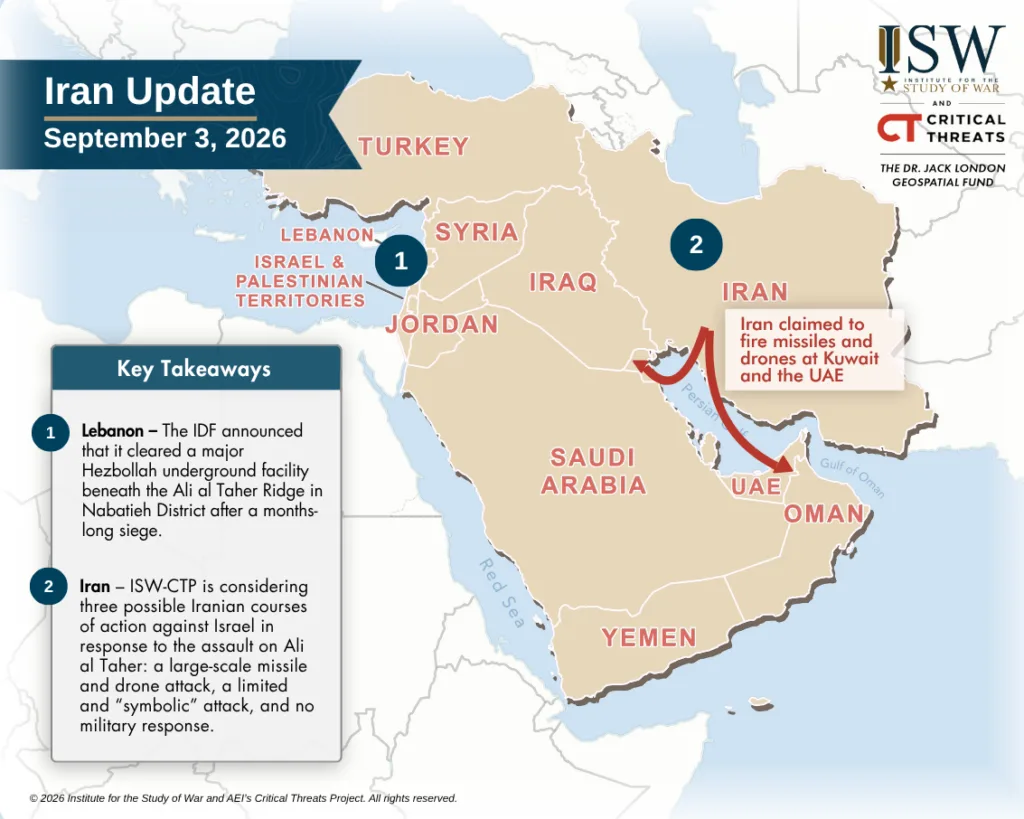
- The Iranian Artesh conducted a missile and drone attack targeting US bases in Kuwait and the United Arab Emirates on September 3, likely as part of the regime’s efforts to raise the costs of the US campaign against Iran. The latest Iranian strikes bear some similarity to a recent Iranian attack on Jordan that some Iranian military officials have claimed is reflective of a new Iranian targeting doctrine that reportedly includes preemptive strikes against US military assets in the region.
- The Israel Defense Forces (IDF) announced on September 3 that it cleared a major Hezbollah underground facility beneath the Ali al Taher Ridge in Nabatieh District after a months-long siege. Ali al Taher occupies advantageous terrain overlooking the Litani River and the neighboring Houla Valley, which enabled Hezbollah to target Israeli forces in southern Lebanon and civilian settlements in northern Israel.
- ISW-CTP is considering three possible Iranian courses of action against Israel in response to the assault on Ali al Taher: a large-scale missile and drone attack, a limited and “symbolic” attack, and no military response. Iranian officials reportedly warned the United States in mid-August 2026 that Iran would respond to any offensive to seize the Ali al Taher facility with a “large-scale attack” on Israel, according to unspecified regional sources speaking to Reuters. All courses of action rely upon the assumption that the reporting about the Iranian warning is accurate.
Toplines
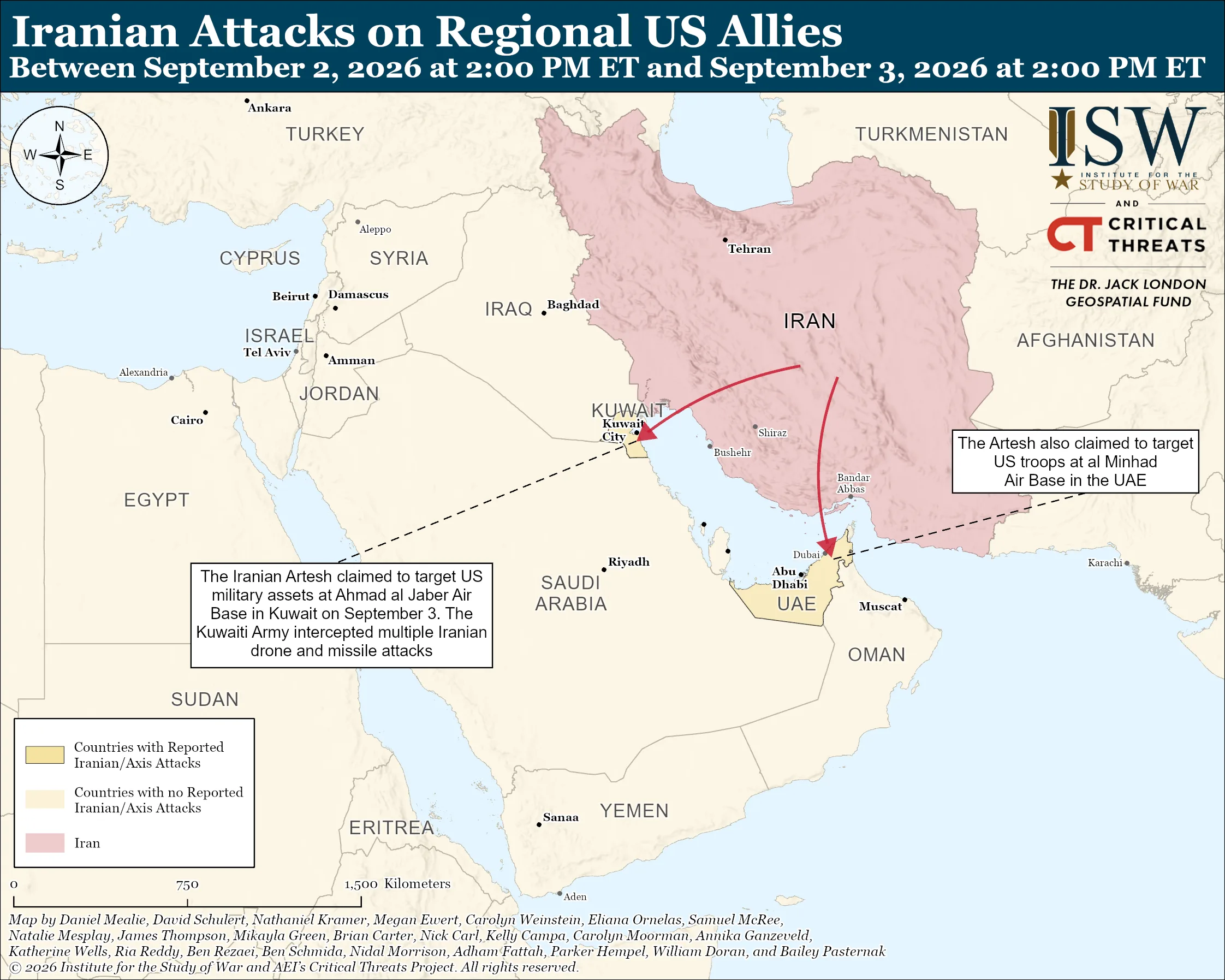
The Iranian Artesh conducted a missile and drone attack targeting US bases in Kuwait and the United Arab Emirates (UAE) on September 3, likely as part of the regime’s efforts to raise the costs of the US campaign against Iran.[1] The Artesh stated that its forces targeted satellite communications systems, equipment warehouses, and fighter aircraft hangars at Ahmad al Jaber Air Base in Kuwait.[2] The Artesh added that its forces also targeted troop positions and radar installations at al Minhad Air Base in the UAE.[3] An unspecified US defense official told anti-regime media on September 3 that the Iranian strikes did not impact any US bases.[4]
The latest Iranian strikes bear some similarity to a recent Iranian attack on Jordan that some Iranian military officials have claimed reflects a new Iranian targeting doctrine. Iran’s strikes on September 3 are a slight departure from the established pattern of tit-for-tat strikes between US and Iranian forces in recent weeks. Iranian forces targeted US bases in Kuwait, Jordan, Bahrain, and Iraq on September 2 in response to the most recent US strikes on Iranian coastal targets on September 1.[5] Iran’s most recent strikes in Kuwait and the UAE do not immediately follow additional strikes on US bases and thus represent a slight deviation from Iran’s typical attack pattern during the current phase of the war. Iran previously conducted a similar “surprise” attack against US forces in Jordan on July 28 after a four-day pause in strikes observed by both sides.[6] ISW-CTP assessed at the time that the regime likely calculated that inflicting US casualties or damage during such a pause could degrade US willingness to continue the conflict.[7] Iranian Artesh Spokesperson Brigadier General Mohammad Akraminia stated on August 26 that one of Iran’s newest targeting doctrines includes preemptive strikes against US military assets in the region and cited the July 28 attack in Jordan as an example of this doctrine.[8] The Artesh’s latest strikes in Kuwait and the UAE may also reflect this preemptive strike doctrine as part of the regime’s attempts to erode US willingness to continue the campaign against the regime.
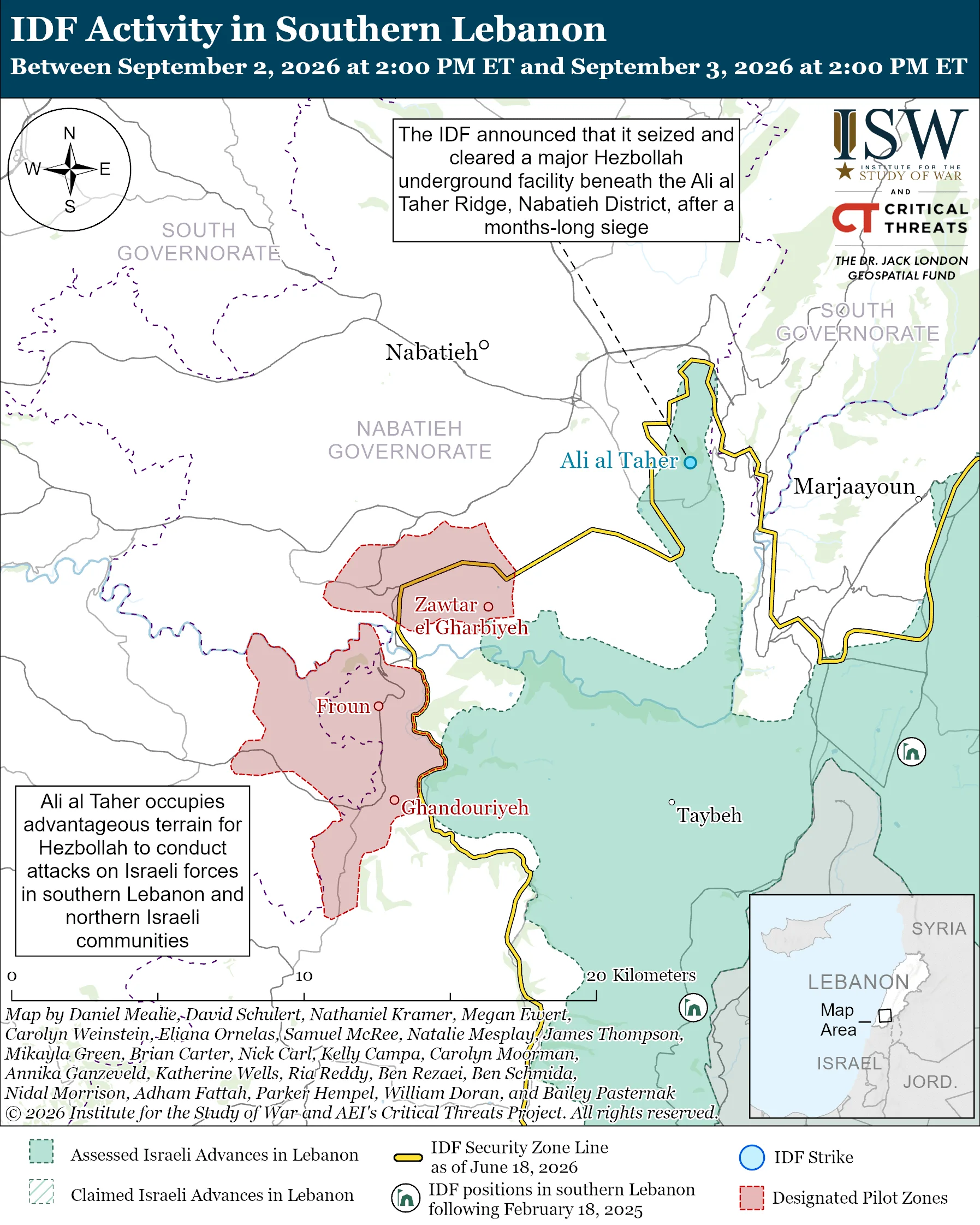
The Israel Defense Forces (IDF) announced on September 3 that it cleared a major Hezbollah underground facility beneath the Ali al Taher Ridge in the Nabatieh District after a months-long siege.[9] The IDF announced that 36th Armored Division forces killed many of the remaining Hezbollah fighters within the complex while others fled the vicinity.[10] The IDF surrounded Ali al Taher in late June 2026 and isolated the remaining Hezbollah forces in the underground facility for over two months.[11] Ali al Taher occupies advantageous terrain overlooking the Litani River and the neighboring Houla Valley that enabled Hezbollah to target Israeli forces in southern Lebanon and civilian settlements in northern Israel.[12] Unspecified regional sources told Reuters on September 3 that the IDF trapped at least 12 Iranian Islamic Revolutionary Guards Corps (IRGC) soldiers, including two senior officers, embedded with the Hezbollah contingent at Ali al Taher since June.[13] Israeli media, citing IDF assessments, reported on September 3 that no IRGC soldiers remain at the facility, however.[14] Neither Hezbollah nor the IRGC has officially acknowledged that the IDF has fully cleared the Ali al Taher facility as of this writing.
ISW-CTP is considering three possible Iranian courses of action (COAs) against Israel in response to the assault on Ali al Taher. Iranian officials reportedly warned the United States in mid-August 2026 that Iran would respond to any offensive to seize the Ali al Taher facility with a “large-scale attack” on Israel, according to unspecified regional sources speaking to Reuters.[15] Lebanese media reported on August 14 that Iran issued a warning similar to the one described by sources to Reuters.[16] All of the following COAs rely upon the assumption that the reporting about the Iranian warning is accurate.
- In a most dangerous COA, Iran conducts a large-scale missile and drone attack targeting Israel in the coming days or weeks designed to deter future Israeli attacks against Hezbollah. Iran nearly collapsed the ceasefire on June 7 by attacking Israel in order to retaliate for an Israeli airstrike that targeted a Hezbollah first-person view (FPV) drone command headquarters in Beirut’s southern suburbs.[17] The attack followed public Iranian warnings that any Israeli attack on Beirut would prompt an Iranian attack on Israel.[18] IRGC Commander Ahmad Vahidi — whom ISW-CTP continues to assess is playing an outsized role in decision-making — successfully pushed for Iranian military action against Israel in response to the IDF’s attack in Beirut’s southern suburbs in June.[19] ISW-CTP also assesses that Vahidi’s faction is willing to risk renewed conflict if doing so enables them to achieve their core objectives.[20] Iranian officials within this faction have previously treated the cessation of attacks on regional allies, including Hezbollah, as a core demand.[21] Senior Israeli officials told Israeli media on September 3 that Israeli decision-makers have not observed Iranian ”intention[s]” to attack Israel in the immediate term.[22]
- Iran conducts a limited, “symbolic” attack on Israeli military targets intended to demonstrate support for Hezbollah without risking a major US-Israeli combined force response. Iranian leaders may feel compelled to respond to the IDF’s clearing operations at Ali al Taher to demonstrate their willingness to protect the Axis of Resistance and strengthen the Axis’s deterrence against Israel and the United States, particularly amid current US, Israeli, and Lebanese efforts to disarm Hezbollah.[23] Iranian leaders may opt for a limited military response to achieve these effects, however, for a variety of reasons. Key Iranian decision-makers like Vahidi may see a symbolic strike on Israel that does not target major cities or civilian centers as a sufficient warning to Israel and the United States. These leaders might also consider a symbolic strike sufficient to respond to the IDF’s potential killing of IRGC soldiers at Ali al Taher.[24] Iranian leaders may also prefer a limited response that employs a small number of munitions due to the reported degradation of Iran’s ballistic missile capabilities following repeated combined force strikes on Iranian missile production sites, stockpiles, and launchers since at least February 2026.[25] ISW-CTP reported on September 2 that the roughly 50 percent reported failure rate of Iranian ballistic missiles fired at Jordan in recent days may reflect degraded longer-range missile capabilities, which are necessary for any Iranian attack on Israel.[26]
- Iran refrains from attacking Israel in order to avoid Israeli military action against Iran. Iranian leaders may calculate that the Ali al Taher facility is too militarily insignificant to warrant a military response that risks combined force strikes, a possible expansion of the current conflict, and increased risk of internal instability. Israeli Defense Minister Israel Katz announced on September 3 that Israel would target all kinds of Iranian infrastructure, including energy infrastructure sites, if Iran attacked Israel.[27] The Iranian regime has shown growing concern in recent weeks that its deteriorating economic conditions could trigger anti-regime protests.[28] Iranian leaders almost certainly recognize that Israeli strikes against critical infrastructure could further weaken the economy and increase the risk of domestic unrest as a result.
- Iran’s discreet warning to the United States may also merely reflect an Iranian effort to generate a purely informational effect that would compel the United States to restrict Israeli activity in Lebanon.[29] Regime officials have also not publicly threatened that Iran would respond militarily to an IDF offensive against Hezbollah at Ali al Taher. The lack of a public Iranian promise to attack Israel in the event of an IDF offensive at Ali al Taher could indicate that Iranian leaders sought to maintain plausible deniability and avoid committing to a renewed direct conflict with Israel.[30]
US and Partner Military Operations
Nothing significant to report.
Iranian Strike Campaign
Assessed Iranian War Aims:
- Secure international recognition of Iranian control over the Strait of Hormuz
- Degrade the US ability and willingness to continue the war
- Restore deterrence vis-à -vis the United States and its regional partners
- Divide the United States and Israel from the Arab states
See topline section.
US-Iran Negotiations
Nothing significant to report.
Iranian Domestic Affairs
Nothing significant to report.
Lebanon
The IDF returned a Lebanese detainee to Lebanese authorities on September 3 to advance Israel and Lebanon’s implementation of the June 26 Trilateral Framework, according to an unspecified Lebanese official speaking to Western media.[31] The IDF is expected to release four additional detainees in exchange for the remains of Jewish civilians and military personnel that Hezbollah killed.[32] The Trilateral Framework agreement does not require Israel and Lebanon to release prisoners, but this exchange could advance stalled progress in implementing the agreement.[33] Saudi media reported on September 3 that US, Israeli, and Lebanese delegations are expected to hold political talks in Rome in mid-September and separate military talks at the US Central Command (CENTCOM) headquarters in Tampa, Florida at an unspecified date.[34]
Iraq
An Iraqi Federal Court sentenced three individuals to fifteen years in prison on September 3 for their participation in a March 13 rocket attack against Iraqi and French forces at the K1 base in Kirkuk Province.[35] US forces handed over the K1 base to the Iraqi government in 2020.[36] French forces have remained at the K1 base since at least 2023 to advise and support Iraqi counterterrorism forces as part of Operation Inherent Resolve.[37] The affiliation of the sentenced individuals is unclear. Likely Iranian-backed Iraqi militia front group Kataib Sarqhat al Quds threatened on March 13 to strike French forces at the K1 base, however.[38] The likely front group’s threat also came after a likely militia drone struck and killed one French soldier and injured six others in Erbil on March 12.[39] The Iraqi Judiciary has sentenced multiple Iranian-backed Iraqi militia-affiliated individuals in recent days for attacks and activities conducted since March 2026.[40]
The Iraqi Kurdistan Counter Terrorism Service reported that coalition forces intercepted 10 drones that an unspecified actor launched over Erbil, Iraqi Kurdistan, on September 3.[41] Security sources told Iraqi media that the drones were not targeting the US Consulate or US bases in Erbil when coalition air defenses intercepted the drones.[42] No actor has claimed responsibility for the attack as of this writing. Iranian-backed Iraqi militias have launched numerous attacks against US positions in Iraqi Kurdistan in March and April 2026.[43] Iran has also repeatedly launched drone and missile strikes targeting US forces in Erbil and Iranian Kurdish opposition groups in Iraqi Kurdistan.[44]
Arabian Peninsula
Nothing significant to report.

[1] https://t.me/iribnews/359507
[2] https://t.me/iribnews/359507 ; https://x.com/KuwaitArmyGHQ/status/2095324773253341615?s=20
[3] https://t.me/iribnews/359507
[4] https://www.iranintl.com/en/202609033124
[5] https://t.me/farsna/459656 ; https://x.com/CENTCOM/status/2094916573920199143?s=20
[6] https://x.com/CENTCOM/status/2082231500318114110?s=20
[7] https://understandingwar.org/research/middle-east/iran-update-special-report-july-29-2026/
[8] https://www.mehrnews dot com/news/6926950
[9] https://x.com/IDF/status/2095569785522360508?s=20 ; https://x.com/CaptainElla1/status/2095566303587369429?s=20
[10] https://x.com/CaptainElla1/status/2095566303587369429?s=20
[11] https://www.nytimes.com/2026/06/24/world/middleeast/israel-lebanon-hezbollah-fighters-tunnels.html
[12] https://www.reuters.com/world/middle-east/ali-al-taher-ridge-emerges-flashpoint-israel-hezbollah-war-2026-09-03/
[13] https://www.reuters.com/world/middle-east/iran-warns-us-against-israeli-attack-south-lebanon-ridge-held-by-hezbollah-2026-09-03/
[14] https://www.maariv dot co.il/news/military/article-1362297?dicbo=v2-CjWPnsu
[15] https://www.reuters.com/world/middle-east/iran-warns-us-against-israeli-attack-south-lebanon-ridge-held-by-hezbollah-2026-09-03/
[16] https://www.ynetnews dot com/article/rkhatj6ife#google_vignette
[17] https://x.com/IsraeliPM_heb/status/2063595227927941407?s=20 ; https://x.com/manniefabian/status/2063908738772152639?s=20 ; https://understandingwar.org/research/middle-east/iran-update-special-report-june-8-2026/
[18] https://t.me/presstv/192252
[19] https://www.wsj.com/world/middle-east/the-iranian-enforcer-driving-tehrans-hard-bargaining-with-the-u-s-b848e67c?msockid=31724c4845486561027c583141486b0b
[20] https://understandingwar.org/research/middle-east/iran-update-special-report-august-17-2026/
[21] https://understandingwar.org/research/middle-east/iran-update-special-report-august-8-2026/ ; https://understandingwar.org/research/middle-east/iran-update-special-report-june-20-2026/
[22] https://www.ynet dot co.il/news/article/b1bhabvozg
[23] https://www.state.gov/releases/office-of-the-spokesperson/2026/06/trilateral-framework-between-the-united-states-of-america-the-state-of-israel-and-the-republic-of-lebanon/
[24] https://x.com/IDF/status/2095569785522360508?s=20 ; https://www.reuters.com/world/middle-east/iran-warns-us-against-israeli-attack-south-lebanon-ridge-held-by-hezbollah-2026-09-03/
[25] https://understandingwar.org/research/middle-east/applying-us-air-warfare-theory-and-doctrine-to-evaluate-the-campaign-against-iran-part-ii-iranian-missile-forces/ ; https://www.axios.com/2026/09/02/iran-tankers-hormuz-attacks-oil ; https://www.wsj.com/livecoverage/israel-iran-strikes-live-coverage/card/many-iranian-missiles-failed-to-launch-or-crashed-before-striking-target-u-s-officials-say-TCd4YP2fiODhl1t9QDrL
[26] https://understandingwar.org/research/middle-east/iran-update-september-2-2026/
[27] https://www.timesofisrael dot com/liveblog_entry/katz-if-iran-attacks-israel-will-be-free-from-all-constraints-and-strike-energy-infrastructure/
[28] https://understandingwar.org/research/middle-east/iran-update-august-31-2026/ ; https://understandingwar.org/research/middle-east/iran-update-august-27-2026/
[29] https://www.reuters.com/world/middle-east/iran-warns-us-against-israeli-attack-south-lebanon-ridge-held-by-hezbollah-2026-09-03/
[30] https://t.me/presstv/192252 ; https://x.com/ir_rezaee/status/2063703451897352255 ; https://understandingwar.org/research/middle-east/iran-update-special-report-june-2-2026 ; https://understandingwar.org/research/middle-east/iran-update-special-report-june-1-2026/
[31] https://apnews.com/article/lebanon-israel-prisoner-malek-ghazi-release-hezbollah-bfe8abeb4f713332a543e23dd9d2bba5
[32] https://www dot ynetnews.com/article/ryajg7p00fl
[33] https://www.state.gov/releases/office-of-the-spokesperson/2026/06/trilateral-framework-between-the-united-states-of-america-the-state-of-israel-and-the-republic-of-lebanon/ ; https://understandingwar.org/research/middle-east/iran-update-august-28-2026/
[34] https://www.alhadath dot net/2026/09/03/مصادر-للعربية-لا-انسحابات-اسرائيلية-اضافية-في-جنوب-لبنان-ولا-اتفاق-على-المراقبين
[35] https://shafaq dot com/ar/أمـن/السجن-15-سنة-لثلاثة-دينوا-ب-طلاق-صواريخ-كاتيوشا-على-معسكر-K1-بكركوك ; https://rudaw dot net/sorani/categories/kurdistan/1869545
[36] https://www.mideastcenter.org/post/the-us-led-coalition-has-now-left-three-bases-in-iraq-qaim-q-west-and-k-1
[37] https://www.france24 dot com/en/live-news/20230829-%F0%9F%94%B4-french-special-forces-soldier-killed-in-anti-terror-operation-in-iraq-on-monday-french-presidency
[38] https://t.me/aishab_alkahf/483
[39] https://x.com/ariel_oseran/status/2032257902489075975
[40] https://x.com/shellykittleson/status/2094408178041565646 ; https://www.alaraby.co dot uk/politics/العراق-السجن-لعنصرين-من-كتائب-حزب-الله-لمهاجمتهما-السفارة-الأميركية ; https://x.com/husham_ali1/status/2094459970536226820
[41] https://almadapaper dot net/451236/
[42] https://almadapaper dot net/451236/