
Toplines
North Korean rhetoric is increasingly referencing nuclear weapons development in a way that reflects North Korea’s evolving nuclear strategy, which is aimed at limiting US options for intervention during a potential Korean Peninsula contingency. Director of the Workers’ Party of Korea (WPK) General Affairs Department Kim Yo Jong, sister of WPK General Secretary Kim Jong Un, denounced the United States, South Korea, and Japan on September 17 for participating in the Pacific Vanguard 2026 multilateral exercise. Kim Yo Jong described the US-led military exercise as reaching “new levels of hostility” and warned that North Korea would respond proportionally to this perceived act of aggression.[1] Kim Yo Jong reaffirmed North Korea’s commitment to strengthening its nuclear “deterrent” and threatened to invoke constitutional provisions if US actions seriously violated North Korea’s “supreme interests” or military sovereignty.[2] The North Korean constitution defines the conditions that would allow North Korea to conduct a nuclear first strike. These stated conditions include attacks on North Korea by weapons of mass destruction, attacks on North Korean leadership or key strategic targets, operational necessity to prevent further escalation, and other threats to state survival or public safety.[3] The South Korean Ministry of Unification (MOU) said on September 18 that North Korea issued no reaction following the Pacific Vanguard combined exercises in 2024 and 2025, and had only responded through state media after previous exercise iterations. Kim Yo Jong’s response to Pacific 2026 therefore reflects a more forceful and emphatic rejection of US, South Korean, and Japanese activity than previously observed.
This rhetoric signals that North Korea may seek to limit US and allied strategic military options on the Korean Peninsula by warning of potential nuclear escalation if its red lines are crossed. North Korea’s nuclear strategy has increasingly focused on preventing US intervention during a conflict by threatening uncontrollable escalation to make US decision-making more costly and difficult instead of threatening to impose unacceptable costs, which is a less realistic option against powerful states like the United States. North Korean threats of nuclear retaliation even during a limited conflict could result in an escalation dilemma in Washington, complicating US efforts to support South Korea during a conflict. North Korea may continue suggesting that it will lower the threshold of nuclear use to undermine allied military coordination and deterrence against North Korea’s nuclear threats.
North Korea may be transitioning its tactical firepower away from mass tube artillery toward a mix of unmanned systems and precision strike systems. North Korea may be aiming to emulate the tactical realities displayed in modern conflicts. WPK General Secretary Kim Jong Un visited several North Korean military production facilities between September 16 and 18.[4] North Korean state media released images showing North Korea’s 600 mm multiple launch rocket systems (MLRS), 240 mm modular missile launchers, and several variants of unmanned aerial vehicles (UAV).[5] Kim stated during his visits that North Korea should enhance the integration of artificial intelligence (AI) into offensive and defensive systems while improving the armor and automation of its artillery.[6] Kim highlighted the importance of artillery in North Korea’s warfighting strategy, stating that the North would be able to “gradually” wear down an enemy’s defense capabilities with its new systems.[7]
North Korean state media’s decision to highlight long-range rocket artillery and unmanned systems may reflect a changing role for North Korea’s artillery arm. North Korea has traditionally relied on large amounts of inaccurate tube artillery systems to provide overwhelming tactical firepower for its frontline forces to enable offensive operations.[8] North Korea has increasingly been showcasing and fielding long-range precision missile and rocket systems with its artillery, however.[9] These systems are more suited to operational and strategic-level strikes in the enemy’s rear rather than frontline tactical support due to their range, accuracy, and smaller amount of munitions.
These shifts may reflect North Korean efforts to integrate certain lessons from the war in Ukraine. Unmanned systems have increasingly performed tactical-level fire support, accounting for the majority of battlefield casualties, although traditional artillery systems have not receded from this role entirely.[10] North Korea will likely retain large amounts of tube artillery systems, but may increase the role unmanned systems play in providing tactical firepower for frontline units. This would allow North Korea to develop artillery units that are specialized for precision strikes against high-value targets in the enemy’s rear, such as key logistics nodes, command and control posts, or South Korean population centers. North Korea’s precision strike complex likely faces several key limitations, including a lack of military satellites and demonstrated missile accuracy, that will limit its effectiveness, however.[11]
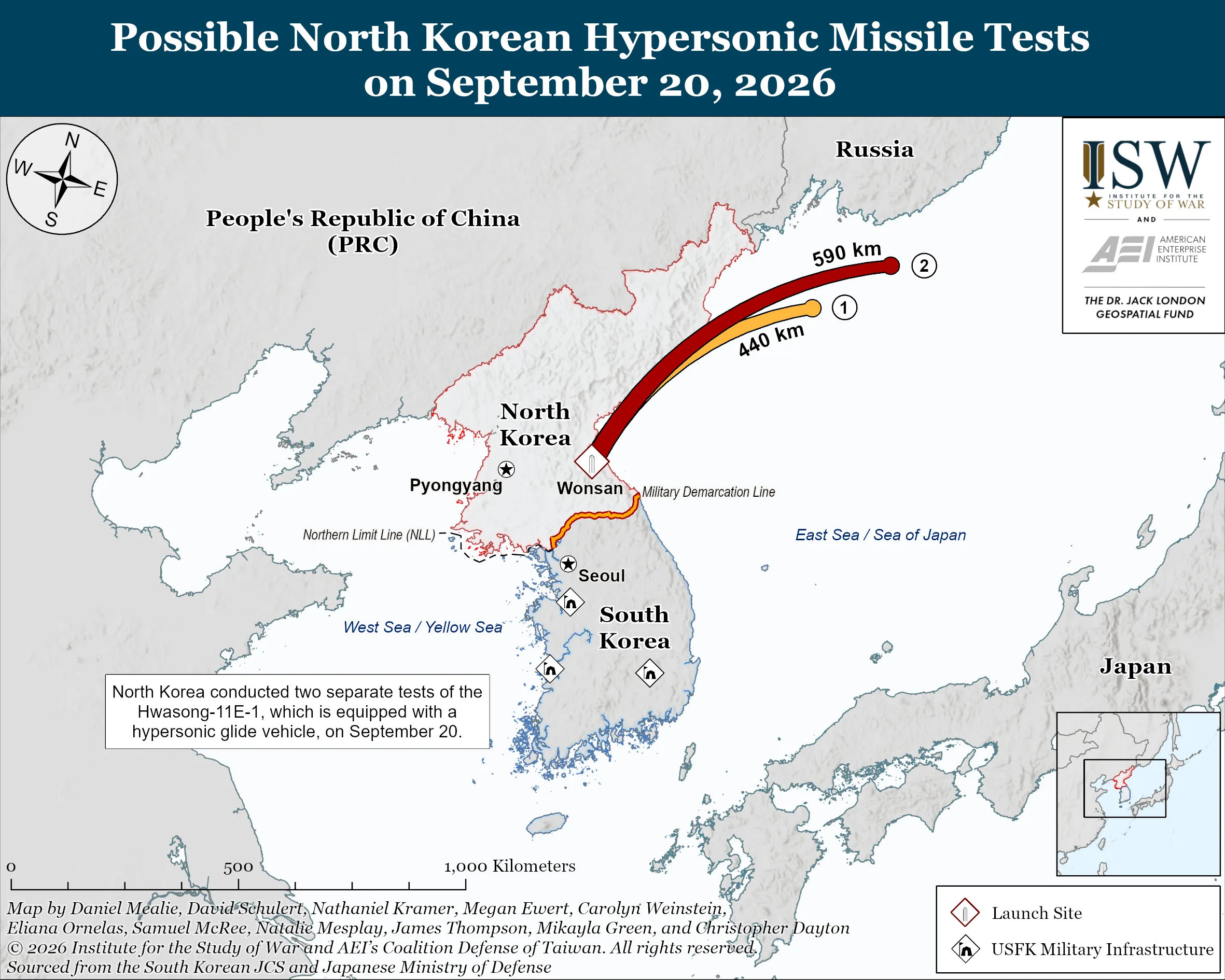
North Korea may have tested a hypersonic weapon during its September 20 missile tests. North Korea could use hypersonic munitions to improve its ability to penetrate South Korea’s integrated air and missile defense (IAMD) network. North Korean state media released images on September 22 of its September 20 missile tests that showed a missile equipped with a hypersonic glide vehicle (HGV).[12] The missile is likely the Hwasong-11E-1, an upgraded variant of a missile that North Korea revealed in October 2025.[13] North Korean state media reported that WPK General Secretary Kim Jong Un described the test as a demonstration of “ultra-modern defense technology” and stated that the acquisition of this technology was of “weighty significance” for North Korea’s military readiness.[14] A HGV is designed to travel at speeds above Mach 5 at low altitudes while being able to maneuver significantly in flight.[15] These characteristics make HGVs significantly harder to intercept than ballistic missiles that follow predictable trajectories and cruise missiles that travel at far slower speeds.[16]
North Korea is likely pursuing hypersonic technology to improve its ability to penetrate South Korea’s IAMD network. Images released by North Korean state media showed the HGV maneuvering while flying, changing its altitude periodically.[17] This capability could complicate South Korean detection and interception efforts, although neither the South Korean Joint Chiefs of Staff (JCS) nor the Japanese Ministry of Defense reported in-flight maneuvers in their summaries of the tests.[18] Metrics for missile range, apogee, and time to target also differed between North Korean and South Korean reporting.[19] It is therefore unclear whether North Korea has genuinely demonstrated an operational HGV capability or is seeking to publicize its possession of an HGV warhead to create the perception that it is operational.
Hypersonic technology remains nascent even within advanced militaries, and North Korea may have to rely on foreign support to advance this capability. The People’s Republic of China (PRC) publicized a test of its DF-ZF HGV for the first time in June 2026.[20] The DF-ZF HGV can be mounted on the DF-17 medium-range ballistic missile.[21] The PRC has been developing HGV technology for several years and may be able to provide relevant expertise to North Korea.[22] It is not clear whether the PRC is willing to aid North Korea with cutting-edge technology like HGVs at this time, however.
Key Takeaways
- North Korean Nuclear Rhetoric: North Korean nuclear rhetoric is increasingly threatening escalation and retaliatory strikes if the United States crosses one of its “red lines.” North Korea is likely seeking to deter United States intervention during a conflict on the Korean Peninsula by threatening uncontrollable escalation and imposing increasingly high costs on the United States.
- North Korean Military Development: North Korea appears to be increasingly focusing on transitioning to unmanned and precision strike systems and away from more inaccurate tube artillery systems. This transition would provide a greater tactical firepower advantage for North Korean forces, enabling offensive operations and overcoming existing weaknesses in North Korea’s precision strike complex.
- North Korean Hypersonic Weapons: North Korea may have tested a hypersonic glide vehicle during its September 20 missile test. North Korea is likely pursuing hypersonic weapons systems to improve its ability to penetrate South Korea’s integrated air and missile defense network, as hypersonic glide vehicles are significantly harder to intercept than ballistic missiles. Hypersonic technologies remain nascent within even the most advanced militaries, so North Korea may require foreign assistance to advance its hypersonic technology.
North Korean Domestic Politics
Nothing significant to report.
North Korean Military Developments
North Korea appears to be gaining information about cutting-edge defense technologies — such as unmanned and counter-unmanned systems — from the PRC. North Korean state media reported on September 18 that a North Korean military delegation led by Vice Defense Minister Kim Kang Il attended the 14th China International Defense Electronics Exhibition (CIDEX) between September 15 and 17.[23] The CIDEX is a PRC-hosted biennial weapons exhibition. The event displayed around 1,000 pieces of military equipment, including unmanned combat systems, counter-unmanned systems, communications and information security technology, commercial aerospace systems, underwater systems, and optoelectronics technology.[24]
North Korea will likely attempt to collect information on emerging defense technologies, particularly unmanned and counter-unmanned systems, to improve its domestic manufacturing capabilities. The South Korean military confirmed that the North Korean drones infiltrating South Korean airspace between 2014 and 2017 were based on modified or replicated designs and platforms of PRC-origin commercial drones.[25] A South Korean expert also assessed on September 19 that North Korea’s new large drone has a design similar to the PRC’s Wing Loong-series drones based on photos released by North Korean state media on September 19.[26] ISW-CDOT cannot independently verify this claim because North Korea released blurred photos. North Korean military officials have attended foreign weapons exhibitions more publicly in recent years, despite United Nations Security Council (UNSC) Resolution 1718 prohibiting member states from such engagement. WPK Munitions Industry Department First Vice Director Kim Jong Sik attended Russia’s “ARMY” weapons exhibition in 2024.[27] North Korean state media explicitly reported that a delegation from the Ministry of National Defense attended CIDEX but did not disclose the delegation’s size or the names and ranks of its members.
North Korea is attempting to pursue sanctions evasion to generate illicit revenue by dispatching workers to a number of states, including Russia and the PRC. North Korea is also likely seeking to exploit the knowledge gained by some overseas workers to advance its weapons manufacturing and modernization. The Multilateral Sanctions Monitoring Team (MSMT), a mechanism responsible for monitoring and reporting North Korean sanctions violations, reported on September 16 that North Korea dispatched workers across 17 nations, including Russia and the PRC, generating an estimated $450 million to $800 million in 2025.[28] These funds were very likely used for North Korean military modernization efforts. The report assessed that Russia hosted approximately 15,000 to 30,000 North Korean workers in 2025, an increase of up to 8,000 workers compared to 2024.[29] The MSMT identified North Korean workers in Russian defense factories manufacturing munitions, steel, and drones.[30] US think tank the Center for Strategic and International Studies reported in March that Russian authorities were expanding housing compounds around the drone facility in Russia’s Alabuga Special Economic Zone to accommodate incoming North Korean workers.[31] The MSMT also stated that the majority of North Korean workers have been issued student visas to evade UNSC Resolution 2375, which prohibits overseas employment of North Korean nationals.[32] A North Korean Ministry of Foreign Affairs (MFA) spokesperson denounced the MSMT report on September 21 as a “fabricated announcement,” and defended North Korean worker dispatches as legitimate international exchange.[33]
Pyongyang very likely uses overseas labor deployments not only as a means to generate illicit revenue for weapons development, but also to accelerate domestic arms production by leveraging workers’ manufacturing experiences. WPK General Secretary Kim Jong Un ordered the modernization of industrial production lines, expansion of artillery production, and an increase in overall manufacturing volume during his visits to North Korean munitions factories throughout 2026.[34] Kim’s directives align with the strategic priorities Kim emphasized during the WPK’s Ninth Party Congress in February, which urged transformation of the Korean People’s Army (KPA) into a high-tech military force.[35] North Korea appears focused on modernizing its manufacturing lines based on Russian assembly workflows to reach North Korea’s own domestic manufacturing goals.
North Korean Foreign Relations
North Korea and the PRC are strengthening exchanges and cooperation between their militaries to jointly oppose US extended deterrence and military alliances in the Indo-Pacific region. North Korean Vice Defense Minister Kim Kang Il met with PRC Defense Minister Dong Jun in Beijing on September 17 during the 13th Beijing Xiangshan Forum. The forum is widely known as the PRC’s alternative to the Western-led Shangri-La Dialogue. The PRC commonly uses the forum to promote its strategic agenda, such as Chinese Communist Party (CCP) General Secretary Xi Jinping’s foreign policy framework, the “Four Global Initiatives,” an alternative global governance and cooperation framework intended to center the strategic interests of “Global South” countries. North Korean state media reported that Kim and Dong agreed to expand cooperation and strengthen coordination on the global stage to oppose “hegemony, power politics, and tendencies toward neo-militarism.”[36]
Kim denounced the United States and US allies for destabilizing regional security through bilateral and trilateral combined exercises, describing the arrangements as reflective of a “nuclear alliance.”[37] Kim claimed that the United States is considering deploying tactical nuclear weapons near North Korea as part of a new US nuclear strategy.[38] Kim said that US military activities in the region provide justification for North Korea to increase its nuclear capabilities.[39]
Kim’s attendance at the Xiangshan Forum marks the first attendance of a North Korean high-level official at the forum in seven years. A North Korean defense minister attended the forum in 2018 and 2019.[40] North Korea’s in-person participation halted during the COVID-19 pandemic from 2020 to 2023, and a defense attaché from the North Korean Embassy in the PRC has attended the forum since 2024.[41] North Korea’s senior-level participation follows Xi and WPK General Secretary Kim Jong Un’s June 2026 agreement to expand bilateral military exchanges. North Korea will likely seek to use PRC-hosted forums to attack US nuclear-sharing with its allies, especially South Korea.
A delegation of PRC government and military officials visited North Korea from September 14 to 18, the first such visit since 2019. PRC state media reported that the PRC Ministry of Veterans Affairs Department of Commendation and Commemoration and Department of International Cooperation deputy director Li Jingxian led the 48-member delegation of “outstanding young cadres” from central CCP and PRC state organs, the People’s Liberation Army (PLA), and provincial and municipal government offices.[42] The PRC sent similar delegations of young cadres to North Korea in 2018 and 2019.[43] North Korea closed its border with the PRC from 2020 to 2023 due to the COVID-19 pandemic. North Korean-PRC trade and diplomatic engagement remained in relative decline until WPK General Secretary Kim Jong Un attended the PRC’s 80th Victory over Japan military parade in Beijing in September 2025 and met with CCP General Secretary Xi Jinping.[44] This meeting marked a turning point in PRC-North Korea relations, after which bilateral engagement has steadily increased.
The PRC delegation visited sites commemorating the participation of PRC People’s Volunteer Army (PVA) troops in the Korean War.[45] PRC state media reported that the delegation “expressed its determination” to “cherish and safeguard the hard-won peaceful environment, and to carry forward the great spirit of resisting the United States and aiding Korea.”[46] PRC and North Korean state media emphasized historical military cooperation between the two countries during the Korean War.[47]
North Korea will likely continue to deepen its diplomatic ties with the PRC to further its economic, diplomatic, and military objectives. North Korea may also seek to balance its relationship with Russia and the PRC to avoid becoming overly dependent on either country.[48] The PRC appears to have abandoned its long-held position of formally supporting North Korean denuclearization since September 2025, omitting references to denuclearization in diplomatic settings and government documents.[49]
North Korean Cognitive Warfare
North Korean coalition-building efforts to counter international calls for denuclearization are increasingly dismantling global nonproliferation norms. International Atomic Energy Agency (IAEA) member states adopted a resolution during a General Conference from September 14 to 18 that reaffirmed that North Korea is not recognized as a nuclear weapons state under the Nuclear Non-Proliferation Treaty (NPT).[50] South Korean media outlet Yonhap News Agency reported that Russia and the PRC voted against the resolution.[51] Director of the General Affairs Department of the WPK Kim Yo Jong rejected the IAEA’s call for North Korean denuclearization on September 17.[52] Kim described the IAEA’s efforts as futile and stated that North Korea would take all necessary measures to defend its “supreme interests,” referring to its nuclear weapons development.[53] North Korea is also seeking to expand foreign support for its nuclear status by pressuring countries to abandon denuclearization demands as a condition for diplomatic engagement. Russia has expressed support for North Korea’s nuclear forces.[54] A Russian representative to the IAEA criticized an IAEA report on North Korea’s nuclear facilities for being unreliable on September 10, due to the IAEA’s lack of access to North Korean facilities.[55] The PRC, meanwhile, has refrained from publicly referencing denuclearization since CCP General Secretary Xi Jinping’s September 2025 summit with WPK General Secretary Kim Jong Un.[56] North Korea has sought to institutionalize Russian and PRC support for its security positions through reciprocal diplomatic backing in international forums.[57] These North Korean efforts reflect the regime’s increasingly explicit assertion that its nuclear program is irreversible, which may complicate US efforts to resume negotiations with North Korea, as the United States has maintained its North Korean denuclearization policy.[58]
Inter-Korean Relations
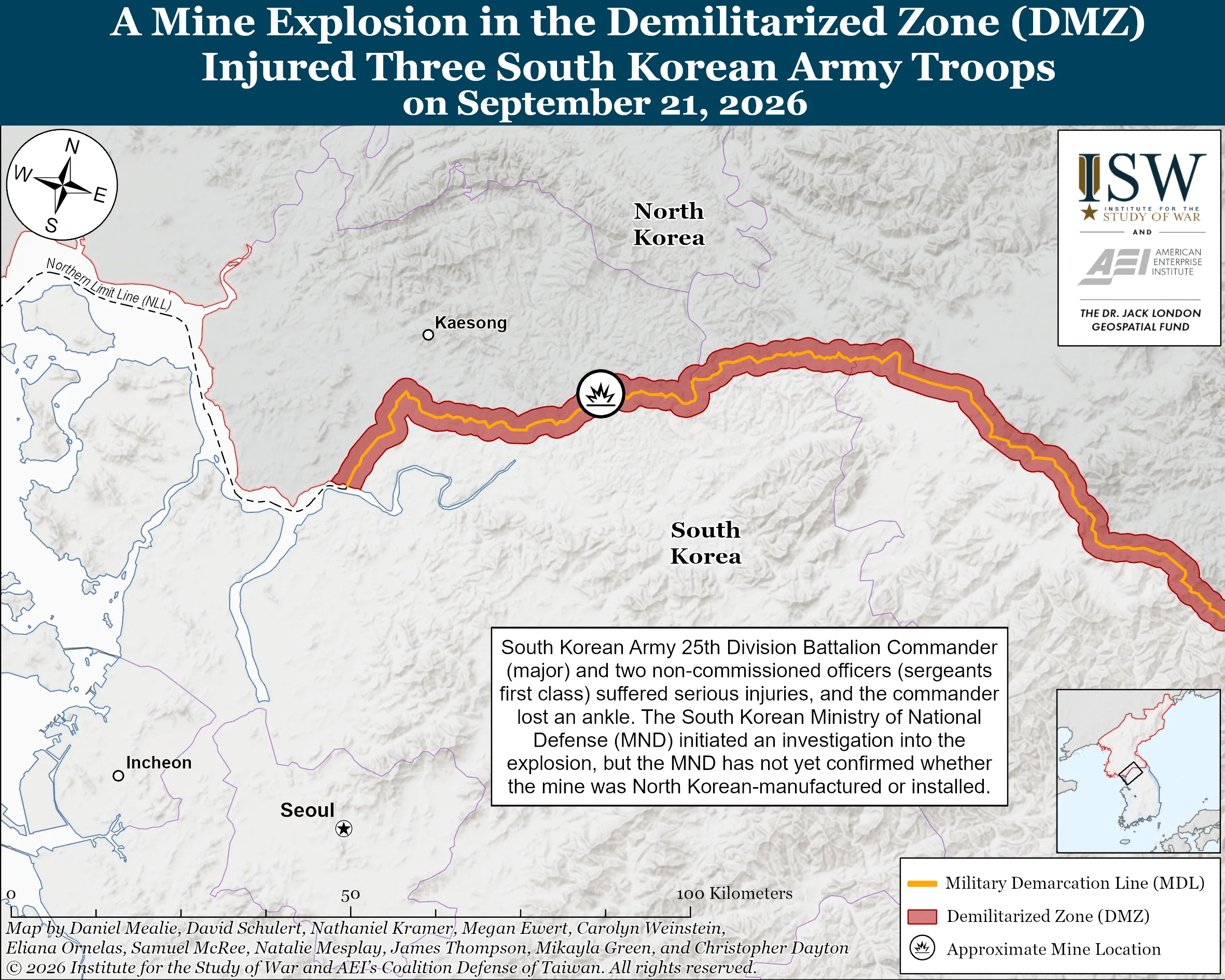
The Lee Jae Myung administration’s dialogue-oriented North Korea policy could shift due to growing public calls for tougher responses to North Korea after a landmine explosion near the Military Demarcation Line (MDL). A landmine exploded on September 21 near Paju and Yeonchon, South Korea, while soldiers from the South Korean 25th Infantry Division were conducting a route-clearing operation. The explosion injured three military officers. The South Korean JCS said the troops were establishing a new search route to investigate an area suspected of containing North Korean landmines near the MDL ahead of a planned UN Command terrain inspection.[59] South Korean military authorities are investigating whether the explosion was caused by a North or South Korean landmine or another explosive device.[60] South Korean opposition People Power Party (PPP) lawmaker Yoo Yong-won raised the possibility that a North Korean mine caused the explosion during a September 21 press conference, citing reports that the accident occurred near an area where North Korean troops had allegedly laid mines, and called for a thorough investigation into the explosive’s origin.[61]
North Korea has conducted border fortification activities near the MDL since 2024, including installing barriers and laying landmines.[62] Yoo previously claimed on September 10 that North Korean-built minefields and other structures extended 10 to 15 meters south of the MDL at six locations amid ongoing border fortification activities.[63] North Korean troops also reportedly crossed the MDL more than 20 times in the month preceding the September 21 explosion.[64] The explosion could intensify domestic scrutiny of the Lee administration’s “peaceful coexistence” policy toward North Korea if the mine is confirmed to be of North Korean origin.
South Korean Domestic Politics
South Korean President Lee Jae Myung clarified that South Korea would restrict its military role in Iran to support operations to mitigate his declining popularity ratings — amid intensifying domestic controversy surrounding Lee’s consideration of troop deployment to the Strait of Hormuz. Lee stated during a September 18 press conference that he had ruled out South Korea’s direct participation in the war in Iran but signaled the possibility of deploying secondary support assets to the Strait of Hormuz.[65] Lee specifically proposed extending the operational zone of the South Korean Navy’s Cheonghae Unit from the Gulf of Aden toward the Strait of Hormuz.[66] The South Korean Ministry of Foreign Affairs (MOFA) previously stated on August 18 that Seoul was evaluating contribution options following requests from US President Donald Trump.[67] The South Korean Ministry of National Defense (MND) consequently dispatched a fact-finding team to the United Arab Emirates (UAE) on September 8 to assess theater security conditions.[68] Lee’s prolonged ambiguity on the scope and operational framework of potential troop deployment provoked domestic criticism and likely helped contribute to Lee’s declining approval ratings. ISW-CDOT assessed that Lee likely faces significant domestic political pressure fueled by growing opposition to the deployment.[69]
Lee could hope to limit political fallout and accommodate Washington’s burden-sharing demands by proposing an indirect South Korean operational presence. The Lee administration appears intent on aligning with the Trump administration’s call for “strategic flexibility” by expanding South Korea’s regional security role. Seoul also likely hopes to maintain positive relations with Washington to accelerate negotiations on joint development and acquisition of nuclear-powered attack submarines (SSNs), the transfer of wartime operational control (OPCON), and bilateral trade. Lee’s deployment proposal still requires ratification from the National Assembly, which may prove difficult given domestic opinion on the matter.
Counter-North Korean Coalition Building Efforts
Nothing significant to report.

[1] https://www.yna.co dot kr/view/AKR20260918010300504
[2] https://www.yna.co dot kr/view/AKR20260918010300504
[3] https://www.sejong dot org/web/boad/1/egoread.php?bd=2&itm=&txt=&pg=1&seq=6772
[4] https://www.nknews.org/2026/09/kim-jong-un-inspects-weapons-factories-calls-for-ai-and-automation-upgrades/
[5] https://www.nknews.org/2026/09/kim-jong-un-inspects-weapons-factories-calls-for-ai-and-automation-upgrades/
[6] https://kcnawatch.org/newstream/1789781584-417831853/%ea%b9%80%ec%a0%95%ec%9d%80%ec%b4%9d%eb%b9%84%ec%84%9c-%ea%b5%ad%eb%b0%a9%ea%b3%b5%ec%97%85%eb%b6%80%eb%ac%b8%ec%9d%98-%ec%82%ac%ec%97%85%ec%9d%84-%ec%a7%80%eb%8f%84/
[7] https://kcnawatch.org/newstream/1789781584-417831853/%ea%b9%80%ec%a0%95%ec%9d%80%ec%b4%9d%eb%b9%84%ec%84%9c-%ea%b5%ad%eb%b0%a9%ea%b3%b5%ec%97%85%eb%b6%80%eb%ac%b8%ec%9d%98-%ec%82%ac%ec%97%85%ec%9d%84-%ec%a7%80%eb%8f%84/
[8] https://armypubs.army.mil/epubs/DR_pubs/DR_a/ARN30043-ATP_7-100.2-000-WEB-2.pdf
[9] https://understandingwar.org/research/china-taiwan/korean-peninsula-update-august-19-2026/
[10] https://www.csis.org/analysis/russian-blood-and-treasure-ballooning-costs-putins-war
[11] https://www.reuters.com/world/asia-pacific/south-korea-says-retrieves-wreckage-north-korean-spy-satellite-2023-07-05/; https://www.38north.org/2026/08/the-kn-23-goes-to-war-has-it-improved-north-koreas-missiles/
[12] https://www.nknews.org/2026/09/north-korea-tested-new-hypersonic-missile-on-sunday-state-media/
[13] https://www.nknews.org/pro/all-the-weapons-on-display-at-north-koreas-2025-arms-expo/
[14] https://kcnawatch.org/newstream/1790026619-253373550/dprk-missile-administration-tests-new-important-combat-weapon-system/
[15] https://www.congress.gov/crs-product/IF11459
[16] https://www.congress.gov/crs-product/IF11459; https://digitalcommons.odu.edu/mae_etds/324/
[17] https://www.nknews.org/2026/09/north-korea-tested-new-hypersonic-missile-on-sunday-state-media/
[18] https://abcnews.com/International/north-korea-test-launches-ballistic-missile-south-korea/story?id=136596851; https://www.reuters.com/world/asia-pacific/north-korea-fires-missile-off-east-coast-yonhap-says-2026-09-20/
[19] https://www.nknews.org/2026/09/north-korea-tested-new-hypersonic-missile-on-sunday-state-media/
[20] https://understandingwar.org/research/china-taiwan/china-taiwan-update-june-26-2026/
[21] https://understandingwar.org/research/china-taiwan/china-taiwan-update-june-26-2026/
[22] https://gjia.georgetown.edu/conflict-security/chinas-hypersonic-weapons/
[23] https://kcnawatch.org/newstream/1789679144-781415304/%ec%a1%b0%ec%84%a0%eb%af%bc%ec%a3%bc%ec%a3%bc%ec%9d%98%ec%9d%b8%eb%af%bc%ea%b3%b5%ed%99%94%ea%b5%ad-%ea%b5%ad%eb%b0%a9%ec%84%b1%eb%8c%80%ed%91%9c%eb%8b%a8-%ec%a0%9c%ef%bc%91%ef%bc%93%ec%b0%a8/
[24] https://www.bastillepost dot com/global/article/6164935-unmanned-systems-take-spotlight-at-china-intl-expo-for-defense-electronics
[25] https://news.kbs.co dot kr/news/pc/view/view.do?ncd=4292240
[26] https://www.yna.co.kr/view/AKR20260919012351504?section=nk/news/all
[27] https://imnews.imbc dot com/replay/2024/nwtoday/article/6628128_36523.html
[28] https://msmt.info/view/save/2026/09/16/1c62aba4-000e-4079-90fb-971b7fd7ad2e-The_DPRK_Use_of_Overseas_Labour_to_Violate_and_Evade_UN_Sanctions.pdf
[29] https://msmt.info/view/save/2026/09/16/1c62aba4-000e-4079-90fb-971b7fd7ad2e-The_DPRK_Use_of_Overseas_Labour_to_Violate_and_Evade_UN_Sanctions.pdf
[30] https://msmt.info/view/save/2026/09/16/1c62aba4-000e-4079-90fb-971b7fd7ad2e-The_DPRK_Use_of_Overseas_Labour_to_Violate_and_Evade_UN_Sanctions.pdf
[31] https://understandingwar.org/research/china-taiwan/korean-peninsula-update-march-18-2026/; https://beyondparallel.csis.org/a-closer-look-at-the-yelabuga-uav-factory/
[32] https://main.un.org/securitycouncil/en/s/res/2375-%282017%29
[33] https://kcnawatch.org/newstream/1789972405-637159691/%ec%99%b8%eb%ac%b4%ec%84%b1-%eb%8c%80%eb%b3%80%ec%9d%b8-%eb%8b%b4%ed%99%94-%eb%b0%9c%ed%91%9c/
[34] https://www.donga dot com/news/Politics/article/all/20260919/134700258/1; https://www.joongang.co.kr/article/25427940; https://www.yna.co.kr/view/AKR20260312012900504
[35] https://www.sejong dot org/web/boad/1/egoread.php?itm=&txt=&pg=1&bd=1&seq=12764; https://understandingwar.org/research/china-taiwan/north-koreas-9th-party-congress-signals-confidence-in-nuclear-deterrence-rejects-denuclearization-and-inter-korean-talks/
[36] https://www.nknews.org/2026/09/north-korean-official-rebukes-us-defends-nukes-during-international-conference/
[37] https://nk.news1 dot kr/news/articles/6293690
[38] https://nk.news1 dot kr/news/articles/6293690
[39] https://nk.news1 dot kr/news/articles/6293690
[40] https://www.newsis dot com/view/NISX20260916_0003791746
[41] https://www.newsis dot com/view/NISX20260916_0003791746
[42] http://www.81 dot cn/szb_223187/szbxq/index.html?paperName=jfjb&paperDate=2026-09-19&paperNumber=04&articleid=987009; https://news.cnr dot cn/native/gd/20260918/t20260918_527817185.shtml
[43] https://www.yna.co dot kr/view/AKR20260918126100083?input=1195m
[44] https://www.yna.co dot kr/view/AKR20260918126100083?input=1195m; https://www.reuters.com/graphics/NORTHKOREA-BORDER/byvrlwjreve/; https://www.aei.org/commentary/china-taiwan-weekly-update-september-8-2025/; https://understandingwar.org/research/china-taiwan/china-taiwan-weekly-update-september-8-2025/
[45] http://www.81 dot cn/szb_223187/szbxq/index.html?paperName=jfjb&paperDate=2026-09-19&paperNumber=04&articleid=987009; https://news.cnr dot cn/native/gd/20260918/t20260918_527817185.shtml; http://www.rodong.rep dot kp/en/index.php?MTJAMjAyNi0wOS0xOS0wMTFAMTFAMUBDaGluYUAwQDNAMTAwQDE==;
http://www.pyongyangtimes.com dot kp/blog?page=today-news&blogid=6aae065b3e49c505a489f90d
[46] http://www.81 dot cn/szb_223187/szbxq/index.html?paperName=jfjb&paperDate=2026-09-19&paperNumber=04&articleid=987009; https://news.cnr dot cn/native/gd/20260918/t20260918_527817185.shtml
[47] http://www.81 dot cn/szb_223187/szbxq/index.html?paperName=jfjb&paperDate=2026-09-19&paperNumber=04&articleid=987009; https://news.cnr dot cn/native/gd/20260918/t20260918_527817185.shtml; http://www.rodong.rep dot kp/en/index.php?MTJAMjAyNi0wOS0xOS0wMTFAMTFAMUBDaGluYUAwQDNAMTAwQDE==;
http://www.pyongyangtimes.com dot kp/blog?page=today-news&blogid=6aae065b3e49c505a489f90d
[48] https://www.aei.org/commentary/korean-peninsula-update-september-2-2026/; https://understandingwar.org/research/china-taiwan/korean-peninsula-update-september-2-2026/;
[49] https://www.aei.org/commentary/china-taiwan-update-august-21-2026/; https://understandingwar.org/research/china-taiwan/china-taiwan-update-august-21-2026/
[50] https://www.yna.co.kr/view/AKR20260918048200009?section=nk/news/all, https://nk.news1.kr/news/articles/6295006
[51] https://www.yna.co.kr/view/AKR20260918048200009?section=nk/news/all, https://nk.news1.kr/news/articles/6295006
[52] https://www.yna.co.kr/view/AKR20260917016300504?section=nk/news/all, https://www.nknews.org/2026/09/kim-yo-jong-slams-iaea-critics-says-north-koreas-nuclear-status-is-absolute/
[53] https://www.yna.co.kr/view/AKR20260917016300504?section=nk/news/all, https://www.nknews.org/2026/09/kim-yo-jong-slams-iaea-critics-says-north-koreas-nuclear-status-is-absolute/
[54] https://www.nknews.org/2026/07/russia-vows-support-for-north-koreas-nuclear-military-buildup-lavrov/
[55] https://www.nknews.org/2026/09/russia-slams-u-n-watchdog-for-reporting-on-north-korean-nuclear-facility/
[56] https://www.nknews.org/?p=960605
[57] https://www.reuters.com/world/asia-pacific/key-points-north-korea-russia-landmark-strategic-partnership-treaty-2024-06-20/
[58] https://www.wsj.com/world/asia/trump-pushes-for-kim-jong-un-meeting-this-year-2a9f9ae0
[59] https://www.news1.kr/diplomacy/defense-diplomacy/6298801
[60] https://www.yna.co.kr/view/AKR20260921095652504; https://www.newsis dot com/view/NISX20260922_0003800654
[61] https://www.yna.co.kr/view/AKR20260921130200001?section=politics/defense
[62] https://www.chosun.com/politics/diplomacy-defense/2026/09/11/RL6WERWJQFB6ZKZHPNUEIITPGU/
[63] https://www.chosun.com/politics/diplomacy-defense/2026/09/10/XLIXIRBSWZADRBE6WMH33JR3X4/
[64] https://www.joongang.co.kr/article/25460371
[65] https://www.joongang.co.kr/article/25463002
[66] https://www.bbc.com/korean/articles/cqp80rrjjx4vo
[67] https://www.news1.kr/diplomacy/defense-diplomacy/6262120
[68] https://www.hani.co dot kr/arti/politics/defense/1276897.html; https://www.yna.co.kr/view/AKR20260910067800504
[69] https://understandingwar.org/research/china-taiwan/korean-peninsula-update-september-16-2026/