
Introduction
The Kremlin used the staged and manufactured 2026 State Duma elections in occupied Ukraine as a de facto referendum on Russian occupation, portraying participation in the election and support for United Russia as evidence of widespread acceptance of Russia’s illegal rule. The September 2026 State Duma elections are Russia’s nationwide parliamentary elections, during which Russians vote for 450 members of the Russian State Duma to serve five-year terms.[1] Half of the Duma’s 450 seats are voted on via a nation-wide party list, whereas the other half are decided via single-seat (also known as single-mandate) constituencies. The 2026 Duma elections, which occurred between September 18 and 20, were the first parliamentary elections since the full-scale invasion of Ukraine and notably the first time parliamentary elections were held in occupied Donetsk, Luhansk, Kherson, and Zaporizhia oblasts.
The Kremlin set careful conditions in the run-up to the 2026 Duma elections to guarantee the ruling United Russia Party’s victory. Russian President Vladimir Putin succeeded in disqualifying Russian opposition party Yabloko from the State Duma elections in August 2026, eliminating the last vestige of so-called “controlled opposition” and denying Russians the option to support the party’s pro-ceasefire stance.[2] United Russia, which previously enjoyed a 310-seat supermajority, has secured 347 Duma seats (58 percent of the vote) as of September 23.[3] The Russian Central Election Commission (CEC) will announce final results on September 25. United Russia’s top five federal Duma candidates were all long-standing Putin loyalists such as Russian Foreign Minister Sergei Lavrov, Russian Yunarmia Chief of the General Staff Captain Vladislav Golovin, Moscow City Mayor Sergei Sobyanin, Kremlin-appointed Commissioner for Children’s Rights Maria Lvova-Belova, and Kremlin-coopted and Kremlin-awarded Russian milblogger Yevgeny Poddubny.[4] United Russia formally claimed to be Russian President Vladimir Putin’s party for the first time since 2007 and officially articulated its identity as the pro-war party in the run-up to the September 18-20 elections.[5] The Kremlin has used both the preparations for the Duma election and United Russia’s victory as evidence that the Russian people support a protracted war and are ready to make extensive social sacrifices in the name of Russian victory.[6]
Elections in Occupied Ukraine, 2014 – 2026
The Kremlin has used the staging and management of broader electoral processes in occupied Ukraine since 2014 as critical tools of its wider occupation playbook. Shortly after the Russian invasion of the Crimean Peninsula in February 2014, pro-Russian officials held an internationally condemned referendum on the annexation of Crimea to Russia.[7] Russian state media claimed that almost 97 percent of the population of Crimea voted in favor of “reunification” with Russia and used the outcome of the referendum as evidence of grassroots support for its occupation of the peninsula.[8] The Ukrainian government and international organizations widely condemned the referendum, noting that it took place under intense conditions of militarization, in the absence of independent international observers, and with clearly falsified attendance statistics and manipulated ballots. Russia similarly held sham referenda in occupied Donetsk and Luhansk oblasts — the so-called Donetsk and Luhansk people’s republics (DNR and LNR) — in 2014 using many of the same machinations as it used in Crimea.[9]
While the 2014 annexation referenda differ from more traditional candidate elections such as subsequent gubernatorial, presidential, and parliamentary elections, they are indicative of the Kremlin’s wider electoral manipulation logic: Russia securitizes and militarizes the occupied area to create an atmosphere of coercion, employs voting mechanisms that are easy to co-opt and manipulate, and uses the manufactured results of the election as proof of legality and legitimacy.[10] The Kremlin applied this same toolkit to the 2022 annexation referenda in occupied Donetsk, Luhansk, Zaporizhia, and Kherson oblasts, which took place between September 23 and 27, 2022. Ukrainian sources and international organizations such as Human Rights Watch reported that occupation officials and armed Russian law enforcement and military personnel coerced residents into voting to “join” Russia.[11] Russian occupation officials claimed that 99.23 percent of voters in occupied Donetsk Oblast, 98.42 percent in occupied Luhansk Oblast, 87.05 percent in occupied Kherson Oblast, and 93.11 percent in occupied Zaporizhia Oblast voted in favor of Russian annexation, leading to Putin’s announcement of the “official” annexation of all of these four oblasts — including parts that Russia still does not control almost exactly four years later.[12]
Occupation officials then similarly manufactured the outcomes of the 2023 local/ regional and 2024 presidential elections in occupied Ukraine. DNR Head Denis Pushilin, LNR Head Leonid Pasechnik, Zaporizhia Oblast occupation head Yevgeny Balitsky, and Kherson Oblast occupation head Vladimir Saldo all submitted their candidacies as official United Russia gubernatorial candidates in what was a staged formality.[13] The election mechanics were built to control the turnout. Russian Federal Security Service (FSB) units reportedly deployed to major population hubs in occupied areas, while armed law enforcement and military personnel reportedly accompanied election commission officials to door-to-door house calls to coerce residents to fill out ballots.[14] Early voting was heavily encouraged, likely to give occupation officials additional time to manage ballots and results.[15] The four United Russia candidates won between 74 and 83 percent of the vote across all four occupied oblasts, in line with Ukrainian estimates that occupation authorities had pre-determined votes in the 75 to 80 percent range.[16] When Putin “ran” for his sixth presidential term in March 2024, occupation officials used the same tactics to guarantee his decisive victory and claim that residents of occupied Ukraine broadly supported Putin’s leadership.[17] The Russian CEC claimed that Putin had higher levels of support in parts of occupied Ukraine than some Russian regions.[18]
September 2026 State Duma elections
The Russian occupation apparatus has employed a diverse range of tactics since 2025 to execute the election management toolkit and manufacture United Russia’s parliamentary victory in occupied Ukraine:
Single-mandate constituencies and re-districting:
The Russian CEC approved a new scheme in April 2025 that re-distributed single-mandate constituencies to include occupied Ukraine in the existing Russian constituency system.[19] The new scheme allocated seven of the existing 225 single-mandate constituencies to occupied Ukraine — three in occupied Donetsk Oblast, two in occupied Luhansk Oblast, and one each in occupied Kherson and Zaporizhia oblasts, meaning that seven candidates from occupied Ukraine could be selected via single-mandate constituencies and 11 via party lists.[20] Two of occupied Donetsk Oblast’s new single-mandate constituencies — the Donetsk and Horlivka okrugs — notably include areas of Donetsk Oblast that Russia has not yet occupied, including the operationally-significant Fortress Belt settlements of Kramatorsk and Slovyansk.[21] Russia is likely to use this administrative fact for informational effect, setting conditions to claim that these areas “voted” as Russian subjects and therefore should be considered Russian territories even if Russian forces do not control them. The inclusion of territory that Russian forces do not occupy demonstrates that the Kremlin is using constituency design not only to administer elections but also to reinforce territorial claims.
The CEC’s single-mandate constituency regulations serve dual purposes: they integrated occupied Ukraine into Russia’s wider electoral bureaucracy and additionally gave Russian officials more ways to manipulate election results. Russian opposition sources have warned that the Kremlin typically has used the re-allocation of single-mandate constituencies (what amounts to re-districting) to create favorable conditions for approved candidates to win.[22] Russian redistribution of single-mandate constituencies helped favored candidates win in elections in occupied Crimea in 2016 and 2021, and likely heavily impacted election results in occupied Donetsk, Luhansk, Kherson, and Zaporizhia oblasts in the Duma elections.[23]
Curated candidate lists:
One of the predominant means by which the Kremlin manages elections is by dictating who is even allowed to run for election in the first place, executed via the curation of candidate lists. Single-mandate constituencies shape candidate lists by defining how many candidates each geographic area is allowed to elect. United Russia announced its candidate lists for all single-mandate constituencies in occupied Ukraine in April 2026, effectively setting the expectation that its representatives would win handily months before the election took place.[24] United Russia notably nominated a slate of pro-war, pro-occupation candidates for the seven single-mandate constituencies in occupied Donetsk, Luhansk, Kherson, and Zaporizhia oblasts.[25]
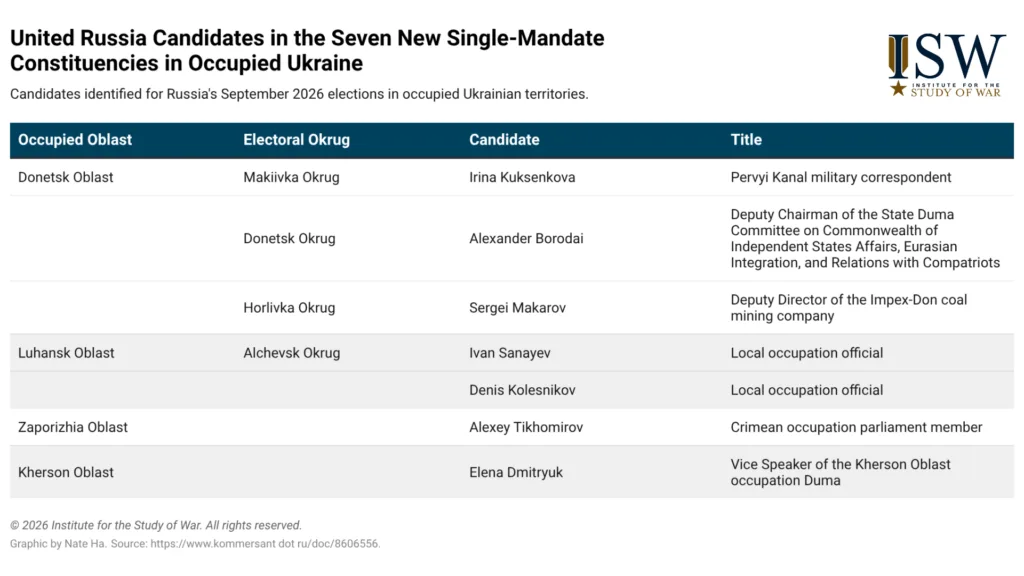
Many of the candidates who applied for inclusion on United Russia’s party lists in occupied Ukraine were additionally either active occupation administration officials or Russian armed forces personnel.[26] The formation of candidate lists in occupied Ukraine effectively assured the victory of pro-war, and by extension pro-occupation, United Russia candidates.
“Elections 2.0” Russian state automated system (GAS):
Russia expanded technological election infrastructure into occupied Ukraine in advance of the Duma elections. Head of the LNR occupation Electoral Commission Marina Sumskaya stated in June that occupied Luhansk Oblast’s electoral system had been fully integrated into the Russian one, and that elections would take place using the new “Vybory (Elections) 2.0” Russian state automated system (GAS).[27] GAS Vybory 2.0 is Russia’s official state information system for the automation and data management of elections, and the conduct of elections in occupied territories on Russian state-run software likely contributed to the fabrication of election results. A hacker group notably infiltrated the systems of GAS Vybory 2.0’s developer Tsifrtech in September 2026 and found unresolved critical errors in the software the week before the Duma elections.[28] The hackers determined that GAS Vybory 2.0 makes errors in determining the winners of single-mandate constituencies and that it included over 100,000 deceased residents of occupied Ukraine and Russia’s Kursk and Bryansk oblasts in its voter data.
Early voting and at-home voting and voting period manipulations:
The CEC approved a list of regulations in July pertaining to the conduct of elections in occupied Ukraine, including provisions that emphasized the importance of early and at-home voting and suggesting the shortening of the voting period to mitigate potential security risks.[29] Local election officials claimed that they paid special attention to early voting at people’s homes and workplaces and advertised the “Mobile Voter” mechanism, which allows voters to cast ballots wherever they are as opposed to at their registered address.[30] At-home and workplace voting is likely to have resulted in widespread voter intimidation, as election officials frequently conduct such visits in the presence of armed personnel.[31] Early voting also likely provided election officials additional time to manipulate ballots.
Militarization and securitization of polling places:
The 2026 Duma elections were carried out in an environment of intense militarization, echoing the conditions that Russia has imposed to intimidate voters in occupied Ukraine since 2014.[32] Occupation officials justified the presence of armed security personnel, including Rosgvardia officers, at polling places as necessary to protect against the threat of Ukrainian drone strikes. Footage posted on September 16 shows local election officials in occupied Donetsk Oblast visiting people’s homes alongside armed military personnel, and in one case shows a woman dropping a ballot into the ballot box held by an armed soldier.[33] A Reuters correspondent posted an image on September 15 showing an armed Russian soldier holding a ballot box as a woman nearby fills out voter documents in occupied Verbivka, Donetsk Oblast.[34] The ubiquitous presence of armed personnel undoubtedly impacted both voter turnout and election outcomes in occupied Ukraine, all but assuring that the elections were neither free nor fair.
Outcomes
United Russia candidates appear to have “won” across the board in occupied Ukraine, with alleged voter turnout exceeding Russian averages. The claimed voter turnout, while certainly inflated, is also likely in part a reflection of the intensive application of the election management toolkit in occupied areas. Russian media and election officials claimed that United Russia won 80.46 percent of the vote in occupied Donetsk Oblast; 78.99 percent in occupied Luhansk Oblast; 74.81 percent in occupied Kherson Oblast; and 79.83 percent in occupied Zaporizhia Oblast.[35] Claimed voter turnout in occupied Crimea was much lower than the other four occupied oblasts (where voter turnout was claimed to be around 80 percent), and United Russia allegedly won 60.70 percent of the vote — much closer to the claimed Russian average.[36] United Russia candidates Kuksenkova, Borodai, Makarov, Kolesnikov, Sanayev, Tikhomirov, and Dmitryuk won their respective single-mandate constituencies across occupied Donetsk, Luhansk, Kherson, and Zaporizhia oblasts.[37]
Forecasts
The Kremlin will use United Russia’s victory in occupied Ukraine as a referendum on the occupation itself. Russian Security Council Deputy Chairperson and United Russia Chairperson Dmitry Medvedev claimed that voter turnout in occupied Donetsk Oblast shows that residents have “a high degree of civic responsibility,” and Pushilin claimed that the elections show that occupied Donetsk Oblast wants to share its future with Russia.[38] Several local election officials claimed that the elections marked the “final” stage of occupied Ukraine’s “integration” into Russia and are a “collective act” of support for Russia.[39] A Russian political scientist told occupied Donetsk Oblast-based outlet Donetsk News Agency on September 21 that the election results and United Russia’s victory are evidence that occupied Ukraine has consolidated around Putin.[40]
These various statements are indicative of two major narrative trends resulting from the elections: first, that high voter turnout in occupied Ukraine is the result of a grassroots civic mobilization around the concept of Russian integration. This aspect echoes how Russia has historically used the conduct and results of elections in occupied Ukraine to legitimize the facts of its illegal occupations.[41] Second, the Kremlin will use United Russia’s victory as evidence that residents of occupied Ukraine are fully supportive of the occupation itself. United Russia’s “People’s Program” — the long-term planning document it publishes built on citizen proposals and appeals on which its candidates campaign — emphasizes the role of “the development of Donbas and Novorossiya” as a United Russia campaign platform.[42] This particular platform alludes to the various socio-economic programs that Russia is implementing to consolidate physical and psychological control over occupied Ukraine. By ensuring United Russia’s victory, the Kremlin has effectively created the impression that residents of occupied Ukraine definitively voted for the continuation of the occupation.
The Kremlin and Russian occupation officials will also use the election results as evidence of grassroots endorsement of Russia’s increasingly formalized official ideology amongst residents of occupied areas, which will set conditions for the Kremlin to continue to force residents of occupied Ukraine into making sacrifices for the Russian state in defense of this constructed and imposed ideology. United Russia itself has become increasingly militarized in the years since the full-scale invasion of Ukraine, both in ideology and party make-up, which has featured increasing numbers of Russian veterans of the war in Ukraine on United Russia ballots.[43] Putin has gradually solidified United Russia’s position as a pro-war, and pro-Putin party, culminating in United Russia’s formal presentation as “Putin’s party” for the first time since 2007 in June 2026.[44] Putin officially charged United Russia to do “anything possible to achieve victory in Ukraine” in August 2022, linking the party’s pro-war, pro-Putin stance as a central part of Russia’s informal state ideology.[45]
United Russia’s ideological militarization has immediate ramifications for occupied Ukraine. Regional occupation authorities tied United Russia’s victory to the propagation of Russian military-patriotic ideals during initial election preparations in early 2026.[46] Pasechnik, for example, stated on March 1 that his administration’s top election priority was the victory of “patriots, loyal to the interests of Russia.”[47] Several of the winning candidates in constituencies throughout occupied Ukraine are also notably involved in Russia’s war effort against Ukraine, echoing the gradual militarization of United Russia’s platform since 2022. Kuksenkova is a military correspondent and a volunteer with the People’s Front, and Borodai emphasized the fact that he was on the frontline as the commander of the 7th Assault Brigade (part of the Union of Donbas Volunteers, which Borodai founded) during the campaign season.[48] The Kremlin will use United Russia’s wins in occupied Ukraine as evidence that occupied areas are wholly supportive of Russia’s informal state ideology. By framing support for United Russia as support for Russia’s wartime political project, the Kremlin can argue that residents of occupied Ukraine have accepted corresponding obligations to the Russian state. Putin may use this as justification for some future form of mobilization, both in Russia and in occupied Ukraine.[49]
Russian officials will undoubtedly weaponize the conduct of elections in occupied territories against the Ukrainian government in pursuit of a favorable end-state to the war in Ukraine. Russia has long insisted on Ukrainian elections as a precondition for negotiations.[50] Ukraine’s constitution and Ukrainian law explicitly forbid elections under martial law, which the Ukrainian government cannot legally suspend as long as Russia continues to attack and occupy Ukraine. Russia has purposefully misrepresented this fact of Ukrainian law to delegitimize the Ukrainian government over the backdrop of episodic negotiations attempts. Russia is likely to use the conduct of its elections in occupied Ukraine as evidence that Ukraine itself must hold elections. This unmeetable demand will likely further complicate future negotiations processes, which are a current point of discussion following recent US administration visits to Kyiv and Moscow and the ongoing United Nations General Assembly.[51] Russia’s elections in occupied Ukraine, however, have been widely condemned as illegal, coerced, and fabricated — which should weaken any Kremlin argument about Ukrainian elections.[52]

[1] https://www.reuters.com/world/what-know-about-russias-upcoming-parliamentary-election-2026-09-15/
[2] https://understandingwar.org/research/russia-ukraine/russian-offensive-campaign-assessment-august-11-2026/; https://understandingwar.org/research/russia-ukraine/russian-offensive-campaign-assessment-september-20-2026/
[3] https://www.vesti dot ru/ns/stal-izvesten-sostav-gosdumy-po-itogam-vyborov-2026-goda
[4] https://tass dot ru/politika/27865493; https://understandingwar.org/research/russia-ukraine/russian-offensive-campaign-assessment-june-28-2026/
[5] https://understandingwar.org/research/russia-ukraine/russian-offensive-campaign-assessment-june-28-2026/; https://understandingwar.org/research/russia-ukraine/russian-offensive-campaign-assessment-september-10-2026/; https://understandingwar.org/research/russia-ukraine/russian-offensive-campaign-assessment-august-22-2026/
[6] https://understandingwar.org/research/russia-ukraine/russian-offensive-campaign-assessment-september-16-2026/; https://understandingwar.org/research/russia-ukraine/russian-offensive-campaign-assessment-august-22-2026/
[7] https://www.theguardian.com/world/2014/mar/16/ukraine-russia-truce-crimea-referendum
[8] https://ria dot ru/20140317/999851464.html; https://ria dot ru/20150316/1052210041.html; http://crimea.gov dot ru/ content/uploads/files/info_dep/protocol.PDF
[9] https://understandingwar.org/wp-content/uploads/2024/03/24-210-0120ISW20Occupation20playbook.pdf
[10] https://understandingwar.org/wp-content/uploads/2024/03/24-210-0120ISW20Occupation20playbook.pdf
[11] https://understandingwar.org/research/russia-ukraine/russian-offensive-campaign-assessment_23-25/; https://www.hrw.org/news/2022/09/30/fictitious-annexation-follows-voting-gunpoint; https://understandingwar.org/wp-content/uploads/2024/03/24-210-0120ISW20Occupation20playbook.pdf; https://understandingwar.org/research/russia-ukraine/russian-offensive-campaign-assessment_23-25/
[12] https://tass dot ru/mezhdunarodnaya-panorama/15888905; https://www.understandingwar.org/backgrounder/ russian-offensive-campaign-assessment-september-27; https://www.understandingwar.org/backgrounder/ russian-offensive-campaign-assessment-september-30
[13] https://t.me/turchak_andrey/1366; https://t.me/pushilindenis/3673 ; https://t.me/BalitskyEV/1462; https://understandingwar.org/research/russia-ukraine/russian-offensive-campaign-assessment_5-15/
[14] https://www.facebook.com/GeneralStaff.ua/posts/pfbid0EvVoyPuPhYwXNFSR6XsUK94i79KcKa4mT2d6Sw7mAr2HUokZ3y9522uqPrU1HgWZl; https://www.facebook.com/GeneralStaff.ua/posts/pfbid0EvVoyPuPhYwXNFSR6XsUK94i79KcKa4mT2d6Sw7mAr2HUokZ3y9522uqPrU1HgWZl
[15] https://t.me/vrogov/11889; https://t.me/VGA_Kherson/12690; https://t.me/VGA_NovayaKahovka/20322
[16] https://understandingwar.org/research/russia-ukraine/russian-offensive-campaign-assessment_11-15/; https://meduza dot io/feature/2023/09/11/sobyanin-snova-vseh-pobedil-kak-proshli-vybory-na-anneksirovannyh-territoriyah-i-chem-zakonchilas-kampaniya-v-hakasii; https://suspilne dot media/569485-na-drugij-den-psevdoviboriv-na-tot-hersonsini-namaluvali-avku-ponad-62-persij-zastupnik-golovi-oblradi/
[17] https://understandingwar.org/research/russia-ukraine/russian-offensive-campaign-assessment_94/; https://understandingwar.org/research/russia-ukraine/russian-offensive-campaign-assessment_8-10/; https://understandingwar.org/research/russia-ukraine/russian-offensive-campaign-assessment_19-9/; https://understandingwar.org/research/russia-ukraine/russian-offensive-campaign-assessment_29-10/
[18] https://understandingwar.org/research/russia-ukraine/russian-offensive-campaign-assessment_18-7/
[19] https://understandingwar.org/research/russia-ukraine/russian-occupation-update-april-28-2025/
[20] https://t.me/tass_agency/311498; https://t.me/kremlin_sekret/16973; https://www.pnp dot ru/social/k-vyboram-v-gosdumu-2026-goda-izmenyat-skhemu-odnomandatnykh-okrugov.html
[21] https://suspilne dot media/donbas/1405968-koni-golosuvanna-na-penku-zbroa-kramatorsk-v-okrugah-ak-rf-provodit-psevdovibori-do-derzdumi-v-okupacii/
[22] https://russian-election-monitor dot org/why-russian-government-is-still-afraid-of-elections/
[23] https://understandingwar.org/research/russia-ukraine/russian-occupation-update-april-28-2025/
[24] https://www.kommersant dot ru/doc/8606556 ; https://understandingwar.org/research/russia-ukraine/russian-occupation-update-april-30-2026/
[25] https://understandingwar.org/research/russia-ukraine/russian-occupation-update-april-30-2026/
[26] https://understandingwar.org/research/russia-ukraine/russian-occupation-update-may-7-2026/
[27] https://tass dot ru/politika/27780325
[28] https://storage dot googleapis.com/istories/stories/2026/09/17/lyubimii-rebenok-tsika/index.html
[29] https://www.interfax dot ru/russia/1097976
[30] https://understandingwar.org/research/russia-ukraine/russian-occupation-update-august-14-2026/; https://dan-news dot ru/exclusive/v-dnr-na-vyborah-v-gosdumu-sdelajut-akcent-na-dosrochnom-golosovanii/; https://ria dot ru/vybory/mobilnyj-izbiratel/; https://tass dot ru/info/12039493
[31] https://understandingwar.org/research/russia-ukraine/russian-occupation-update-august-14-2026/
[32] https://www.washingtonpost.com/world/2024/03/16/putin-election-voting-gunpoint-occupied-ukraine/; https://www.nytimes.com/2024/03/16/world/europe/ukraine-occupied-territories-russia-election.html
[33] https://x.com/nexta_tv/status/2100275770413244442
[34] https://www.reuters.com/pictures/pictures-day-september-15-2026-2026-09-15/7FTJUH6EABKIDJ4NYEBBLW26LM
[35] https://ria dot ru/20260922/rossija-2119610153.html ; https://ria dot ru/20260923/rossija-2119728961.html; https://ria dot ru/20260922/er-2119544369.html; https://ria dot ru/20260921/er–2119341091.html
[36] https://rg dot ru/2026/09/22/reg-ufo/v-krymu-podveli-itogi-vyborov.html?utm_referrer=https%3A%2F%2Fyandex.ru%2F
[37] https://dan-news dot ru/politics/kandidaty-ot-edinoj-rossii-lidirujut-v-treh-odnomandatnyh-okrugah-dnr/ ; https://www.vesti dot ru/ns/na-vyborakh-v-gosdumu-v-dnr-posle-obrabotki-100-protokolov-lidiruet-voenkor ; https://lug-info dot ru/news/denis-kolesnikov-i-ivan-sanaev-prohodjat-v-gosdumu-po-luganskomu-i-alchevskomu/ ; https://zonews dot ru/news/kandidat-ot-edinoj-rossii-pobezhdaet-na-vyborah-v-gosdumu-v-zaporozhskoj/; https://zonews dot ru/news/kandidat-edinoj-rossii-lidiruet-na-vyborah-deputatov-gosdumy-v-zaporozhskoj/; https://tass dot ru/politika/28136253; https://tass dot ru/politika/28132685 ; https://xonews dot ru/news/kandidat-ot-edinoj-rossii-pobezhdaet-na-vyborah-v-gosdumu-v-hersonskoj-oblasti/
[38] https://t.me/PushilinDenis/10342
[39] https://lug-info dot ru/news/pervye-vybory-v-gosdumu-dlja-lnr-oznachajut-zavershenie-integracii-v-rossiju-/ ; https://tass dot ru/politika/28133767
[40] https://dan-news dot ru/exclusive/ekspert-vybory-v-gd-pokazali-vysochajshij-uroven-doverija-naselenija-k-vlasti/
[41] https://understandingwar.org/wp-content/uploads/2024/03/24-210-0120ISW20Occupation20playbook.pdf
[42] https://understandingwar.org/research/russia-ukraine/russian-occupation-update-august-27-2026/; https://er dot ru/party/program
[43] https://understandingwar.org/research/russia-ukraine/russian-offensive-campaign-assessment-september-21-2026/
[44] https://understandingwar.org/research/russia-ukraine/russian-offensive-campaign-assessment-june-28-2026/
[45] https://understandingwar.org/research/russia-ukraine/russian-offensive-campaign-assessment-august-22-2026/
[46] https://understandingwar.org/research/russia-ukraine/russian-occupation-update-march-5-2026/
[47] https://tass dot ru/politika/26600975
[48] https://www.kommersant dot ru/doc/8606556; https://dan-news dot ru/exclusive/front-vmesto-listovok-pobeditel-vyborov-v-dnr-rasskazal-o-svoej-pozicii/
[49] https://understandingwar.org/research/russia-ukraine/russian-offensive-campaign-assessment-september-21-2026/
[50] https://understandingwar.org/research/russia-ukraine/the-west-shouldnt-play-russias-game-with-ukrainian-elections/
[51] https://understandingwar.org/research/russia-ukraine/russian-offensive-campaign-assessment-september-6-2026/; https://understandingwar.org/research/russia-ukraine/russian-offensive-campaign-assessment-september-22-2026/
[52] https://www.gov.uk/government/news/joint-statement-on-russias-sham-elections-in-ukraines-temporarily-occupied-territories; https://www.consilium.europa.eu/en/press/press-releases/2026/09/21/russiaukraine-statement-by-the-high-representative-on-behalf-of-the-eu-on-russian-state-duma-elections-held-on-18-20-september-2026-and-their-non-applicability-on-ukrainian-territory/