
The Institute for the Study of War (ISW) and The Critical Threats Project (CTP) at the American Enterprise Institute are publishing updates Monday through Friday to provide analysis on the war with Iran. Most updates cover events from the past 24-hour period, whereas Monday updates also include events from the preceding weekend, collected after ISW-CTP’s 2:00 PM ET Friday data cutoff. ISW-CTP may publish special updates on Saturdays and Sundays if events warrant, however.
Key Takeaways
- Iran has launched a concerted effort in recent days to more aggressively target US naval forces, likely to degrade the United States’ willingness and ability to continue enforcing the US naval blockade on Iranian ports.
- US officials warned that Iran may be using “more sophisticated weapons” to target US vessels in recent days.
- Iran may be relying upon targeting assistance from Russia or the People’s Republic of China to support Iranian attacks on US warships and vessels. US officials raised their concerns to the Wall Street Journal that Russian or PRC targeting assistance enabled Iran’s recent attacks against US vessels.
- Iran appears to be targeting anchored and docked commercial vessels in the Persian Gulf and Gulf of Oman, likely to deter the United States from conducting further strikes on Iranian oil tankers.
- Iranian targeting constraints may be contributing to Iran’s decision to target stationary vessels. ISW-CTP recently assessed on September 4 that Iran is struggling to fix moving commercial-vessel targets, given that Iran has not increased attacks on moving civilian vessels in the Strait of Hormuz despite the reported increase in the flow of traffic through the waterway.
- The Iranian regime is framing its retaliation against vessels that do not comply with Iranian policies in the Strait of Hormuz as its own Iranian enforcement of a “sanctions regime” in order to legitimize illegal Iranian activities against commercial vessels.
- Iran used cluster munition ballistic missiles in an attack on US forces in Jordan on September 9, which indicates that Iran sought to inflict greater damage or casualties to impose further human and political costs on the United States.
Toplines
Iran has launched a concerted effort to more aggressively target US naval forces in recent days, likely to degrade the United States’ willingness and ability to continue enforcing the US naval blockade on Iranian ports. Iran has fired an unspecified number of ballistic missiles at a US aircraft carrier, US Navy destroyers, and at least one US Marine vessel since September 4, according to US officials speaking to the Wall Street Journal.[1] The Islamic Revolutionary Guards Corps (IRGC) Aerospace Force attempted to attack two US Navy warships on September 5, and US Central Command (CENTCOM) noted on September 8 that the IRGC fired ballistic missiles targeting a US Navy warship twice in the past two days.[2] US officials described some of the attacks as “close calls.”[3] Iran likely aims to degrade US willingness and ability to enforce the US blockade on Iranian ports through a concerted effort to target US naval vessels. The IRGC said that it conducted its attempted attack on September 5 targeting US warships because the vessels’ crew were enforcing the US blockade.[4] Iran is likely attempting to achieve this objective by imposing tactical and operational-level effects on the United States. Iran likely aims to degrade US capabilities to enforce the blockade by inflicting damage to US vessels and assets, including aircraft. Damaging or even disabling US ships or aircraft may necessitate the vessels return to port for repair or resupply, which would force them to withdraw for a period of time. Iran also likely aims to inflict casualties among US servicemembers to raise the political costs of maintaining the US blockade.
US officials warned on September 8 that Iran may be using “more sophisticated weapons” to target US vessels in recent days.[5] Iranian officials have claimed that Iran used new missiles to target US naval vessels, including medium-range Qassem Basir missiles.[6] The Qassem Basir, which Iran unveiled in May 2025, is a solid-fueled medium-range ballistic missile with a 1,200-kilometer range and a maneuverable reentry vehicle (MaRV).[7] The MaRV allows missiles to maneuver mid-flight, which can help them evade air defenses. The Qassem Basir is reportedly equipped with electro-optical seeker technology capable of tracking moving targets, according to the Telegraph.[8] It remains unclear whether Iran used the Qassem Basir in the recent attacks on US warships, however. Iran would still need sufficiently accurate information on the vessel’s approximate location before launch, even if Iranian forces fired Qassem Basir missiles.
Iran may be relying upon targeting assistance from Russia or the People’s Republic of China (PRC) to support Iranian attacks on US warships and vessels. US officials raised their concerns to the Wall Street Journal that Russian or PRC targeting assistance enabled Iran’s recent attacks against US vessels.[9] Both Russia and the PRC have provided Iran with intelligence and satellite imagery that could support Iran’s ability to target US military positions, including naval forces.[10] US officials stated in March 2026 that Russia shared the locations of US military assets, including warships and aircraft, with Iran.[11] The United States sanctioned several PRC-based entities in May 2026 for providing Iran with satellite imagery of US facilities in the Middle East.[12]
Iran appears to be targeting stationary commercial vessels in the Persian Gulf and Gulf of Oman, likely to deter the United States from conducting further strikes on Iranian oil tankers. US forces destroyed five Iranian crude oil tankers on September 8.[13] The United States has destroyed 10 Iranian tankers in total since September 5 in response to Iran’s attacks on US naval forces.[14] The IRGC Navy issued an evacuation warning following the US tanker attacks on September 8 to tanker crews near Kuwaiti and Bahraini ports that host US forces and threatened to attack the crews “at anchor or at the ports.”[15] Iran may calculate that attacking non-Iranian commercial vessels in response to US strikes on Iran’s tanker fleet will compel shipping companies and regional commercial actors to pressure the United States to stop targeting Iranian tankers. Iran likely attacked three tankers on September 9: the Hercules Star, which was anchored off the coast of Dubai, UAE; an unspecified liquefied natural gas (LNG) tanker at port in Khor Fakkan, UAE; and the New Andros in Iraqi territorial waters.[16] Two of these vessels, the Hercules Star and the unspecified LNG tanker, were docked in port or anchored, which means that they were not in motion when Iran struck them.[17] Iran’s targeting of stationary ships also enables Iran to demonstrate that commercial vessels remain vulnerable even when anchored or in port, which Iran may calculate could build pressure among shipping companies on the United States to end attacks on Iranian tankers.
Iranian targeting constraints may also be contributing to Iran’s decision to target stationary vessels. Iran has occasionally struck stationary vessels throughout the war.[18] CTP-ISW recently assessed on September 4 that Iran is struggling to fix moving commercial-vessel targets, given that Iran has not increased attacks on moving civilian vessels in the Strait of Hormuz despite the reported increase in the flow of traffic through the waterway.[19] “Fixing” a target is part of the “find, fix, finish” targeting cycle, which involves forces detecting and identifying a specific threat (find), tracking and pinpointing its exact location in time and space to prevent escape (fix), and deploying military options to capture, neutralize, or destroy the target (finish).[20] Stationary vessels are easier targets because Iranian forces do not need to continuously locate and update the position of a moving vessel before striking. Iran may therefore be adapting its targeting approach to preserve its ability to threaten regional shipping despite its surveillance and targeting constraints.[21]
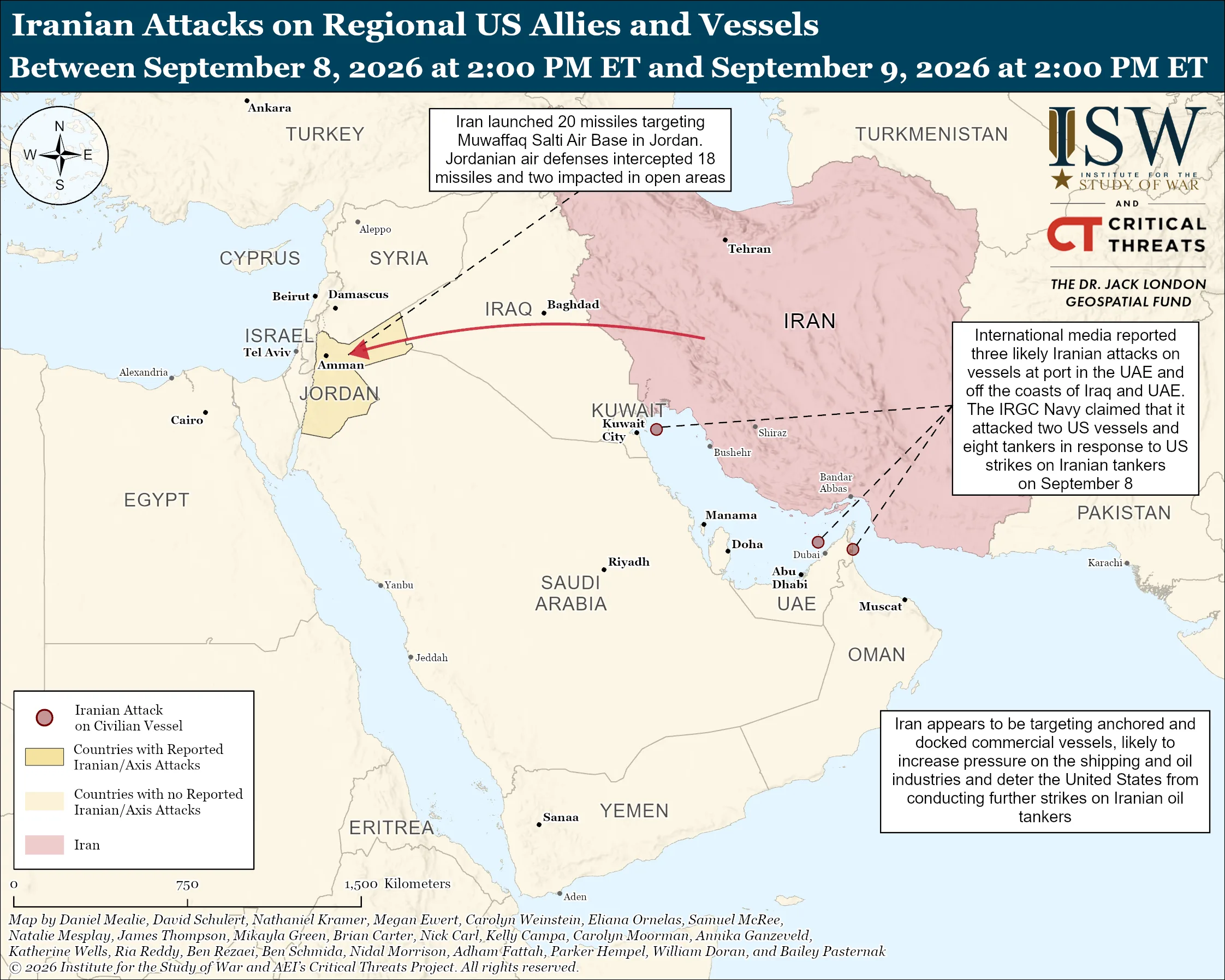
The Iranian regime is also framing its retaliation against vessels that do not comply with Iranian policies in the Strait of Hormuz as Iranian enforcement of a “sanctions regime” in order to legitimize illegal Iranian activities against commercial vessels. IRGC spokesperson Brigadier General Hossein Mohebbi warned on September 9 that any vessel entering the “restricted area” of the Strait of Hormuz without coordination will be subject to Iranian “sanctions.”[22] Mohebbi and Supreme National Security Council Secretary Major General Mohsen Rezaei have referred in recent days to Iran levying “sanctions” against vessels that violate Iranian transit requirements.[23] These officials are likely referring to the “sanctions list” the Persian Gulf Strait Authority’s (PGSA) “non-compliant vessels list” rather than internationally recognized sanctions similar to US financial sanctions.[24] Iran can impose fines on, or seize these blacklisted vessels during future passages, according to Mohebbi and Rezaei.[25] Iran is attempting to use international legal terms to justify denying select vessels or countries access to the strait as a legitimate action that Iran can take.
Iran used cluster munition ballistic missiles in an attack on US forces in Jordan on September 9, which indicates that Iran sought to inflict greater damage or casualties to impose further human and political costs on the United States.[26] A Fox News journalist reported that Iran fired missiles containing cluster munitions in an attack targeting Muwaffaq Salti Airbase in Azraq, Jordan, on September 8.[27] Two US officials said that the attack resulted in ”minimal” damage to US equipment and caused no deaths among US servicemembers.[28] Jordanian air defenses intercepted 18 and allowed two missiles to fall in unpopulated areas.[29] It is unclear how many of these missiles contained cluster munitions. Cluster munitions disperse over a wide area and are intended to maximize damage. Iran has extensively deployed cluster warheads in attacks targeting Israel in this most recent war in order to maximize casualties and impose psychological terror among the Israeli population. Israeli media estimated that about 70 percent of Iranian missiles launched at Israel in late March 2026 contained cluster munitions.[30] Iran may have fired cluster munitions targeting Muwaffaq Salti Airbase to maximize YUS casualties and damage to equipment.
US and Partner Military Operations
See topline section.
Iranian Strike Campaign
Assessed Iranian War Aims:
- Secure international recognition of Iranian control over the Strait of Hormuz
- Degrade the US ability and willingness to continue the war
- Restore deterrence vis-à -vis the United States and its regional partners
- Divide the United States and Israel from the Arab states
US-Iran Negotiations
Nothing significant to report.
Iranian Domestic Affairs
Nothing significant to report.
Lebanon
Nothing significant to report.
Iraq
The United States called on the Iraqi federal government to support US efforts targeting Iran’s sanctions evasion networks, according to an unnamed US State Department spokesperson speaking to Iraqi media on September 9.[31] The spokesperson called on the Iraqi government to support efforts to isolate Iran economically through the US Treasury Department’s Operation Economic Outcast, including through dismantling Iran’s sanctions evasion networks.[32] Iran has long exploited Iraqi financial institutions to evade sanctions, illicitly obtain US dollars, launder money, and generate revenue for Iranian-backed Iraqi militias.[33] The spokesperson’s call to the Iraqi government comes amid recent US pressure on the Iraqi federal government to dismantle Iranian and Iranian-backed Iraqi militia-associated financial networks as part of the broader US strategy to curb Iranian influence in Iraq and its exploitation of Iraqi financial institutions for sanctions evasion.[34]
National State Forces Coalition leader Ammar al Hakim called for the Iraqi government to reward Iranian-backed militias that have surrendered their weapons with policymaking roles in the federal government on September 9.[35] Hakim, whose political coalition is part of the political alliance called the Shia Coordination Framework, told Iraqi Kurdish media on September 9 that the government is currently involved in “intensive” negotiations with militias on issues related to Prime Minister Ali al Zaydi’s calls for the militias to disarm.[36] It is unclear whether Hakim’s request referred to the prospect of offering militia leaders favored positions in the Iraqi federal government or more broadly employing disarmed militia fighters in formal Iraqi state security organs. Zaydi has reportedly considered a plan to incorporate disarmed militia fighters into Iraqi state security organs, including the Counter Terrorism Service (CTS), in recent months, according to unspecified Iraqi sources.[37] Any Iraqi militia disarmament plan that grants formal state security roles to Iranian-backed militia members but does not address militias’ allegiance and connections to Iran will likely further entrench Iranian influence within the Iraqi state.[38] This poses a particular risk for specialized security organs like the CTS, which the United States developed during the Iraq War and has historically been protected from Iranian infiltration.[39]
Arabian Peninsula
Pakistani Defense Minister Khawaja Asif stated on September 8 that Pakistan could provide military support to Saudi Arabia under the Mecca Joint Defense Agreement if the Houthis continue to attack Saudi Arabia.[40] Saudi Arabia, Pakistan, and Turkey formed the defensive alliance on August 7.[41] The pact includes a collective defense framework in which an attack on one alliance member state is viewed as an attack on all members.[42] Asif reiterated to Pakistani media on September 8 that the alliance members will honor the agreement if there is “aggression” against one of its members.[43] Asif directly warned the Houthis that their attacks on Saudi Arabia “could make this agreement operational.”[44] Asif acknowledged that he is unaware if Saudi Arabia has requested that Pakistan and Turkey provide military support to Saudi Arabia amid the Houthis’ ongoing attacks (see below).[45]
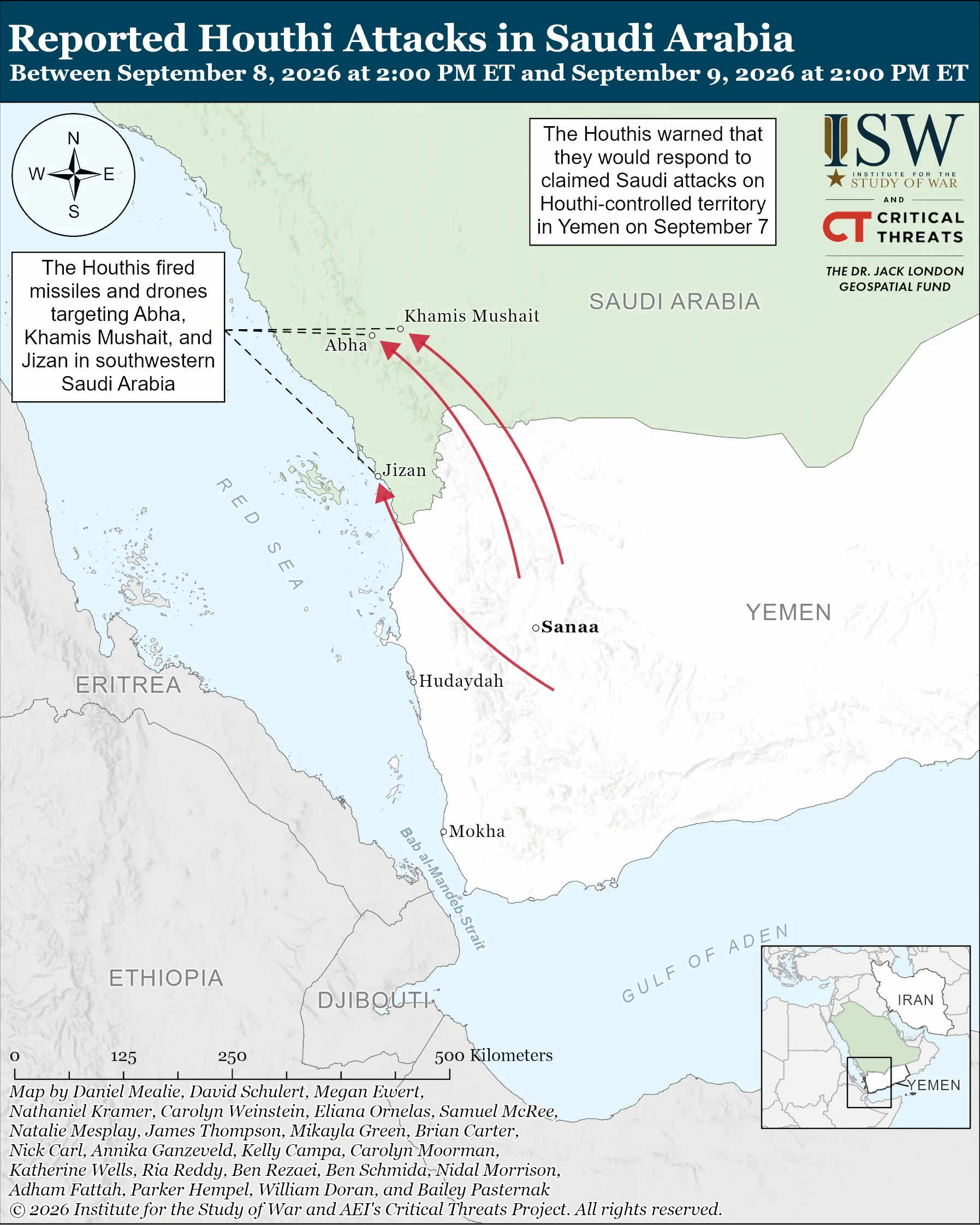
The Houthis launched additional ballistic missile and drone attacks on targets in southwestern Saudi Arabia on September 9.[46] The Saudi-led coalition spokesperson, Major General Turki al Maliki, announced that the Houthis launched an unspecified number of drones and missiles targeting Khamis Mushait and Abha in Asir Province and Jizan in Jizan Province.[47] Maliki did not specify whether Saudi air defenses intercepted any of the projectiles or any details about the intended targets in these locations. Houthi military spokesperson Yahya Sarea warned on September 9 that the Houthis would retaliate against Saudi Arabia over alleged Saudi attacks launched from Saudi airbases in Khamis Mushait on September 7.[48] The Houthis have not claimed the attack at the time of this writing. The Houthis have increasingly targeted Saudi oil facilities to increase the costs of Saudi military operations in Yemen as part of a broader Houthi effort to compel Saudi Arabia to concede to Houthi demands.[49] The Houthis struck Saudi oil facilities in Abha, Jizan, and Najran, and a Saudi military base in Khamis Mushait with ballistic missiles and drones on September 8, for example.[50]

[1] https://www.wsj.com/world/middle-east/iran-launched-undisclosed-second-wave-of-attacks-on-u-s-navy-ships-560f31a1 ; https://understandingwar.org/research/middle-east/iran-update-september-7-2026/
[2] https://www.centcom.mil/MEDIA/PUBLIC-RELEASES/Article/4593050/us-destroys-5-irgc-tankers-after-iran-targets-another-american-warship/ ; https://t.me/farsna/460401
[3] https://www.wsj.com/world/middle-east/iran-launched-undisclosed-second-wave-of-attacks-on-u-s-navy-ships-560f31a1
[4] https://t.me/farsna/460401
[5] https://www.wsj.com/world/middle-east/iran-launched-undisclosed-second-wave-of-attacks-on-u-s-navy-ships-560f31a1
[6] https://www.telegraph.co.uk/us/news/2026/09/09/us-forces-destroy-five-iranian-oil-carriers/
[7] https://understandingwar.org/research/middle-east/iran-update-may-5-2025/
[8] https://www.telegraph.co.uk/us/news/2026/09/09/us-forces-destroy-five-iranian-oil-carriers/
[9] https://www.wsj.com/world/middle-east/iran-launched-undisclosed-second-wave-of-attacks-on-u-s-navy-ships-560f31a1
[10] https://understandingwar.org/research/middle-east/iran-update-evening-special-report-march-6-2026/
[11] https://www.washingtonpost.com/national-security/2026/03/06/russia-iran-intelligence-us-targets/
[12] https://www.state.gov/releases/office-of-the-spokesperson/2026/05/disrupting-irans-overseas-military-procurement-networks ;
https://understandingwar.org/research/middle-east/iran-update-special-report-may-9-2026/
[13] https://www.centcom.mil/MEDIA/PUBLIC-RELEASES/Article/4593050/us-destroys-5-irgc-tankers-after-iran-targets-another-american-warship/
[14] https://www.centcom.mil/MEDIA/PUBLIC-RELEASES/Article/4593050/us-destroys-5-irgc-tankers-after-iran-targets-another-american-warship/ ;
https://x.com/CENTCOM/status/2097625485450543588?s=20
[15] https://t.me/Tasnimnews/443258
[16] https://www.reuters.com/world/middle-east/seafarer-oil-products-tanker-killed-incident-off-dubai-peninsula-says-2026-09-09/ ;
https://www.reuters.com/world/middle-east/iran-attacks-us-base-jordan-ships-near-hormuz-after-tankers-sunk-2026-09-09/
[17] https://www.reuters.com/world/middle-east/seafarer-oil-products-tanker-killed-incident-off-dubai-peninsula-says-2026-09-09/ ;
https://www.reuters.com/world/middle-east/iran-attacks-us-base-jordan-ships-near-hormuz-after-tankers-sunk-2026-09-09/
[18] https://www.reuters.com/world/middle-east/more-tankers-come-under-attack-us-iran-conflict-spreads-region-2026-03-05; https://understandingwar.org/research/middle-east/iran-update-evening-special-report-march-16-2026/
[19] https://understandingwar.org/research/middle-east/iran-update-september-4-2026/ ;
https://www.cnbc.com/2026/09/02/energy-secretary-chris-wright-tells-cnbc-that-more-than-17-million-barrels-of-oil-transited-hormuz-on-monday.html ;
https://www.cnn.com/2026/09/02/politics/latest-us-strikes-against-iran-marked-a-shift-in-strategy ;
https://www.reuters.com/business/energy/us-energy-secretary-says-17-million-barrels-oil-transited-strait-hormuz-monday-2026-09-02/
[20] https://understandingwar.org/research/middle-east/iran-update-august-31-2026/ ;
https://www.swcs.mil/Special-Warfare-Journal/Article/4565489/has-f3ead-outlived-its-usefulness/
[21] https://understandingwar.org/research/middle-east/iran-update-september-4-2026/
[22] https://www.entekhab dot ir/fa/news/938607
[23] https://www.mehrnews dot com/news/6939453
[24] https://understandingwar.org/research/middle-east/iran-update-september-7-2026/ ;
https://www.reuters.com/business/energy/iran-blacklists-more-ships-trying-sail-through-hormuz-govt-website-shows-2026-09-02/
[25] https://x.com/PGSA_IRAN/status/2091593525452558754?s=20
[26] https://www.foxnews.com/video/6404785881112
[27] https://www.foxnews.com/video/6404785881112
[28] https://www.nytimes.com/2026/09/09/us/politics/iran-strikes-jordan-base.html
[29] https://petra.gov dot jo/en/news/jordan-armed-forces-intercept-18-iranian-ballistic-missiles-targeting-kingdom
[30] https://www.mako.co dot il/news-military/2026_q1/Article-9f63f0e8c380d91027.htm
[31] https://shafaq dot com/en/Iraq/US-calls-on-Iraq-to-join-Iran-financial-crackdown
[32] https://shafaq dot com/en/Iraq/US-calls-on-Iraq-to-join-Iran-financial-crackdown ; https://understandingwar.org/research/middle-east/iran-update-august-24-2026/ ; https://home.treasury.gov/news/press-releases/sb0613
[33] https://home.treasury.gov/news/press-releases/sb0277 ; https://understandingwar.org/research/middle-east/iran-update-february-7-2023/ ; https://www.wsj.com/politics/national-security/iraq-banks-u-s-fed-iran-financing-0c3e740c ; https://home.treasury.gov/news/press-releases/jy2053
[34] https://almadapaper dot net/439458/ ; https://understandingwar.org/research/middle-east/iran-update-special-report-june-16-2026-2/
[35] https://www.kurdistan24 dot net/ar/story/938248/الحكيم-لـ-كوردستان-24-حصر-السلاح-يجب-أن-يتم-بالتفاوض
[36] https://www.kurdistan24 dot net/ar/story/938248/الحكيم-لـ-كوردستان-24-حصر-السلاح-يجب-أن-يتم-بالتفاوض
[37] https://understandingwar.org/research/middle-east/iran-update-special-report-june-4-2026/ ; https://shafaq dot com/ar/سیاسة/خاص-الزيدي-يقترح-مقايضة-سلاح-الفصا-ل-بمشاريع-ميركية ;https://shafaq dot com/ar/سیاسة/خاص-الزيدي-يقر-خطة-دمج-الفصا-ل-35-لف-فرصة-عمل-مقابل-تسليم-السلاح
[38] https://understandingwar.org/research/middle-east/iran-update-special-report-june-4-2026/
[39] https://www.washingtoninstitute.org/policy-analysis/how-washington-can-salvage-iraqs-counter-terrorism-service
[40] https://www.bloomberg.com/news/articles/2026-09-09/pakistan-pledges-to-honor-security-pact-if-saudi-arabia-attacked https://x.com/shazbkhanzdaGEO/status/2097419951263154629?s=20
[41] https://www.nytimes.com/2026/08/07/world/middleeast/saudi-turkey-pakistan-joint-defense-pact.html
[42] https://www.nytimes.com/2026/08/07/world/middleeast/saudi-turkey-pakistan-joint-defense-pact.html
[43] https://www.bloomberg.com/news/articles/2026-09-09/pakistan-pledges-to-honor-security-pact-if-saudi-arabia-attacked
[44] https://www.bloomberg.com/news/articles/2026-09-09/pakistan-pledges-to-honor-security-pact-if-saudi-arabia-attacked
[45] https://www.bloomberg.com/news/articles/2026-09-09/pakistan-pledges-to-honor-security-pact-if-saudi-arabia-attacked
[46] https://x.com/CJFCSpox/status/2097747041011024096
[47] https://x.com/CJFCSpox/status/2097747041011024096
[48] https://t.me/army21ye/3682
[49] https://understandingwar.org/research/middle-east/iran-update-september-8-2026/
[50] https://www.reuters.com/world/middle-east/saudi-led-coalition-yemen-says-73-injured-houthi-attacks-kingdom-2026-09-08/