
Toplines
US Forces Korea (USFK) may become central to US efforts to mobilize allied defense industrial bases (DIB) for US operational efficiency in the Indo-Pacific. The USFK proposed a plan that would clarify South Korea’s operational role in a potential Taiwan contingency. USFK Commander Xavier Brunson proposed establishing South Korea as a Regional Sustainment Hub (RSH) on April 22.[1] The concept builds on the US Department of Defense’s 2024 “Regional Sustainment Framework,” which aims to reduce time and cost by conducting maintenance, repair, and overhaul (MRO) in allied countries rather than returning assets to the United States.[2] South Korea already conducts maintenance of certain US aircraft. Establishing South Korea as an RSH would expand current maintenance efforts to include warships, missile systems, and drones.[3] The US’s ability to conduct MRO in South Korea’s forward-deployed hubs may improve the response capabilities and logistical efficiency of US forces during a Taiwan contingency. The US’s 2026 National Defense Strategy (NDS) proposed enabling US allies to take primary responsibility for their own defense while prioritizing deterrence against the People’s Republic of China (PRC) in the Indo-Pacific.[4] US Under Secretary of Defense for Policy Elbridge Colby previously stated the need to reorient the USFK to better address broader regional threats, including the PRC.[5] The South Korean Lee Jae Myung administration proposed transferring wartime operational control (OPCON) from the United States to South Korea, increasing South Korea’s defense budget to 3.5 percent of GDP, and developing an indigenous nuclear-powered attack submarine (SSN) to showcase its commitments to its defense following the NDS’s release.[6]
The Lee administration’s response to the NDS may suggest a willingness for South Korea to assume a broader role in deterring the PRC, aligned with US alliance expectations in the Indo-Pacific. A completed OPCON transfer would position South Korea to lead combined defense operations on the Korean Peninsula. Lee has argued that South Korea’s diesel-electric submarine fleet lacks the endurance to track North Korean and PRC submarines, suggesting that South Korea would use SSNs to counter PRC submarine activities.[7] The establishment of South Korea as an RSH would likely require the Lee administration to adopt a more assertive stance regarding South Korea’s operational role in a potential Taiwan contingency. South Korea has maintained strategic ambiguity regarding cross-Strait issues, likely due to the PRC’s significance to South Korea’s economy. The PRC imposed economic pressure on South Korea following South Korea’s 2017 deployment of the United States-provided Terminal High Altitude Area Defense (THAAD) system.[8] The PRC may again use economic pressure to deter South Korea from cooperating with the US plan.
The United States and South Korea appear aligned on accelerating the transfer of wartime OPCON from the United States to South Korea by 2029. USFK Commander General Xavier Brunson stated on April 22 that USFK submitted a roadmap to the Pentagon detailing the requirements South Korea must meet to transfer wartime OPCON by the second quarter of the 2029 fiscal year.[9] Brunson said the OPCON timeline is in a “good position,” given South Korea’s continued investments in defense, while also acknowledging the need for South Korea to invest more in its defense industry to accelerate the acquisition of systems needed for the OPCON transfer.[10] South Korea’s Ministry of National Defense (MND) said the defense ministers of South Korea and the United States would finalize the transfer timeline at the annual Security Consultative Meeting (SCM) in October 2026, before submitting the plan to the presidents of both countries.[11] The Lee Jae Myung administration proposed completing the OPCON transition by 2030, and US President Donald Trump agreed to support the transition in a joint fact sheet published on November 14.[12]
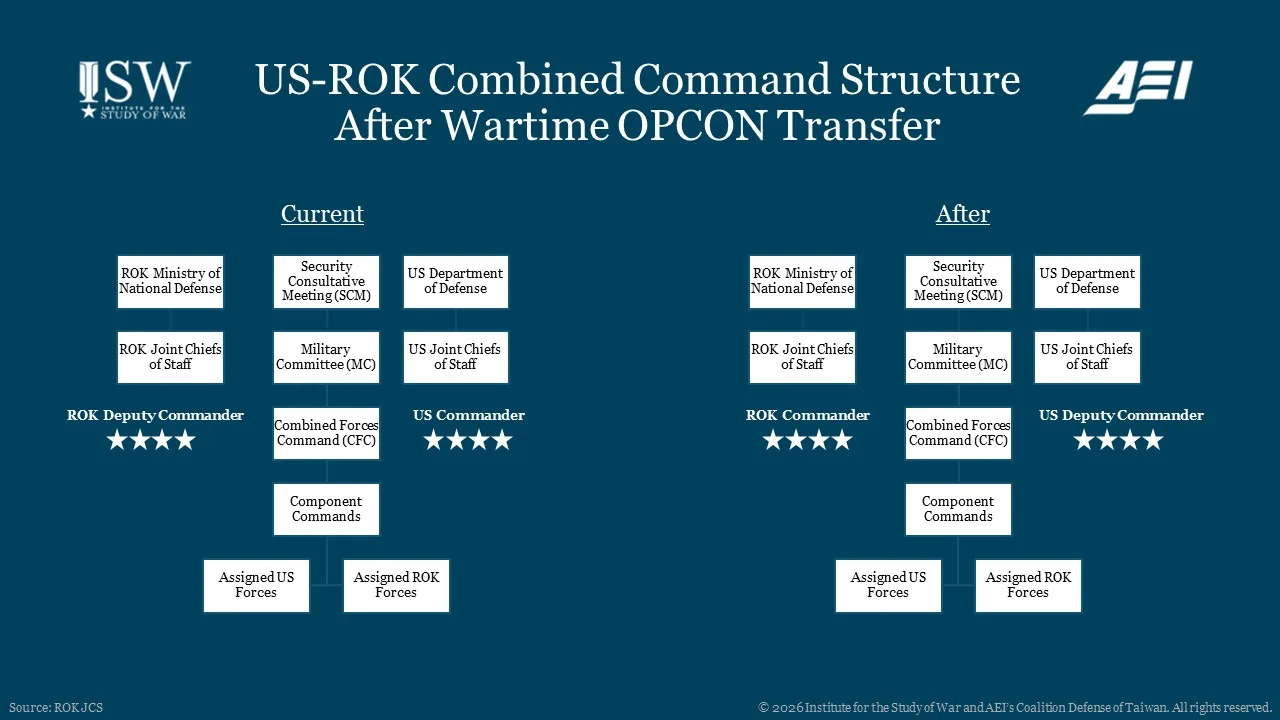
OPCON refers to the legal authority to direct and control military forces in the execution of missions or wartime operations.[13] A South Korean four-star general would lead the Combined Forces Command (CFC) following the wartime OPCON transition, with a US general serving as deputy.[14] South Korea and the United States in 2018 agreed on the transition plan based on three conditions: South Korea’s military capabilities to lead the combined defense, alliance response capabilities against North Korean nuclear and missile threats, and a security environment on the Korean Peninsula conducive to a stable transition.[15] The combined forces use three verification requirements—initial operational capability (IOC), full operational capability (FOC), and full mission capability (FMC)—to evaluate the first and second conditions.[16] South Korea has completed the evaluation and assessment of the IOC and is now undergoing the FOC assessment, with plans to complete it by the end of 2026.[17]
Brunson’s statement marks the first US confirmation of the timeline under the Lee administration. Discussions of the transition of wartime OPCON began around 2005, but South Korea and the United States delayed the plan twice between 2010 and 2015 due to concerns that South Korea was unprepared for North Korean threats.[18] South Korea’s pursuit of the OPCON transition aligns with the Trump administration’s 2026 NDS, which calls for the US’s allies to take primary responsibility for deterring regional threats.[19] The initiative includes a South Korean purchase of US military equipment worth over 25 billion USD and an increase of South Korea’s defense budget to 3.5 percent of its GDP by 2035, both of which are in accordance with Trump’s policy priorities.[20] The US Congress may restrict funding for wartime OPCON transition under the 2026 National Defense Authorization Act (NDAA) unless the Secretary of Defense certifies that it serves US national security interests, is coordinated with South Korea and Japan, and details the command structure of a South Korean-led CFC. The NDAA also prohibits reducing USFK troop levels below 22,000.[21]
Key Takeaways
- US-South Korea Alliance Building: USFK Commander Xavier Brunson proposed establishing South Korea as a regional sustainment hub (RSH) to conduct maintenance on US aircraft and ships. Establishing South Korea as an RSH may improve the logistical efficiency of US forces during a Taiwan contingency.
- OPCON Transfer: The United States and South Korea appear aligned on their desire to complete OPCON transfer from the United States to South Korea by 2029. South Korea needs to continue investing in its defense and modernizing its military to meet the US’s requirements for OPCON transfer.
North Korean Domestic Politics
Nothing significant to report.
North Korean Military Developments
North Korean hackers are increasingly targeting individuals and small firms with weaker security instead of larger crypto exchanges. North Korea is also increasingly using artificial intelligence (AI) tools to conduct identity fraud at scale. US-based cybersecurity firm Expel reported on April 22 that “HexagonalRodent,” a hacking group linked to North Korea’s state-funded hacking group “Famous Chollima,” stole cryptocurrency worth over 12 million USD from individuals between January and March 2026.[22] Famous Chollima has been conducting cyber operations targeting the cryptocurrency and blockchain sectors using target-specific malware and phishing emails since 2018.[23] HexagonalRodent allegedly extracted 26,584 cryptocurrency assets from 2,726 compromised systems in the first three months of 2026.[24] The group primarily targeted Web3 developers by using AI-generated identities on recruitment platforms.[25] Hackers then conducted fraudulent job interviews and induced victims to install malware with backdoors during coding assessments, allowing the hackers to extract sensitive information.[26] HexagonalRodent specifically targeted individual developers and investors, who tend to have weaker security measures than cryptocurrency exchanges.[27] Expel estimated that HexagonalRodent operates using 31 hackers across six teams, some of whom also operate independently.[28] Seoul-based media outlet NK PRO also reported that the “Lazarus”-related group “TraderTraitor” allegedly stole over 290 million USD worth of cryptocurrency from an Indian-based crypto stacking company on April 19, the largest North Korean cryptocurrency heist in 2026.[29] TraderTraitor leveraged the stolen assets as collateral to borrow funds from other decentralized finance (DeFi) platforms.[30] Lazarus is a hacking group under the North Korean Reconnaissance Information General Bureau.[31] Lazarus has conducted numerous cyber operations, including an attack on the global cryptocurrency exchange Bybit in February 2025, during which it allegedly stole a record-high 1.5 billion USD in cryptocurrency.[32]
North Korean-affiliated hacking groups are increasingly diversifying their methods of cryptocurrency theft by incorporating AI, fake crypto asset distribution, identity fraud, and the use of intermediaries, alongside more conventional hacking methods.[33] Expel assessed that HexagonalRodent successfully executed the operations despite its relatively unsophisticated methodologies by using AI to target individuals.[34]
The US Department of Justice announced on April 15 it sentenced two US citizens to prison for stealing nearly 80 American identities to support North Korean IT operations aimed at securing fraudulent employment at US companies.[35] ISW-CDOT previously assessed that North Korean hacking groups are expanding attacks against small-scale cryptocurrency firms with weaker security.[36] North Korean hackers have also exploited vulnerabilities in DeFi platforms, which often have weaker verification mechanisms and are more susceptible to code manipulation than traditional financial systems.[37] US Director of National Intelligence Tulsi Gabbard stated on March 18 that North Korean cyberattacks are becoming increasingly sophisticated and agile.[38] North Korea allegedly stole approximately 2 billion USD in cryptocurrency in 2025, a significant portion of which likely funded North Korean military development, including its weapons of mass destruction (WMD) programs.[39]
North Korean Foreign Relations
North Korea appointed new ambassador-level representatives largely to “global South” countries, likely to expand its international engagement and challenge the “United States-led global order.” The North Korean Ministry of Foreign Affairs (MFA) appointed new ambassadors to the United Kingdom, Sweden, Brazil, Indonesia, and Nigeria, and replaced the vice foreign minister responsible for PRC affairs.[40] The MFA appointed former Vice Minister of External Economic Relations Ji Kyong Su, who managed trade with Russia, to the ambassadorship for Belarus on April 7.[41] Former North Korean MFA Director General for Africa, Middle East, and Latin American Affairs Song Se Il will serve as the new ambassador to Brazil.[42] Brazil appointed Ricardo Primo as its ambassador to Pyongyang in February 2026.[43] Workers’ Party of Korea (WPK) General Secretary Kim Jong Un emphasized expanding relations with “anti-imperialist and independent” countries at the 9th Party Congress in February 2026.[44] Kim also signaled an expansion of diplomatic activity to promote a “multipolar world,” indicating an intent to counter the United States-led global order.[45] Kim’s rhetoric marked a shift from the 8th Party Congress in 2021, when Kim primarily focused on bilateral relations with the PRC, Russia, Vietnam, and the United States.[46]
North Korea is likely seeking to build ties with countries that pursue “independent” foreign policy to secure broader international support. Indonesia’s “independent and active” foreign policy and long-time membership with the non-aligned movement is one such example, and likely why North Korea is pursuing closer relations with Jakarta.[47] Indonesian Foreign Minister Sugiono visited Pyongyang for the first time in 12 years in October 2025 and expressed a desire to increase exchanges between North Korea and the Association for Southeast Asian Nations (ASEAN).[48] Pyongyang may be expanding relations with other regional powerhouses like Brazil and Nigeria to increase its engagement with other regional blocs.
North Korea may also seek greater international support for the easing of United Nations (UN) sanctions, similar to the support it has received from Russia and the PRC.[49] North Korea also likely seeks to enhance its international legitimacy by maintaining relations with European countries, including US allies. North Korea currently operates 12 diplomatic missions across Europe, including in the United Kingdom and Russia.[50] North Korea is likely to continue appointing new diplomatic personnel and increasing diplomatic engagement to strengthen its international standing.
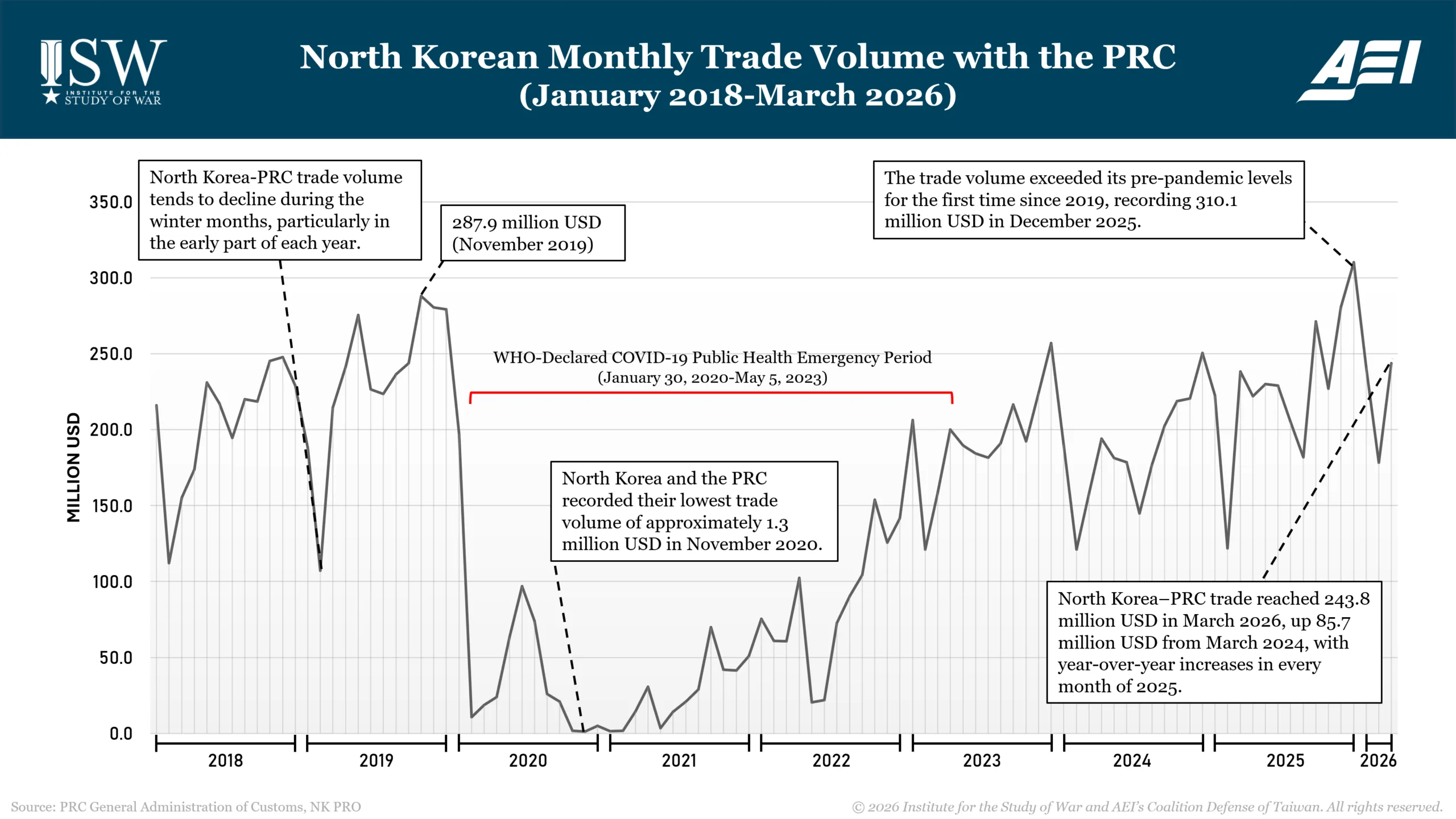
North Korea is likely expanding its people-to-people and economic exchanges with the PRC to pre-COVID-19 levels to maximize economic revenue from the PRC and Russia. North Korean exports to the PRC in March reached their highest levels since 2018. North Korea and the PRC conducted technical tests for trains at two bridges along the PRC-North Korea border on April 9.[51] These bridges previously handled passenger and cargo traffic between mid-sized border cities along the upper Yalu River and lower Tumen River.[52] North Korea suspended railway services following its border closure in 2020 due to the COVID-19 pandemic.[53] Most cargo and passenger traffic between North Korea and the PRC at present passes through the Sino-Korean Friendship Bridge, which connects Dandong, PRC and Sinuiju, North Korea.[54] North Korea authorized freight train operations along the Dandong-Sinuiju route in 2022 and resumed the Beijing-Pyongyang passenger service in March 2026.[55] PRC airline Air China also resumed flights in March for the first time in six years.[56] North Korea is expanding civilian exchanges by hosting tourism expos and discussing bilateral cooperation with PRC officials.[57] The PRC General Administration of Customs reported that the PRC-North Korean trade volume has recovered to pre-pandemic levels, reaching 243.8 million USD in March.[58] North Korea-PRC bilateral trade declined to approximately 10 million USD following the 2020 border closure, down from 279.8 million USD in December 2019, and fell further to 1.3 million USD in November 2020.[59] Seoul-based media outlet NK PRO reported that the increase in North Korean exports drove the March recovery, with approximately 44 percent of revenue coming from tungsten ore.[60] North Korea’s MFA invited PRC Foreign Minister Wang Yi on April 9 to reaffirm bilateral commitments to expanding exchanges and cooperation.[61]
North Korea appears to be gradually restoring bilateral relations with the PRC through expanded economic cooperation. North Korea reportedly sent approximately 1,000 workers to the PRC in April. This brings the total number of North Korean workers in the PRC to more than 100,000.[62] North Korea-PRC relations stagnated in 2024 despite the border reopening, but recent developments suggest a revival in trade and exchanges.[63] North Korea still appears to be prioritizing engagement with Russia over the PRC, however. South Korean think tank the Korean Development Institute (KDI) stated in December 2025 that North Korea-Russia cooperation in energy and heavy chemical industries, sectors linked to the military, expanded after North Korea deployed troops to Kursk, Russia, in 2024.[64] ISW-CDOT previously assessed that North Korea and Russia are increasing cooperation in tourism, manufacturing, and medical investment to evade sanctions.[65] Pyongyang appears to be positioning itself to maximize trade benefits and reduce its trade dependency on Beijing. North Korea relied on the PRC for approximately 98 percent of its total trade volume in 2024, according to South Korea’s Korea Trade-Investment Promotion Agency (KOTRA).[66] North Korea is likely to restore political relations with the PRC to their pre-COVID-19 state while prioritizing its strategic alignment with Russia.[67]
North Korea and Russia held multiple senior official exchanges around the April 26 first anniversary of their joint “liberation” of Kursk. North Korean-Russian engagement indicates their continued commitment to strengthening military and civil cooperation beyond the short-term demands of the Ukraine War. WPK General Secretary Kim Jong Un inaugurated the Memorial Museum of Combat Feats in Pyongyang on April 26 to commemorate the North Korean soldiers who fought and died helping Russia repel a Ukrainian incursion from Russia’s Kursk Oblast in 2024 and 2025.[68] A Russian delegation, including State Duma Speaker Vyacheslav Volodin and Defense Minister Andrei Belousov, attended the inauguration. Belosuov also awarded ten North Korean soldiers the Russian Order of Courage.[69] Kim met separately with Volodin and Belousov and discussed expanding North Korean military cooperation with Russia.[70] Belousov said that Russia is prepared to sign a Russian-North Korean military cooperation plan for 2027-2031 later this year.[71] Russia has relied on North Korea as a key source of munitions and specialized workers to support its war effort in Ukraine, in addition to the roughly 15,000 North Korean troops deployed to fight in Kursk.
Three other ministerial-level Russian officials visited North Korea beginning on April 20. Russian Interior Minister Vladimir Kolokoltsev met with North Korean Public Security Minister Pang Tu-sop on April 21 to discuss expanding law enforcement exchanges and cooperation.[72] Russia’s interior ministry said that the talks mostly focused on combating drug smuggling. Kolokoltsev also reportedly met with local law enforcement at North Korea’s Wonsan Kalma resort on April 23 to share Russia’s experience using AI facial recognition software for internal security purposes.[73] Russian Health Minister Mikhail Murashko and Minister of Natural Resources and Ecology Alexander Kozlov attended a groundbreaking ceremony for the North Korea-Russia Friendship Hospital on April 22 alongside North Korean first vice premier Kim Tok Hun and other North Korean officials.[74] Kozlov also met with North Korean External Economic Affairs Minister Yun Jong-ho to discuss economic cooperation. Kozlov and Yun are the co-chairmen of the North Korea-Russia Intergovernmental Committee for Trade, Economy, and Scientific and Technological Cooperation.
North Korean state media announced that the two sections of the Tumen cross-border bridge to Russia were connected on April 21.[75] The bridge is a joint project of North Korea and Russia to create their first border crossing for cars, which will connect to Russia’s highway system. Russian officials said the bridge will open on June 19.[76] The only other bridge connecting Russia and North Korea is the nearby Korea-Russia Friendship Bridge, a rail bridge built in 1959. Russia and North Korea have expanded tourism and transportation cooperation since Russia’s full-scale invasion of Ukraine in 2022.[77] North Korea likely hopes to preserve its strong partnership with Russia in the long term to alleviate North Korea’s international isolation and economic struggles.
Inter-Korean Relations
Nothing significant to report.
South Korean Domestic Politics
South Korean President Lee Jae Myung faces political pressure from the opposition People Power Party (PPP) to remove Unification Minister Chung Dong-young, following the United States’ protest and partial intelligence-sharing restrictions based on allegations that Chung disclosed classified information. Chung identified Kusong, along with Yongbyon and Kangson, as locations of North Korean uranium enrichment facilities during a parliamentary hearing in March 2026.[78] South Korean media outlet Asia Business Daily reported on April 21 that US Assistant Secretary of State for East Asian and Pacific Affairs Michael DeSombre, the US Central Intelligence Agency, and the USFK expressed concerns over Chung’s remarks and warned that the US would restrict its intelligence sharing with South Korea, as a result.[79] The South Korean Defense Intelligence Agency stated on April 22 that information related to North Korea’s uranium enrichment facilities remains restricted from disclosure under the United States-South Korea combined classified category.[80] The South Korean Ministry of Unification (MOU) on April 22 stated that Chung used open source intelligence for his claims, citing a report by the Institute for Science and International Security (ISIS), public remarks by Director General of the International Atomic Energy Agency Rafael Grossi, and a report from the Center for Strategic and International Studies.[81] The ISIS report in 2016 raised the possibility of the North Korean city of Kusong housing uranium enrichment or plutonium reprocessing facilities, but CSIS identified the region as housing a nuclear high explosive test facility, rather than an enrichment or reprocessing facility.[82] The South Korean government conducted a security review of MOU personnel and found no indicators of a breach.[83] Washington restricted some intelligence sharing with South Korea following Chung’s statement. South Korean media outlet Yonhap News Agency reported on April 21 that this restriction has a limited impact on allied military readiness against North Korean threats.[84]
US restrictions on some intelligence likely reflect concerns about South Korea’s handling of sensitive information, rather than a breakdown in the alliance. US adversaries who have developed covert nuclear-weapon programs, such as Iran, have sought measures to evade US detection pathways.[85] Public identification of a suspected enrichment site may alert North Korea to the specific locations under US scrutiny, prompting facility relocation, concealment, or measures to defeat allied collection methods.[86] South Korea’s opposition PPP legislators planned parliamentary committee hearings to investigate Chung’s remarks and have called for Chung’s resignation.[87] South Korean President Lee Jae Myung supported the MOU position that Chung referred to open-source information and expressed concerns that “certain actors,” likely referring to government officials who leaked the US protest to the press, are spreading unfounded claims about the South Korea-United States alliance.[88]
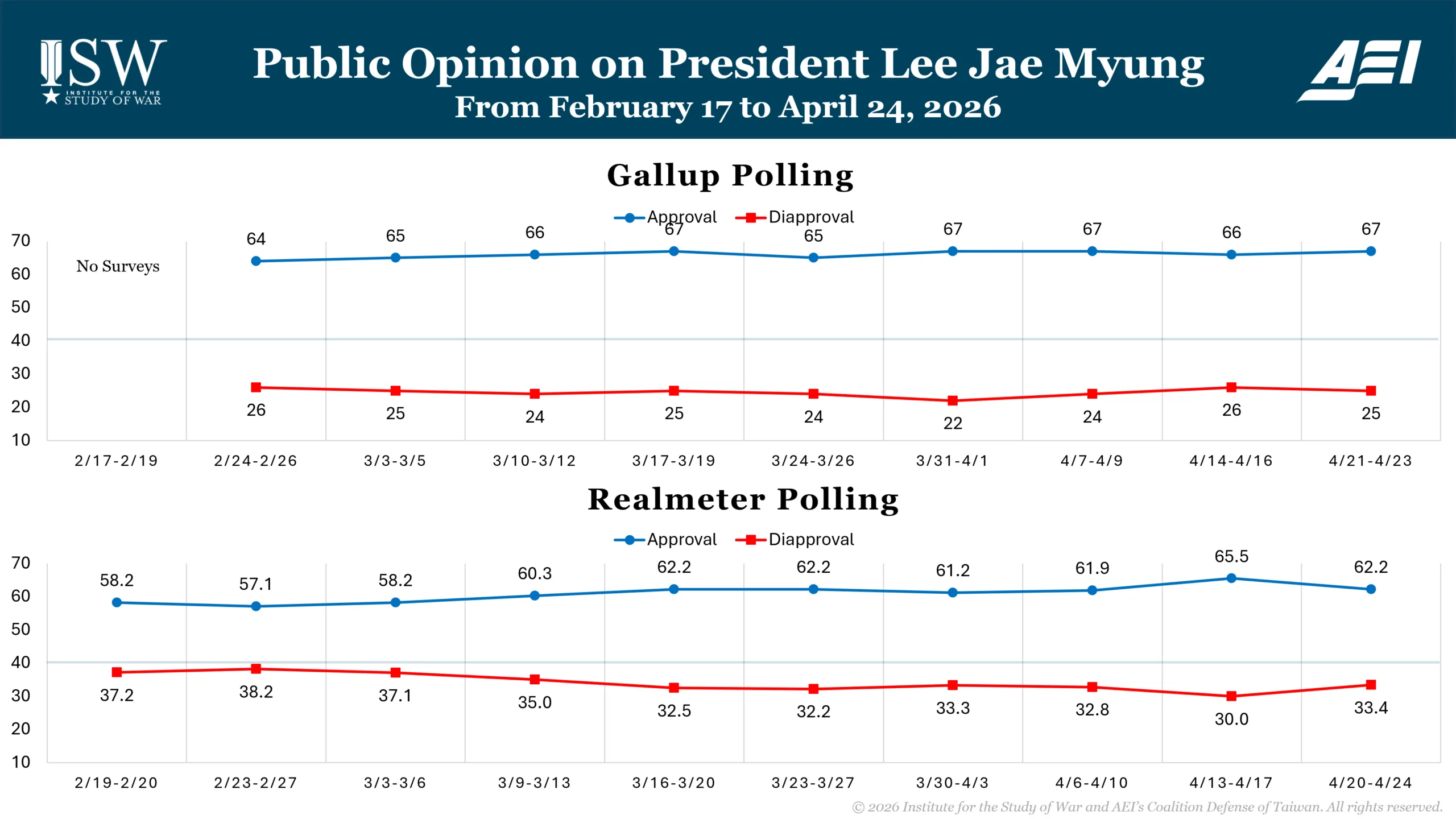
South Korean President Lee Jae Myung recorded his highest approval ratings and maintained a rating in the 60 percent range throughout the month of April. Lee’s positive ratings are likely due to his policy responses to the Middle East conflict. Gallup reported that Lee’s approval rating recovered to its previous highest point, reaching 67 percent in the fourth week of April.[89] Ninety-five percent of ruling Democratic Party (DP) supporters approved of the Lee administration, while 49 percent of moderates viewed Lee favorably.[90] Only 27 percent of opposition PPP supporters approved of Lee.[91] Lee maintained his approval rating of around 66-67 percent throughout April.[92] The Lee administration implemented fiscal and monetary policies to mitigate the effects of the Middle East conflict on South Korea and sought to stabilize oil prices through diplomacy in March and April.[93] The administration executed proactive policies to curb economic decline, including preemptively establishing an emergency response system, passing a supplementary budget, implementing an oil price cap, dispatching economic envoys to the Middle East for crude oil procurement, and allocating public relief funds to support economically disadvantaged groups.[94] Respondents viewed the administration’s efforts regarding rising oil prices positively. Those with negative views attributed their responses to the decline in value of the South Korean Won against the USD since Lee’s inauguration and the administration’s expansionary fiscal policy.[95] Gallup also reported approval ratings of South Korean political parties. The DP maintained 48 percent approval throughout April, while the PPP fluctuated at around 20 percent approval.[96] The PPP’s approval rating has consistently declined since the second half of last year.[97] South Korea will hold a nationwide local election on June 3.[98] Realmeter reported that Lee received a 62.2 percent approval rating, a decrease of 3.3 percent from the previous week.[99] Both Gallup and Realmeter assessed that Lee maintained consistently high approval ratings throughout April, however. Realmeter attributed the decline in the fourth week of April to a continued economic hardship, despite Lee’s policies.[100] Realmeter further stated that MOU Minister Chung Dong-young’s remarks on the Kuson nuclear facility and resulting security concerns influenced the downward shift.[101]
Counter-North Korean Coalition Building Efforts
See toplines.

[1] https://www.koreatimes.co dot kr/southkorea/defense/20260423/us-military-looks-to-make-korea-regional-hub-for-equipment-repair
[2] https://www.donga dot com/news/Politics/article/all/20260424/133802890/2
[3] https://www.youtube dot com/watch?v=4W2KTi9bjLY
[4] https://media.defense.gov/2026/Jan/23/2003864773/-1/-1/0/2026-NATIONAL-DEFENSE-STRATEGY.PDF
[5] https://www.atlanticcouncil.org/in-depth-research-reports/issue-brief/navigating-the-new-normal-strategic-simultaneity-us-forces-korea-flexibility-and-alliance-imperatives/
[6] https://www.congress.gov/crs-product/R48877
[7] https://understandingwar.org/research/china-taiwan/korean-peninsula-update-april-22-2026/#:~:text=North%20Korea%20may%20be%20preparing,the%20international%20community.%5B4%5D
[8] https://theasanforum dot org/chinese-economic-coercion-during-the-thaad-dispute/; https://www.uscc.gov/sites/default/files/Research/Report_China%27s%20Response%20to%20THAAD%20Deployment%20and%20its%20Implications.pdf
[9] https://www.nknews dot org/2026/04/usfk-aims-to-transfer-wartime-operational-control-to-rok-by-2029-commander-says/
[10] https://www.nknews dot org/2026/04/usfk-aims-to-transfer-wartime-operational-control-to-rok-by-2029-commander-says/
[11] https://www.donga dot com/news/amp/all/20260423/133797446/1
[12] https://www.yna.co dot kr/view/AKR20251114081851504
[13] https://www.congress.gov/crs-product/R48877
[14] https://www.archives.go dot kr/next/newsearch/listSubjectDescription.do?id=002937&sitePage=
[15] https://www.congress.gov/crs-product/R48877
[16] http://www.korea dot kr/common/download.do?fileId=186164277&tblKey=GMN; https://news.kbs.co dot kr/news/pc/view/view.do?ncd=4528438
[17] https://news.kbs dot co.kr/news/view.do?ncd=8407975
[18] https://www.archives.go dot kr/next/newsearch/listSubjectDescription.do?id=010239&sitePage=
[19] https://media.defense.gov/2026/Jan/23/2003864773/-1/-1/0/2026-NATIONAL-DEFENSE-STRATEGY.PDF
[20] https://www.yna.co dot kr/view/AKR20251114081851504
[21] https://www.congress.gov/crs-product/R48877
[22] https://expel.com/blog/inside-lazarus-how-north-korea-uses-ai-to-industrialize-attacks-on-developers/
[23] https://www.crowdstrike.com/en-us/adversaries/famous-chollima/; https://www.huntress.com/threat-library/threat-actors/famous-chollima
[24] https://expel.com/blog/inside-lazarus-how-north-korea-uses-ai-to-industrialize-attacks-on-developers/; https://www.joongang.co dot kr/article/25423056
[25] https://expel.com/blog/inside-lazarus-how-north-korea-uses-ai-to-industrialize-attacks-on-developers/
[26] https://expel.com/blog/inside-lazarus-how-north-korea-uses-ai-to-industrialize-attacks-on-developers/; https://www.joongang.co dot kr/article/25423056
[27] https://expel.com/blog/inside-lazarus-how-north-korea-uses-ai-to-industrialize-attacks-on-developers/; https://www.joongang.co dot kr/article/25423056
[28] https://expel.com/blog/inside-lazarus-how-north-korea-uses-ai-to-industrialize-attacks-on-developers/; https://www.joongang.co dot kr/article/25423056
[29] https://www.nknews dot org/pro/north-korean-hackers-linked-to-290m-heist-from-cryptocurrency-platform/
[30] https://www.nknews dot org/pro/north-korean-hackers-linked-to-290m-heist-from-cryptocurrency-platform/; https://www.cbinsights.com/company/kelp-dao; https://x.com/KelpDAO/status/2046332070277091807
[31] https://home.treasury.gov/news/press-releases/sm774; https://www.yna.co dot kr/view/AKR20250915074100504
[32] https://www.bbc.com/korean/articles/ceqj00lypw9o;
[33] https://understandingwar.org/research/china-taiwan/korean-peninsula-update-april-22-2026/; https://understandingwar.org/research/china-taiwan/korean-peninsula-update-april-14-2026/; https://understandingwar.org/research/china-taiwan/korean-peninsula-update-april-7-2026/
[34] https://expel.com/blog/inside-lazarus-how-north-korea-uses-ai-to-industrialize-attacks-on-developers/
[35] https://understandingwar.org/research/china-taiwan/korean-peninsula-update-april-22-2026/; https://www.justice.gov/opa/pr/two-us-nationals-sentenced-facilitating-fraudulent-remote-information-technology-worker
[36] https://understandingwar.org/research/china-taiwan/korean-peninsula-update-march-25-2026/
[37] https://hedera.com/learning/is-defi-safe/
[38] https://www.youtube.com/watch?v=4mHochl3KFQ
[39] https://understandingwar.org/research/china-taiwan/korean-peninsula-update-march-18-2026/; https://www.cnn.com/2023/05/10/politics/north-korean-missile-program-cyberattacks; https://understandingwar.org/research/china-taiwan/korean-peninsula-update-april-7-2026/
[40] https://www.yna.co dot kr/view/AKR20260418044000504?input=1195m; https://www.newsis dot com/view/NISX20260421_0003600553; https://www.newsis dot com/view/NISX20260425_0003606255
[41] https://understandingwar.org/research/china-taiwan/korean-peninsula-update-april-14-2026/; https://www.hankookilbo dot com/news/article/A2026041210240001323
[42] https://x.com/ItamaratyGovBr/status/2044534713600057409; https://www.yna.co dot kr/view/AKR20260418044000504?input=1195m
[43] https://www.poder360 dot com.br/poder-internacional/senado-aprova-indicacao-de-embaixador-para-a-coreia-do-norte/
[44] https://kcnawatch dot org/newstream/1772076051-920827632/%eb%b6%88%ea%b5%b4%ec%9d%98-%ea%b0%9c%ec%b2%99%ed%88%ac%ec%9f%81%ec%9c%bc%eb%a1%9c-%ec%a0%84%ec%b7%a8%ed%95%9c-%ec%9c%84%eb%8c%80%ed%95%9c-%ec%8a%b9%eb%a6%ac%ec%99%80-%ec%98%81%ea%b4%91%ec%9d%84/
[45] https://kcnawatch dot org/newstream/1772076051-920827632/%eb%b6%88%ea%b5%b4%ec%9d%98-%ea%b0%9c%ec%b2%99%ed%88%ac%ec%9f%81%ec%9c%bc%eb%a1%9c-%ec%a0%84%ec%b7%a8%ed%95%9c-%ec%9c%84%eb%8c%80%ed%95%9c-%ec%8a%b9%eb%a6%ac%ec%99%80-%ec%98%81%ea%b4%91%ec%9d%84/
[46] https://www.tongiltimes dot com/news/articleView.html?idxno=87
[47] https://www.lowyinstitute dot org/the-interpreter/indonesia-s-diplomacy-changing-confidence
[48] https://www.scmp dot com/week-asia/politics/article/3329218/indonesia-aims-be-neutral-conduit-between-2-koreas-visit-pyongyang
[49] https://news.un.org/en/story/2024/03/1148121
[50] https://www.ncnk.org/resources/briefing-papers/all-briefing-papers/dprk-diplomatic-relations
[51] https://www.nknews dot org/2026/04/chinese-locomotives-run-on-rail-lines-to-north-korea-in-apparent-test/
[52] https://www.nknews dot org/2026/04/chinese-locomotives-run-on-rail-lines-to-north-korea-in-apparent-test/
[53] https://www.nknews dot org/2026/04/chinese-locomotives-run-on-rail-lines-to-north-korea-in-apparent-test/
[54] http://www.snkpress dot kr/news/articleView.html?idxno=1283
[55] https://understandingwar.org/research/china-taiwan/korean-peninsula-update-march-18-2026/
[56] https://understandingwar.org/research/china-taiwan/korean-peninsula-update-march-18-2026/
[57] https://understandingwar.org/research/china-taiwan/korean-peninsula-update-april-22-2026/
[58] https://www.nknews dot org/pro/north-koreas-exports-to-china-hits-new-highs-driven-by-raw-minerals/
[59] https://www.nknews dot org/pro/north-koreas-exports-to-china-hits-new-highs-driven-by-raw-minerals/
[60] https://www.nknews dot org/pro/north-koreas-exports-to-china-hits-new-highs-driven-by-raw-minerals/
[61] https://www.yna.co dot kr/view/AKR20260409178600083
[62] https://www.dailynk dot com/20260417-4/; https://www.voakorea.com/a/state-department-says-china-undermining-u-n-sanctions-on-north-korea-amid-reports-of-dprk-workers-entering-china-042326/8141759.html; https://www.kci.go dot kr/kciportal/ci/sereArticleSearch/ciSereArtiView.kci?sereArticleSearchBean.artiId=ART003113036
[63] https://www.rfa.org/korean/news_indepth/nkchinatrade-04242024092634.html
[64] https://www.kdi.re dot kr/research/reportView?pub_no=19050
[65] https://understandingwar.org/research/china-taiwan/korean-peninsula-update-april-7-2026/; https://understandingwar.org/research/china-taiwan/korean-peninsula-update-march-31-2026/; https://understandingwar.org/research/china-taiwan/korean-peninsula-update-march-25-2026/; https://understandingwar.org/research/china-taiwan/korean-peninsula-update-march-18-2026/; https://understandingwar.org/research/china-taiwan/korean-peninsula-update-january-22-2026/
[66] https://dl.kotra.or dot kr/pyxis-api/2/digital-files/a2a08dc0-04d9-447e-8df4-24caead37337
[67] https://understandingwar.org/research/china-taiwan/korean-peninsula-update-march-18-2026/
[68] https://kcnawatch dot org/newstream/1745878075-343569229/russian-president-issues-statement-on-participation-of-combat-sub-units-of-dprk-armed-forces-in-operations-for-liberating-kursk-area-of-russia/
[69] https://www.nknews.org/2026/04/russia-awards-north-korean-heroes-for-their-bravery-in-battle-a gainst-ukraine/
[70] https://www.nknews.org/2026/04/kim-inaugurates-memorial-for-north-korean-soldiers-who-fought-in-ukraine-war/
[71] https://tass dot com/defense/2122611
[72] https://kcnawatch dot org/newstream/1776942246-814654724/talks-held-between-ministers-of-dprk-and-russia/
[73] https://www.nknews.org/2026/04/north-korean-airspace-abuzz-with-russian-jets-amid-ai-surveillance-talks/
[74] https://www.hankyung dot com/article/2026042200377 ; https://kcnawatch dot org/newstream/1776937345-756717414/ground-breaking-ceremony-for-building-dprk-russia-friendship-hospital-held/
[75] https://kcnawatch dot org/newstream/1776937346-951176809/both-sections-of-dprk-russia-border-motor-bridge-connected/
[76] https://www.nknews.org/2026/04/russia-says-new-road-bridge-to-north-korea-set-to-open-this-summer/
[77] https://understandingwar.org/research/china-taiwan/korean-peninsula-update-february-17-2026/
[78] https://en.yna.co dot kr/view/AEN20260423007200315?section=nk/nk
[79] https://www.asiae.co dot kr/article/2026042109071711233
[80] https://www.joongang.co dot kr/article/25422547
[81] https://www.yna.co dot kr/view/AKR20260422157000504?section=nk/news/all
[82] https://www.yna.co dot kr/view/AKR20260421159300504?site=longstay_news_view; https://beyondparallel.csis.org/yongdok-tong-nuclear-high-explosive-test-facility-part-2/, https://www.yna.co dot kr/view/AKR20260421010051071?section=nk/news/all
[83] https://www.yna.co dot kr/view/AKR20260421159300504?site=longstay_news_view
[84] https://www.yna.co dot kr/view/AKR20260420159251504?section=nk/news/all
[85] https://news.mit.edu/2018/explained-detecting-threat-nuclear-weapons-scott-kemp-0608
[86] https://www.joongang.co dot kr/article/25422547
[87] https://www.yna.co dot kr/view/AKR20260421082851001?section=nk/news/all
[88] https://www.hani.co dot kr/arti/politics/defense/1255113.html
[89] https://www.gallup.co dot kr/gallupdb/reportContent.asp?seqNo=1637
[90] https://www.gallup.co dot kr/gallupdb/reportContent.asp?seqNo=1637
[91] https://www.gallup.co dot kr/gallupdb/reportContent.asp?seqNo=1637
[92] https://www.gallup.co dot kr/gallupdb/reportContent.asp?seqNo=1637
[93] https://understandingwar.org/research/china-taiwan/korean-peninsula-update-april-14-2026/
[94] https://understandingwar.org/research/china-taiwan/korean-peninsula-update-april-7-2026/; https://understandingwar.org/research/china-taiwan/korean-peninsula-update-april-14-2026/; https://www.korea dot kr/news/policyNewsView.do?newsId=148963458
[95] https://understandingwar.org/research/china-taiwan/korean-peninsula-update-april-7-2026/
[96] https://www.gallup.co dot kr/gallupdb/reportContent.asp?seqNo=1637
[97] https://www.gallup.co dot kr/gallupdb/reportContent.asp?seqNo=1637
[98] https://www.koreaherald dot com/article/10679795
[99] http://www.realmeter dot net/%ec%97%90%eb%84%88%ec%a7%80%ea%b2%bd%ec%a0%9c%ec%8b%a0%eb%ac%b8-%eb%a6%ac%ec%96%bc%eb%af%b8%ed%84%b0-4%ec%9b%94-4%ec%a3%bc-%ec%b0%a8-%ec%a3%bc%ea%b0%84-%eb%8f%99%ed%96%a5-%e6%9d%8e-%eb%8c%80/
[100] http://www.realmeter dot net/%ec%97%90%eb%84%88%ec%a7%80%ea%b2%bd%ec%a0%9c%ec%8b%a0%eb%ac%b8-%eb%a6%ac%ec%96%bc%eb%af%b8%ed%84%b0-4%ec%9b%94-4%ec%a3%bc-%ec%b0%a8-%ec%a3%bc%ea%b0%84-%eb%8f%99%ed%96%a5-%e6%9d%8e-%eb%8c%80/
[101] http://www.realmeter dot net/%ec%97%90%eb%84%88%ec%a7%80%ea%b2%bd%ec%a0%9c%ec%8b%a0%eb%ac%b8-%eb%a6%ac%ec%96%bc%eb%af%b8%ed%84%b0-4%ec%9b%94-4%ec%a3%bc-%ec%b0%a8-%ec%a3%bc%ea%b0%84-%eb%8f%99%ed%96%a5-%e6%9d%8e-%eb%8c%80/