
Toplines
South Korea is pre-emptively addressing potential nonproliferation concerns stemming from its plans to build a nuclear-powered attack submarine (SSN). South Korea’s Ministry of Foreign Affairs (MOFA) plans to invite International Atomic Energy Agency (IAEA) Director General Rafael Grossi to Seoul to discuss the IAEA verification procedures required for the construction of SSNs.[1] US President Donald Trump approved South Korea’s plan to build SSNs during his October 29 summit with South Korean President Lee Jae Myung.[2] A November 13 US-South Korea joint factsheet indicated that Washington would work with Seoul to achieve construction requirements, including exploring “avenues to source fuel.”[3] SSNs use nuclear reactors fueled by enriched uranium, enabling extended endurance without refueling for 30 to 40 years. South Korea’s diesel-electric submarines must surface to charge their batteries every 20 days, however.[4]
US and UK SSNs use highly enriched uranium (HEU), and Australia is acquiring United States-designed HEU-powered SSNs under AUKUS.[5] HEU of over 60 percent concentration is used to make nuclear weapons.[6] Australia’s program has therefore involved IAEA safeguards.[7] South Korea has not yet determined the source of its fuel supply or whether its SSNs will use HEU or low-enriched uranium (LEU). LEU is not sufficiently enriched to be used for nuclear weapons, so using LEU may help to alleviate some proliferation concerns. South Korea would still require IAEA verification to produce the SSNs regardless of whether it chooses HEU or LEU. Trump suggested in October 2025 that the submarines could be built at the United States-based Hanwha Philly Shipyard.[8] South Korean National Security Council Advisor Wi Sung-lac said in November 2025 that the submarines would be built domestically, however.[9] South Korea currently relies on US nuclear technology and fuel to operate its commercial nuclear energy reactors under the “123 agreement,” which restricts South Korea’s use of transferred nuclear material for any military purpose.[10] The United States would have to revise Article 13 of the 123 agreement to supply fuel for South Korean SSNs.[11] The US Congress would not have to approve this revision, but the revision must undergo a 90-day congressional review period before taking effect.[12] Several US senators raised concerns regarding South Korean nuclear proliferation in a January 30 letter to Trump.[13]
South Korea is likely pursuing SSNs due to perceived capability gaps in countering North Korea’s submarine-based nuclear threat. The Lee administration is also advancing the transition of wartime operational control, which prepares Seoul to acquire independent defense capabilities.[14] Lee has argued that South Korea’s diesel-electric submarines lack the endurance to track North Korean and People’s Republic of China (PRC) submarines, aligning with broader US efforts to encourage allied burden-sharing in the Indo-Pacific.[15] North Korea denounced South Korea’s SSN development plan in a state media commentary in November 2025, accusing South Korea of pursuing “independent nuclear armaments,” and triggering “a regional nuclear domino effect.”[16] The PRC has not formally protested the initiative.[17] The PRC opposed AUKUS’s nuclear submarine cooperation and may respond with economic retaliation—as it did following South Korea’s 2017 deployment of its Terminal High Altitude Area Defense system—to deter Seoul from pursuing the program.[18]
South Korean President Lee Jae Myung expressed regret to North Korea on April 6 over recent South Korean drone incursions, which elicited a positive response from Workers’ Party of Korea (WPK) General Secretary Kim Jong Un’s sister Kim Yo Jong.[19] The Lee administration will likely interpret Kim’s statement positively, though ISW-CDOT does not assess that inter-Korean dialogue is likely. Lee expressed his regret over the drone incursion for the first time on April 6, describing the incident as an act by reckless individuals that prompted unnecessary military tension.[20] South Korean Minister of Unification Chung Dong-young expressed the Ministry of Unification’s (MOU) regret over the incident multiple times in February, to which Kim Yo Jong also responded favorably.[21] Three South Korean civilians, a National Intelligence Service employee, and two active-duty South Korean military officers allegedly sent drones into North Korean airspace four times between September 2025 and January 2026.[22] Kim Yo Jong responded positively to Lee’s statement on the same day it was made, conveying that Kim Jong Un assessed Lee’s stance as that of a “frank and broad-minded man’s attitude.”[23]
Kim Yo Jong’s fast response likely reflects Pyongyang’s extreme sensitivity to sovereignty violations. Pyongyang may also be concerned about the exposure of its strategic assets near the demilitarized zone (DMZ). The Lee administration may seek to use this opportunity to expand its peaceful coexistence policy. The Blue House (South Korea’s Presidential Office) expressed its hope that the mutual confirmation of peaceful intent would contribute to the coexistence policy and viewed Kim Yo Jong’s rapid statement as a positive sign towards bilateral communication.[24] Pyongyang is unlikely to view this statement as an opening for rapprochement, however. North Korea has repeatedly designated South Korea as a hostile state and likely perceives no benefits from improving ties with Seoul. Kim Yo Jong’s statement was likely a reaction to Seoul’s expression of regret over a sovereignty violation, not an invitation for cooperation. Kim Yo Jong warned of severe consequences should such sovereignty violations recur and emphasized that Seoul must cease all provocations and abandon any attempts at “contact for the sake of stability.[25]
Key Takeaways
- South Korean Nuclear Submarines: South Korea is pre-emptively planning to meet with the IAEA to assuage potential proliferation concerns stemming from its plan to develop nuclear submarines. South Korean officials are pursuing nuclear submarine development to address perceived capability gaps in countering North Korean capabilities.
- Inter-Korean Relations: WPK General Secretary Kim Jong Un’s sister Kim Yo Jong responded positively to South Korean President Lee Jae Myung’s expression of regret over a recent South Korean drone incursion into North Korea. ISW-CDOT does not assess that this will make inter-Korean dialogue more likely in the near future, however.
North Korean Domestic Politics
Nothing significant to report.
North Korean Military Developments
A North Korea-affiliated hacking group allegedly implemented malware into a globally used open-source program on March 31. North Korea utilizes its cyberattack operations to generate illicit revenue.[26] Google’s cyber-intelligence firm Mandiant reported that the North Korea-affiliated hacking group UNC1069 injected malware into the open-source program Axios on March 30.[27] Axios is a type of Node Package Manager (NPM) that serves as a data conduit, enabling web browsers and applications to exchange information with servers.[28] Axios is widely used across nearly all industrial sectors, including healthcare and finance.[29] UNC1069 has primarily targeted virtual assets and financial industries since 2018.[30]
North Korea partially funds its military through cyberattacks, which are difficult to monitor and allow it to evade US and United Nations (UN) sanctions. Former US Deputy National Security Advisor Anne Neuberger stated in 2023 that cryptocurrency heists fund approximately half of North Korea’s missile program.[31] US Treasury Secretary Scott Bessent confirmed in March that North Korea develops weapons of mass destruction (WMD) by exploiting digital assets.[32] The US Treasury Department stated that North Korea stole approximately 2 billion US dollars (USD) in cryptocurrency in 2025.[33] North Korea continues to diversify its tactics, strategy, and targets for cyber operations to maximize revenue from. Lead Threat Intelligence Advisor at Google Cloud Jamie Collier claimed that North Korea completely overhauled its cyber tactics approximately 18 months ago.[34] Collier emphasized that periodic shifts in North Korea’s strategy make it extremely difficult for entities to predict or track its next move.[35] North Korea recently employed artificial intelligence (AI) to fabricate identities for North Korean individuals to gain employment at Western IT firms.[36] These North Korean IT workers stole corporate information and assets. This reflects broader North Korean efforts to expand AI development.[37]
North Korea is accelerating efforts to expand its number of major surface combatants. This is consistent with ISW-CDOT’s assessment that Kim Jong Un tasked the Korean People’s Army Navy (KPAN) with developing a green-water navy. South Korean media released satellite footage of North Korea’s Nampho shipyard from March 12 to March 28 that showed several large cranes, including a floating crane, in constant operation around an unfinished Choe Hyon-class guided missile destroyer.[38] The satellite imagery likewise showed that construction had shifted from finishing the hull to adding weapons and radar systems to the vessel, indicating it is in an advanced stage of production.[39] Kim tasked North Korean shipbuilding with delivering two Choe Hyon-class destroyers to the KPAN every year until 2030, which would bring the KPAN’s destroyer count to 12.[40] North Korea is also aiming to produce an unknown number of guided missile frigates, which would further expand its surface fleet.[41] The satellite imagery of another destroyer in advanced stages of construction suggests North Korea could meet its yearly shipbuilding goal for 2026.
Kim has suggested that an expanded surface fleet will improve North Korea’s nuclear deterrent by adding another leg to its nuclear triad.[42] Expanding the KPAN’s destroyer fleet to 12 hulls would further disperse North Korea’s nuclear armament, enhancing its survivability.[43]
The pace of North Korean shipbuilding efforts indicates that Kim has prioritized expanding the KPAN surface fleet and aims to transform the force into a green-water navy. ISW-CDOT reported that North Korea is expanding facilities at Chongjin Shipyard on the East Sea, potentially accelerating North Korean shipbuilding and efforts to create a green-water force.[44] A green-water navy retains a focus on littoral and coastal defense but also has the capability for longer-range deployments in neighboring sea areas.[45] An expanded destroyer fleet would grant the KPAN a much greater expeditionary capability than its existing patrol craft and midget submarines.[46] North Korea could use a green-water navy to threaten shipping lanes and the sea lines of communication (SLOCs) between its regional adversaries or to defend its own SLOCs with the PRC and Russia.[47] An expanded KPAN surface fleet could also force South Korea’s Navy to allocate a larger portion of its surface fleet to countering KPAN deployments in the East Sea, potentially diminishing their contributions to South Korea’s integrated air and missile defense network.
North Korean Foreign Relations
The PRC likely seeks to regain its influence over North Korea by resuming diplomatic exchanges and expanding bilateral cooperation with Pyongyang. North Korean state media reported on April 4 that PRC leadership sent congratulatory messages to Pyongyang regarding North Korea’s March 15 Supreme People’s Assembly.[48] PRC Premier Li Qiang expressed Beijing’s desire to elevate traditional PRC-North Korean ties.[49] These messages follow statements from other Chinese Communist Party (CCP) leadership urging greater cooperation with North Korea across sectors.[50] The PRC and North Korea have been working to restore diplomatic and civilian exchanges to pre-pandemic levels.
PRC-North Korea relations deteriorated significantly after Pyongyang signed a mutual defense treaty with Russia and deployed troops to help Russia’s war against Ukraine in 2024. The PRC has long been North Korea’s primary ally, and its relative influence decreased due to expanding Russia-North Korea military and economic ties.[51] PRC-North Korean relations appeared to recover somewhat in 2025, after the PRC invited WPK General Secretary Kim Jong Un to Beijing’s Victory over Japan Day parade in September 2025 and tacitly dropped its opposition to North Korea’s nuclear weapons program.[52] The PRC appears to be prioritizing non-military exchanges to restore its relationship with North Korea. The PRC likely aims to prevent further marginalization of its role amidst flourishing Russian-North Korean relations. North Korea will likely seek to maintain a balanced rapport with the PRC and Russia. Kim refrained from highlighting ties with specific allies at the 9th Party Congress in February, a notable change from the 8th Party Congress in 2021, when Kim highlighted the country’s relationship with Beijing and Moscow.[53] Russia likely supplies North Korea with sensitive military technologies and hardware in exchange for North Korean troop deployment in Russia. ISW-CDOT previously assessed that North Korea would expand these exchanges using its first road bridge with Russia, which is expected to be completed in June.[54] The Russian Embassy in Pyongyang announced on April 5 that construction is underway for the Khasan checkpoint, which will be capable of handling over 300 vehicles and 2,000 people daily.[55] North Korea simultaneously aims to generate revenue by resuming civilian exchanges with the PRC, such as attracting PRC tourists. Pyongyang invited PRC Ambassador Wang Yajun to the newly opened Wonsan-Kalma Coastal Tourist Area in February to facilitate the return of PRC tourists.[56] North Korea could generate more than 175 million USD if its tourism recovers to pre-pandemic levels.[57] Pyongyang is very likely to funnel these revenues into military and nuclear developments to bolster regime stability.
North Korea dispatched a record number of workers to Russia in 2025 to evade sanctions and earn foreign currency. Russia supported these efforts by classifying laborers as “students” in its official data, while addressing domestic labor shortages caused by the ongoing war in Ukraine. Russia’s Consular Department of the Ministry of Foreign Affairs reported on April 1 that it issued more than 36,000 entry visas to North Koreans in 2025—an approximately 294 percent increase from the 9,239 visas issued in 2024.[58] Russian visa issuances to North Koreans steadily declined from 12,859 in 2016 to 1,583 in 2020 and fell to zero during the 2021-2023 COVID-19 pandemic period.[59] This earlier decline followed Russia’s implementation of UN Security Council (UNSC) sanctions requiring member states to expel North Korean workers. Russia reversed this position in 2022, when Russian Deputy Prime Minister Marat Khusnullin publicly stated plans to employ between 20,000 and 50,000 North Korean laborers for infrastructure development and reconstruction in Russian-occupied territories of eastern Ukraine.[60] Approximately 98 percent of the visas granted to North Koreans in 2025 were “student visas.”[61] Seoul-based media outlet NK Pro reported that Russia has employed North Korean workers by channeling them through educational institutions under the guise of “industrial internships.”[62] NK Pro also reported that Russian businesses established joint ventures with North Korean firms and hired North Korean laborers between 2024 and 2026 across sectors, including food production, agriculture, IT, and construction.[63]
The expansion of North Korean laborers in Russia—in both scale and sectoral scope—reflects a sustained bilateral effort to undermine UNSC sanctions. Russia vetoed a 2024 UN resolution to extend the mandate of the Panel of Experts that monitors sanctions enforcement.[64] The bilateral Treaty on Comprehensive Strategic Partnership signed in June 2024 by Russia and North Korea, includes provisions opposing “unilateral coercive measures of an extraterritorial nature” and commits both parties to reject actions that infringe on each other’s core interests.[65] Russian President Vladimir Putin has characterized the UN sanctions regime as “strangulation by the West” and called for its revision following the agreement.[66] Russia’s growing reliance on North Korean labor also reflects acute domestic labor shortages driven by the war in Ukraine.[67] Japanese media outlet Kyodo News reported that Russia plans to deploy North Korean workers to the Alabuga Special Economic Zone (ASEZ), which hosts manufacturing facilities that assemble unmanned aerial vehicles with technological assistance from Iran.[68] CTP-ISW assessed that the ASEZ produces roughly 5,000 Geran drones a month.[69] Such deployments would likely support Russia’s war efforts, while enabling North Korea to expand foreign currency earnings and diversify beyond its traditional economic reliance on the PRC.[70]
North Korean Influence Operations
Nothing significant to report.
Inter-Korean Relations
The Lee Jae Myung administration cosponsored the United Nations Human Rights Council (UNHRC) resolution on North Korean human rights, following concerns raised about the administration’s North Korea policy.[71] This decision is unlikely to shift Seoul’s policy significantly, however. South Korean MOFA spokesperson Park Il announced on March 31 that South Korea cosponsored the UNHRC resolution to seek practical improvements in North Korean human rights outcomes through international cooperation.[72] The Blue House finalized the decision on March 30. The Lee administration initially considered abstaining from the resolution to prioritize efforts to restore inter-Korean dialogue.[73] South Korean Unification Minister Chung Dong-young argued on March 26 that Seoul should not cosign a resolution that would incite North Korean anger. Chung instead advocated for the “peaceful coexistence” policy.[74] The “peaceful coexistence” policy is the Lee administration’s North Korea policy, which aims to restore inter-Korean exchange and mutual respect for both systems.[75] South Korea’s opposition People Power Party and multiple human rights organizations urged the Lee administration to cosponsor the resolution.[76] South Korean National Security Advisor Wi Sung-lac and South Korea’s MOFA also advocated for participation in the resolution, citing concerns about international criticism.[77] South Korea, under previous progressive administrations, abstained or did not participate in the UNHCR resolution from 2003 to 2005, in 2007, and from 2019 to 2022 to preserve dialogue channels with Pyongyang.[78] The Lee administration was a cosponsor of the 2025 UN General Assembly resolution on the North Korean human rights issue, however.[79] The former progressive Roh Moo-hyun administration participated in the resolution for the first time in 2006 due to the impact of North Korea’s first nuclear test.[80]
The Lee administration’s decision to cosponsor the North Korean human rights resolution appears to be an attempt to address international human rights concerns rather than a fundamental shift in its policy. The South Korean MOU remains committed to peaceful coexistence and pursuing inter-Korean dialogue despite the administration’s decision on the UNHRC resolution.
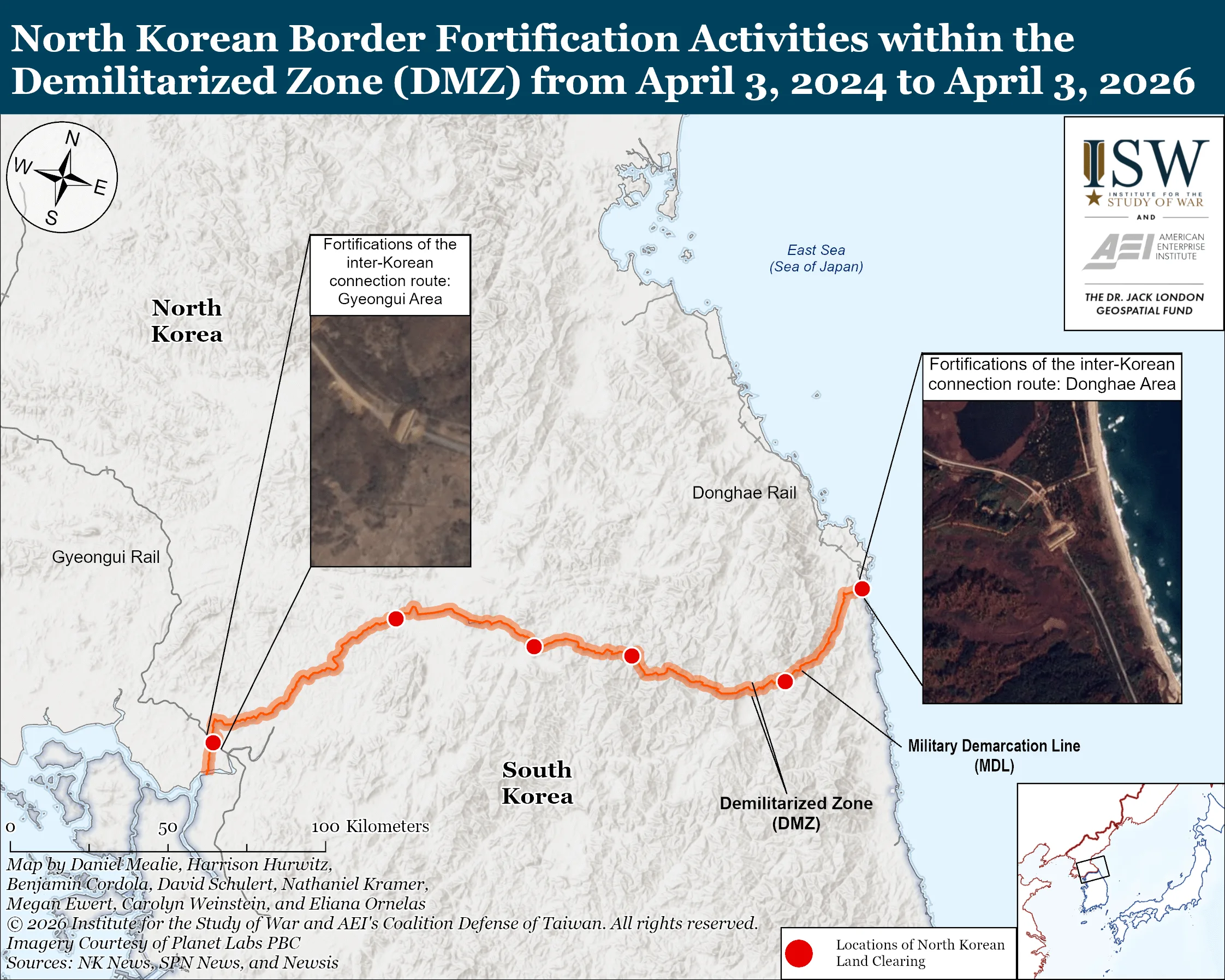
North Korea resumed border fortification activities in the DMZ, likely to signal dissatisfaction with South Korea and reject calls for inter-Korean dialogue. South Korea’s Joint Chiefs of Staff (JCS) stated on March 30 that a “large number” of North Korean troops had been conducting maintenance work north of the Military Demarcation Line (MDL) within the DMZ in early March, including tree clearing, construction of supply routes, and maintenance of barren terrain.[81] The resumption follows a halt in activities since December 2025, likely due to winter training exercises.[82] North Korea began clearing vegetation across the DMZ in April 2024, according to the Seoul-based media outlet NK News.[83] NK News also reported that North Korea simultaneously installed barbed-wire fences, anti-tank barriers, and anti-personnel mines on the Gyeongui and Donghae roads, while demolishing facilities near these roads that previously served as inter-Korean connection points.[84] North Korean troops crossed into South Korea at multiple locations along the DMZ approximately 16 times in 2025 while conducting these activities, prompting South Korea to fire warning shots.[85] South Korea’s Ministry of National Defense (MND) attributed these incursions to the deterioration of MDL markers—originally installed in 1973 to define the boundary—which have declined from 1,292 to around 200 due to neglect.[86] The MND proposed inter-Korean talks in November 2025 to address the issue, but North Korea did not respond.[87]
WPK General Secretary Kim Jong Un ordered the removal of the inter-Korean Gyeongui rail line and amended the North Korean constitution to redefine North Korea’s borders during the Supreme People’s Assembly session on January 16, 2024.[88] Kim Jong Un previously declared the abandonment of unification and characterized the two Koreas as “hostile states” in December 2023, following the severance of inter-Korean communication channels in 2020 and the collapse of the United States-North Korea Hanoi Summit in 2019.[89] North Korea’s demolition and mining activities near symbolic inter-Korean roads likely reinforce its continued rejection of dialogue with South Korea. South Korean defense analysts also assess that vegetation clearing may improve North Korea’s ability to surveil South Korean guard posts along the DMZ.[90] Heavy fortifications directly violate the Comprehensive Military Agreement (CMA)—also known as the “September 19 Inter-Korean Military Agreement”—which North Korea unilaterally nullified in November 2023 and South Korea partially suspended in June 2025.[91] The increased North Korean troop presence and fortification will likely require heightened readiness and an adjusted military posture from South Korea, complicating the Lee administration’s efforts to de-escalate military tensions with North Korea and revive the CMA, as part of inter-Korean confidence-building measures.[92]
South Korean Domestic Politics
South Korean President Lee Jae Myung’s approval ratings returned to their peak in the first week of April, maintaining a strong upward trend. Gallup reported a two percent increase in Lee’s approval ratings, reaching 67 percent in the first week of April.[93] Lee’s approval ratings have continued to increase since the first week of February, despite economic hardships due to conflicts in the Middle East.[94] Both approving and disapproving respondents cited Lee’s economic policy as the reason for their responses.[95] Positive respondents may be responding to the Lee administration’s proactive efforts to mitigate the negative impacts of the Middle East conflict, including his preemptive declaration of an emergency response system, the request for a supplementary budget, and the implementation of an oil price cap.[96] Negative respondents may attribute their reasoning to the Lee administration’s real estate, fiscal, and monetary policies which resulted in a recent depreciation of the South Korean won (KRW).[97] The Lee administration’s North Korean policy did not significantly impact the overall rating for either group, despite the approval rating for Lee’s North Korea policy dropping from 44 percent in December 2025 to 37 percent in March.[98] Gallup also reported that 89 percent of respondents were concerned about economic difficulties due to the ongoing Middle East conflict. Fifty-four percent of respondents viewed Lee’s management of the crisis favorably, while 19 percent of respondents viewed it negatively.[99] Realmeter reported that Lee’s approval ratings dropped to 61.2 percent in the first week of April, a one percent decrease from the fourth week of March.[100] Realmeter ascribed this decline to intensified economic pressure from high market prices and weak exchange rates against the US dollar.[101] Realmeter also reported that US President Donald Trump’s April 2 announcement on the Middle East conflict momentarily decreased Lee’s approval ratings to 58.6 percent.[102] The KRW’s exchange rate to USD moved sideways to the low 1,500s in the first week of April.[103] The value of KRW dropped from 1,376.90 won to one USD on Lee’s June 4 inauguration to 1,530.50 won to one USD on April 1.[104]

Counter-North Korean Coalition Building Efforts
Nothing significant to report.

[1] https://www.newsis.com/view/NISX20260331_0003572128
[2] https://www.whitehouse.gov/fact-sheets/2025/11/joint-fact-sheet-on-president-donald-j-trumps-meeting-with-president-lee-jae-myung/
[3] https://www.state.gov/bureau-of-international-security-and-nonproliferation/releases/2025/01/u-s-republic-of-korea-r-o-k-agreement-for-peaceful-nuclear-cooperation
[4] https://www.nti.org/analysis/articles/south-korea-submarine-capabilities/
[5] https://www.war.gov/Spotlights/AUKUS/
[6] https://www.ucs.org/resources/fissile-materials-basics, https://www.britannica.com/technology/submarine-naval-vessel/Nuclear-propulsion
[7] https://www.iaea.org/newscenter/pressreleases/iaea-director-general-statement-in-relation-to-aukus-announcement-0
[8] https://www.theguardian.com/world/2025/oct/30/trump-gives-south-korea-permission-to-build-nuclear-powered-submarine
[9] https://www.hani.co dot kr/arti/politics/bluehouse/1229238.html
[10] https://www.congress.gov/crs-product/R41032
[11]
https://fissilematerials.org/library/kr123.pdf
[12] https://www.congress.gov/crs-product/R41032
[13] https://understandingwar.org/research/china-taiwan/korean-peninsula-update-february-17-2026/
[14] https://www.newstomato dot com/ReadNews.aspx?no=1281644
[15] https://www.chosun dot com/politics/politics_general/2025/10/30/2LYU4Y5CVJAKNPE624W2NFGWVQ/
[16] https://www.hani.co dot kr/arti/politics/politics_general/1229977.html
[17] https://www.hani.co dot kr/arti/politics/politics_general/1230457.html
[18] https://www.uscc.gov/research/chinas-response-us-south-korean-missile-defense-system-deployment-and-its-implications
[19] https://www.joongang.co dot kr/article/25417963
[20] https://www.donga dot com/news/Politics/article/all/20260406/133681605/2
[21] https://understandingwar.org/research/china-taiwan/korean-peninsula-update-february-25-2026/
[22] https://www.nknews dot org/2026/01/north-korea-accuses-seoul-of-drone-incursions-under-lee-administration/; https://www.donga dot com/news/Politics/article/all/20260406/133681605/2
[23] https://kcnawatch dot org/newstream/1775479365-707709262/press-statement-of-kim-yo-jong-department-director-of-c-c-wpk/
[24] https://www.yna.co dot kr/view/AKR20260406167900001
[25] https://kcnawatch dot org/newstream/1775479365-707709262/press-statement-of-kim-yo-jong-department-director-of-c-c-wpk/
[26] https://www.newsis dot com/view/NISX20260401_0003573319
[27] https://koreajoongangdaily.joins dot com/news/2026-04-01/national/northKorea/Hackers-linked-to-Pyongyang-planted-malicious-code-in-Axios-update-Google-says/2558970; https://www.cnn.com/2026/03/31/politics/north-korea-hacking-crypto
[28] https://cloud.google.com/blog/topics/threat-intelligence/north-korea-threat-actor-targets-axios-npm-package?hl=en; https://koreajoongangdaily.joins dot com/news/2026-04-01/national/northKorea/Hackers-linked-to-Pyongyang-planted-malicious-code-in-Axios-update-Google-says/2558970
[29] https://www.newsis dot com/view/NISX20260401_0003573319
[30] https://www.yna.co dot kr/view/AKR20260401028800009
[31] https://www.cnn.com/2023/05/10/politics/north-korean-missile-program-cyberattacks
[32] https://home.treasury.gov/news/press-releases/sb0359
[33] https://www.chosun dot com/international/us/2026/03/11/4XYTVIRLINAIFC6LVYB35OYAJQ/; https://home.treasury.gov/news/press-releases/sb0359
[34] https://www.voakorea.com/a/north-korea-overhauls-hacking-tactics-every-18-months-uses-ai-for-deepfakes-phishing-and-malware-20260323/8129077.html
[35] https://www.voakorea.com/a/north-korea-overhauls-hacking-tactics-every-18-months-uses-ai-for-deepfakes-phishing-and-malware-20260323/8129077.html
[36] https://understandingwar.org/research/china-taiwan/korean-peninsula-update-march-18-2026/
[37] https://www.sedaily dot com/article/20027138?ref=naver
[38] https://koreajoongangdaily.joins dot com/news/2026-04-02/national/northKorea/Norths-rampedup-construction-of-third-destroyer-suggests-bid-to-build-nucleararmed-navy-lawmaker-says-/2559714
[39] https://koreajoongangdaily.joins dot com/news/2026-04-02/national/northKorea/Norths-rampedup-construction-of-third-destroyer-suggests-bid-to-build-nucleararmed-navy-lawmaker-says-/2559714; https://www.naval-technology.com/buyers-guide/warship-design-build-modernisation-and-repair/
[40] https://www.nknews dot org/2026/03/kim-jong-un-oversees-cruise-missile-test-from-new-warship-ahead-of-deployment/
[41] https://beyondparallel.csis.org/nampo-guided-missile-frigate-unwrapped/; https://beyondparallel.csis.org/new-guided-missile-frigate-fitting-out-at-nampo/
[42] https://understandingwar.org/research/china-taiwan/korean-peninsula-update-march-3-2026/
[43] https://understandingwar.org/research/china-taiwan/north-koreas-9th-party-congress-signals-confidence-in-nuclear-deterrence-rejects-denuclearization-and-inter-korean-talks/
[44] https://understandingwar.org/research/china-taiwan/korean-peninsula-update-march-12-2026/
[45] https://understandingwar.org/research/china-taiwan/korean-peninsula-update-march-12-2026/
[46] https://understandingwar.org/research/china-taiwan/korean-peninsula-update-march-12-2026/
[47] https://understandingwar.org/research/china-taiwan/korean-peninsula-update-march-12-2026/
[48] https://www.yonhapnewstv.co dot kr/news/AKR20260404103234RhY
[49] https://www.yonhapnewstv.co dot kr/news/AKR20260404103234RhY
[50] https://www.yna.co dot kr/view/AKR20260401062000083?input=1195m; https://www.nknews.org/2026/04/head-of-chinese-economic-group-visiting-north-korea-to-promote-trade/
[51] https://understandingwar.org/research/china-taiwan/china-taiwan-update-march-13-2026/; https://www.voakorea.com/a/7877187.html
[52] https://www.nknews.org/2025/09/kim-jong-un-arrives-at-chinese-military-parade-in-beijing-cgtv/
[53] https://kcnawatch dot org/newstream/1772076051-920827632/%eb%b6%88%ea%b5%b4%ec%9d%98-%ea%b0%9c%ec%b2%99%ed%88%ac%ec%9f%81%ec%9c%bc%eb%a1%9c-%ec%a0%84%ec%b7%a8%ed%95%9c-%ec%9c%84%eb%8c%80%ed%95%9c-%ec%8a%b9%eb%a6%ac%ec%99%80-%ec%98%81%ea%b4%91%ec%9d%84/; https://chosonsinbo dot com/2021/01/9-31/
[54] https://understandingwar.org/research/china-taiwan/korean-peninsula-update-march-12-2026/; https://understandingwar.org/research/china-taiwan/china-taiwan-weekly-update-september-15-2025/
[55] https://www.news1 dot kr/nk/politics-diplomacy/6125793
[56] https://understandingwar.org/research/china-taiwan/korean-peninsula-update-march-18-2026/; https://www.nknews.dot org/2026/02/chinese-envoy-visits-north-koreas-wonsan-kalma-resort-raises-hopes-for-tourism/; https://understandingwar.org/research/china-taiwan/china-taiwan-update-february-23-2026/
[57] https://understandingwar.org/research/china-taiwan/korean-peninsula-update-march-18-2026/; https://www.nknews.org/2019/10/as-chinese-tourism-to-north-korea-soars-local-operators-feel-the-strain/
[58] https://www.nknews dot org/2026/04/russia-issued-over-36k-visas-to-north-koreans-in-2025-almost-all-for-education/
[59] https://www.nknews dot org/2026/04/russia-issued-over-36k-visas-to-north-koreans-in-2025-almost-all-for-education/
[60] https://beyondparallel.csis.org/north-korea-russia-cooperation/
[61] https://vk dot com/wall10610317_2780
[62] https://vk dot com/wall10610317_2780
[63] https://www.nknews dot org/2026/04/russian-businessman-appears-to-play-key-role-in-north-korean-labor-schemes/
[64] https://www.csis.org/analysis/russias-veto-dismembering-un-sanctions-regime-north-korea
[65] https://www.gisreportsonline.com/r/russia-north-korea-treaty/#:~:text=Perhaps%20more%20significantly%2C%20the%20treaty,Korea%20%E2%80%9Cmust%20be%20revisited.%E2%80%9D
[66] https://en.yna.co dot kr/view/AEN20240620009600315
[67] https://www.reuters.com/business/world-at-work/russia-facing-labour-crunch-worsened-by-war-pivots-india-workers-2026-02-11/
[68] https://beyondparallel.csis.org/a-closer-look-at-the-yelabuga-uav-factory/
[69] https://understandingwar.org/research/adversary-entente/adversary-entente-cooperation-at-russias-shahed-factory-threatens-global-security/
[70] https://understandingwar.org/research/adversary-entente/adversary-entente-cooperation-at-russias-shahed-factory-threatens-global-security/
[71] https://www.nknews.org/2026/03/__trashed/
[72] https://ch.mofa.go dot kr/www/brd/m_24968/view.do?seq=367068&page=1
[73] https://www.donga dot com/news/Inter/article/all/20260328/133628108/1 ; https://www.news1 dot kr/nk/politics-diplomacy/6111210
[74] https://www.khan.co dot kr/article/202603261516001
[75] https://www.korea dot kr/docViewer/skin/doc.html?fn=198367249&rs=/docViewer/result/2026.02/03/198367249
[76] https://www.hrw.org/ko/news/2026/03/26/joint-letter-to-president-lee-jae-myung-re-north-korean-human-rights-resolution-at; https://www.peoplepowerparty dot kr/news/comment_view/BBSDD0001/112856
[77] https://news.kbs.co dot kr/news/pc/view/view.do?ncd=8521717
[78] https://www.yna.co dot kr/view/AKR20161018051700014 ; https://www.chosun dot com/politics/diplomacy-defense/2026/03/31/CZIMNSEXSVAMXI5IODYFLORPA4/
[79] https://www.yna.co dot kr/view/AKR20251112039751504
[80] https://www.yna.co dot kr/view/MYH20161018014600038; https://www.chosun dot com/site/data/html_dir/2006/11/17/2006111760068.html
[81] https://www.korea dot kr/briefing/policyBriefingView.do?newsId=156751652
[82] https://www.nknews dot org/2026/03/north-korean-troops-start-reinforcing-border-again-after-monthslong-pause-seoul/
[83] https://www.nknews dot org/2024/06/north-korea-clearing-land-inside-dmz-in-possible-armistice-violation-imagery/
[84] https://www.nknews dot org/2024/04/north-korea-demolished-facilities-along-roads-connecting-koreas-seoul-says/
[85] https://www.ytn.co dot kr/_ln/0101_202512191313347585
[86] https://www.ytn.co dot kr/_ln/0101_202512191313347585
[87] https://www.chosun dot com/politics/diplomacy-defense/2025/11/21/K7SNHQKRZFGQ5GG3KVKKCM7C5I/
[88] https://www.nknews dot org/2024/01/north-korea-to-destroy-inter-korean-links-redefine-borders-in-constitution/
[89] https://www.bbc.com/korean/articles/c4nyjy7l859o.amp
[90] https://www.nknews dot org/2024/06/north-korea-clears-land-at-six-locations-inside-dmz-satellite-imagery-shows/
[91] https://www.korea dot kr/briefing/policyBriefingView.do?newsId=156634219
[92] https://www.korea dot kr/news/policyNewsView.do?newsId=148947640
[93] https://www.gallup.co dot kr/gallupdb/reportContent.asp?seqNo=1632
[94] https://www.gallup.co dot kr/gallupdb/reportContent.asp?seqNo=1632
[95] https://www.gallup.co dot kr/gallupdb/reportContent.asp?seqNo=1632
[96] https://www.koreaherald dot com/article/10702371; https://www.chosun dot com/politics/politics_general/2026/04/05/7EHDN7TFDJCZDOXDEOIVQ7CVSU/; https://www.yna.co dot kr/view/AKR20260309125100003
[97] https://www.joongang.co dot kr/article/25399473; https://monthly.chosun dot com/client/Mdaily/daily_view.asp?Idx=24083&Newsnumb=20260424083
[98] https://www.gallup.co dot kr/gallupdb/reportContent.asp?seqNo=1629
[99] https://www.gallup.co dot kr/gallupdb/reportContent.asp?seqNo=1632; https://www.gallup.co dot kr/gallupdb/reportContent.asp?seqNo=1629
[100] http://www.realmeter dot net/%ec%97%90%eb%84%88%ec%a7%80%ea%b2%bd%ec%a0%9c%ec%8b%a0%eb%ac%b8-%eb%a6%ac%ec%96%bc%eb%af%b8%ed%84%b0-4%ec%9b%94-1%ec%a3%bc-%ec%b0%a8-%ec%a3%bc%ea%b0%84-%eb%8f%99%ed%96%a5-%e6%9d%8e-%eb%8c%80/
[101] http://www.realmeter dot net/%ec%97%90%eb%84%88%ec%a7%80%ea%b2%bd%ec%a0%9c%ec%8b%a0%eb%ac%b8-%eb%a6%ac%ec%96%bc%eb%af%b8%ed%84%b0-4%ec%9b%94-1%ec%a3%bc-%ec%b0%a8-%ec%a3%bc%ea%b0%84-%eb%8f%99%ed%96%a5-%e6%9d%8e-%eb%8c%80/
[102] http://www.realmeter dot net/%ec%97%90%eb%84%88%ec%a7%80%ea%b2%bd%ec%a0%9c%ec%8b%a0%eb%ac%b8-%eb%a6%ac%ec%96%bc%eb%af%b8%ed%84%b0-4%ec%9b%94-1%ec%a3%bc-%ec%b0%a8-%ec%a3%bc%ea%b0%84-%eb%8f%99%ed%96%a5-%e6%9d%8e-%eb%8c%80/
[103] https://www.kebhana dot com/cont/mall/mall15/mall1508/index.jsp
[104] https://www.kebhana dot com/cont/mall/mall15/mall1501/index.jsp