
Toplines
The Workers’ Party of Korea (WPK) opened the 9th Party Congress with a focus on economic development and external security on February 19. The removal of key senior officials from the Central Committee reflects WPK General Secretary Kim Jong Un’s ongoing consolidation of power. Kim Jong Un delivered an opening speech, framing the past five years as successful despite challenges. Kim said that “hostile forces” grew more reckless in enforcing sanctions against North Korea, which hindered its economic development and threatened national security.[1] Kim also claimed that North Korea “irreversibly” strengthened its external-facing position and the geopolitical landscape created “favorable” conditions for its socialist system. Kim vowed to prioritize economic construction, improving livelihoods, and social transformation through his “new era” development policy and rural revolution program.[2]
Kim vowed to reorganize WPK leadership ostensibly to improve party competency. He criticized defeatism, irresponsibility, and immaturity in leadership ability among unspecified WPK officials. The WPK proceeded to elect 39 members to the executive board of the 9th Congress, replacing 23 members from the last congress. Chairman of the Supreme People’s Assembly Choe Ryong Hae, along with WPK secretaries Jo Yong Won, Ri Il Hwan, and Pak Jong Chun, retained their seats from the previous congress.[3] The reshuffle removed officials associated with inter-Korean affairs and unification policy, including former United Front Department Director Kim Yong Chol and Ri Son Kwon. North Korean state media reported that the participants reviewed work of the 8th Central Committee for the first three days of the congress and declared that the five-year plans set by the 8th Party Congress were successfully completed across all sectors. It added that the congress adopted revised rules to strengthen the authority and operational systems of WPK central leadership bodies but did not list the revisions.[4]
The 9th Party Congress on February 22 re-elected Kim Jong Un as the WPK General Secretary and elected members and alternate members of the 9th WPK Central Committee.[5] The new Central Committee —comprised of 139 full members and 111 alternate members — observed a replacement rate of 51.6 percent.[6] The WPK reappointed or promoted most full members. Approximately 76.6 percent of alternate members were newly elected.[7] The Kim regime appears to have targeted cabinet economic officials overseeing priority sectors, including coal, shipbuilding, fisheries, maritime transport, and chemicals, for replacement.[8] The 9th Central Committee did not re-elect senior figures, such as Choe Ryong Hae, Ri Pyong Chol, and Pak Jong Chun.[9]
Kim Jong Un appears to be using the 9th Party Congress to consolidate his authority independent of Kim Il Sung-era legacies and accelerating generational transition toward younger technocrats. Kim Jong Un has long relied on second-generation descendants of Kim Il Sung-era “revolutionary” figures to bolster his legitimacy.[10] Choe Ryong Hae, the son of former Korean People’s Army (KPA) Minister Choe Hyon who fought Japan alongside Kim Il Sung, served as a key stabilizing figure early in Kim’s rule. Choe’s removal — alongside other senior leaders — signals Kim Jong Un’s overall confidence in his governing base. ISW-CDOT previously assessed that Kim Jong Un systematically weakened Choe’s political network to manage the influence of competing factions.[11] The assessment is consistent with the active membership of Deputy Chief of the WPK Secretariat Jo Yong Won, considered Choe’s rival, in the 9th Central Committee. The high turnover among alternate members likely reflects efforts to elevate younger technocrats and accelerate the implementation of signature policy initiatives, such as the “12 major priority goals” over food, energy, and industrial material production and the “20×10 Regional Development Plan.”[12] North Korea has not yet clarified its policies regarding inter-Korean relations or the United States. The removal of Kim Yong Chol and Ri Song Kwon suggests continued adherence to a hostile two-state framework, however.
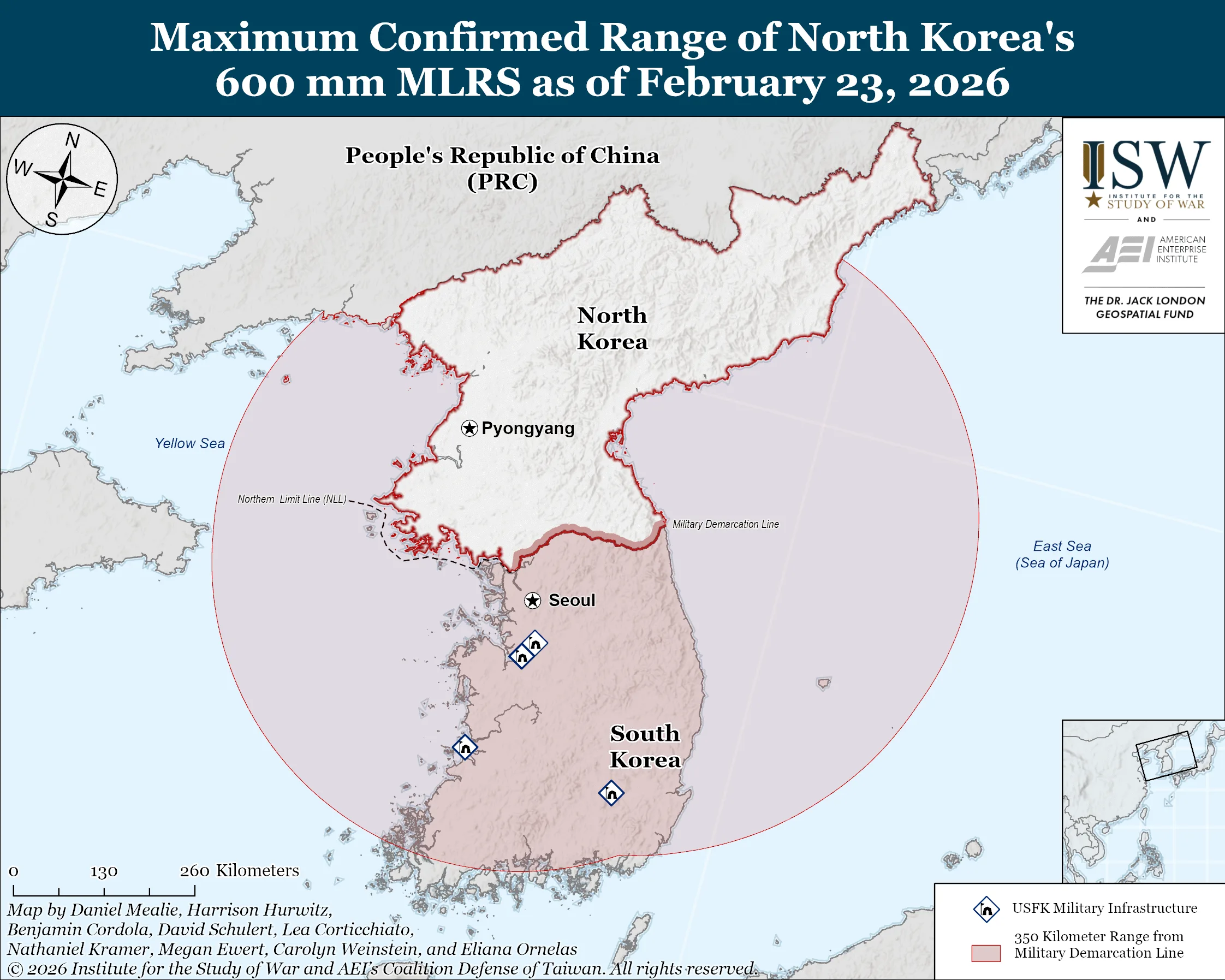
North Korea is likely trying to improve its ability to penetrate South Korea’s integrated air and missile defense (IAMD) network with short-range ballistic missiles (SRBM). That capability could enhance North Korea’s nuclear deterrent and provide the KPA with more vectors for precision fires in a wartime scenario. North Korea presented 50 600mm multiple launch rocket systems (MLRS) capable of firing SRBMs during a February 18 ceremony to the KPA and Kim Jong Un.[13] Kim claimed in his speech at the ceremony that the missile platform used artificial intelligence (AI) and a “compound targeting system” to enhance accuracy and could carry a nuclear warhead.[14] North Korean state media claimed the system is an upgraded version of the 600mm MLRS system first tested in 2019.[15] The most recent variant features five launch tubes and a wheeled chassis, whereas the previous variant had six launch tubes on a tracked chassis.[16] A wheeled chassis likely improves the system’s road-based maneuverability over the tracked variant.
The most recent variant of the 600mm MLRS may provide the KPA with a precision-strike capability that is resilient against South Korea’s IAMD network. The KPA tested the system on January 27 firing two rockets at ranges of 340 km and 350 km, respectively.[17] The tests revealed the missile’s apogee to be 80 km, comparatively low for a ballistic missile.[18] A low missile apogee could allow the projectile to avoid South Korea‘s and the United States Forces Korea (USFK)’s long-range interceptors, designed to target ballistic missiles at higher altitudes.[19] North Korea has also demonstrated the capability to produce missiles with a quasi-ballistic trajectory, meaning they can alter their path during the missile’s flight and increase the difficulty of successful intercept.[20] South Korean military experts also speculated that North Korean state media’s emphasis on the missile’s autonomy indicated it was resistant to soft-kill methods like jamming.[21] ISW-CDOT cannot independently confirm whether the new missile system features these capabilities, however.
ISW-CDOT previously assessed that North Korea’s 2021–2025 defense modernization plan emphasized “miniaturization” of nuclear weapons with diversified launch platforms to enhance the survivability of its nuclear deterrent.[22] Deploying tactical nuclear weapons with these systems would help to achieve this goal due to the high mobility of the launch platform and the ability to disperse several launchers across a wide area.
It is unlikely that most of these systems will deploy nuclear warheads due to limitations in North Korean fissile material, indicating these systems will primarily contribute to conventional military operations.[23] The US think tank Center for Strategic and International Studies (CSIS) suggested that the missile system has a maximum range of 380 km.[24] This would allow the system to target most of the Korean Peninsula if launched close to the DMZ. The missile’s range and survivability, if accurate, would allow the KPA to strike targets of strategic or operational significance behind the frontline, such as South Korean political centers, logistics hubs, command and control (C2) nodes, or USFK basing infrastructure. It is not clear whether North Korea can produce munitions with the high precision needed to execute these missions effectively, however.
ISW-CDOT has reported that Kim showcases high-end military equipment to suggest that North Korea can defend itself independently.[25] Kim is likely using the new variant of the 600mm MLRS similarly, particularly ahead of the WPK’s 9th Party Congress, both to illustrate North Korean military proficiency and their ability to scale production of these systems.
Vice Department Director of the WPK Central Committee Kim Yo Jong, the sister of Kim Jong Un, welcomed South Korean Unification Minister Chung Dong-young’s acknowledgment of South Korean drone incursions.[26] The Lee Jae Myung administration is likely to push to formalize inter-Korean dialogue channels despite likely North Korean disinterest. Chung said on February 18 that the Ministry of Unification (MOU) would pursue a series of legal amendments to prevent the recurrence of civilian drone incursions into North Korea, including codifying penalties under the Aviation Safety Act and banning drone incursions under the Inter-Korean Relations Development Act.[27] Chung also announced plans for the MOU to restore the “9.19 Inter-Korean Military Agreement,” focusing on reinstating no-fly zones near the Demilitarized Zone (DMZ). Pyongyang and Seoul established the 9.19 Military Agreement in 2018 to reduce military tensions. North Korea unilaterally terminated the agreement in 2023, and the South Korean government suspended it in 2024 in response to North Korea’s repeated violations of its terms.[28] North Korean state media reported on February 19 that Kim Yo Jong issued a response to the MOU measures, stating that she “highly regards” Chung for “expressing regret” and showing “willingness to prevent recurrence” of the drone incursions.[29] Kim warned, however, of “terrible consequences” if airspace violations continue and urged South Korea to adopt preventive steps.[30] The exchange came after South Korean nationals allegedly flew small commercial drones equipped with recording devices into various areas of North Korea from September 2025 to January 2026.[31]
A series of MOU statements and measures aimed at reducing unintended inter-Korean conflicts reflects the Lee administration’s broader efforts under the “peaceful coexistence” policy.[32] The policy prioritizes lowering military risks on the Korean Peninsula, consistent with Lee’s focus on economic stability over end-state goals such as unification. Lee’s approach also seeks to encourage North Korea’s return to dialogue by signaling a reversal from the Yoon administration’s pressure-focused policy. The MOU likely views exchanges as meaningful steps towards normalizing inter-Korean communications, which were severed in 2022.[33] The Lee administration is likely to accelerate efforts to convert the exchanges into a more formalized dialogue channel.
The likelihood of North Korea opening communications with the Lee administration remains low, however. Kim’s February 19 statement did not indicate any shift from North Korea’s hostile two-state framework, instead reiterating themes of North Korean sovereignty and the separation of the two Koreas.[34]
Key Takeaways
- North Korean politics: The WPK opened the 9th Party Congress with a focus on economic development and external security. The WPK removed key figures from its Central Committee as part of Kim Jong Un’s ongoing consolidation of power.
- North Korea military modernization: North Korea is likely trying to improve its ability to penetrate the South Korean IAMD with SRBMs. That capability could enhance its nuclear deterrent and provide it with more vectors for precision fire.
- Inter-Korean relations: The WPK welcomed South Korea’s acknowledgment of recent civilian drone incursions along the DMZ. The Lee administration may respond by further pursuing inter-Korean dialogue, though Pyongyang remains unlikely to respond positively.
North Korean Domestic Politics
See toplines.
North Korean Military Developments
See toplines.
North Korean Foreign Relations
North Korea hosted a Lunar New Year gathering for People’s Republic of China (PRC) Ambassador Wang Yajun and other officials from the PRC Embassy in Pyongyang at the Wonsan-Kalma Coastal Tourist Area on February 15.[35] North Korean Director of the Wonsan-Kalma Coastal Tourist Area Administration Kim Yong-deok told the PRC officials that the site serves to promote tourism in North Korea and that Pyongyang looks forward to exchanges and cooperation with “relevant Chinese departments.”[36] Wang said that the site would attract more domestic and international tourists, “including those from China.”[37] Wang also expressed hopes that the resort area would help promote bilateral cooperation in tourism.[38] This marks the first visit by the PRC officials to the Wonsan-Kalma Tourist Area, a 2.5-mile-long beach resort opened in July 2025.[39]
North Korea closed its borders from 2019 to 2024 due to the COVID-19 pandemic. North Korea allowed Russian tourists in 2024 and began receiving visitors from the PRC, Australia, France, Germany, and the United Kingdom in February 2025, but the regime suspended non-Russian tourism after 14 days for unspecified reasons.[40] PRC tourism has not yet resumed. PRC tourism to North Korea reached its peak in 2018 with around 200,000 visitors.[41] Seoul-based media outlet NK News estimated that North Korea generated around 175 million US dollars in revenue through PRC tourism in 2019.[42]
North Korea’s decision to host PRC Embassy officials at its foreign tourism zone may indicate its intention to resume tourism and attract PRC tourists. North Korea also reportedly featured the Wonsan-Kalma Tourist Area in a 2026 calendar issued to PRC tourists in December 2025, months after halting foreign entry in February 2025, suggesting the suspension may be temporary.[43]
Potential tourism resumption for PRC nationals would provide North Korea with additional sources of foreign currency without being subject to international sanctions enforcement. North Korea has notably increased the trip cost from around 500 US dollars in 2020 to between 1,350 US dollars and 1,800 US dollars in 2025. North Korea may exceed its 2019 estimate of 175 million US dollars if PRC tourism recovers to pre-pandemic levels.[44] North Korea’s foreign currency reserves currently come from arms sales and troop deployments to Russia, cryptocurrency theft, and operations involving overseas IT workers.[45] North Korea’s high trade deficit with the PRC, however, approximately 24 to 31 billion US dollars and nearly six to eight percent of North Korea’s GDP, requires a significant volume of foreign currency injection.[46] Potential earnings from foreign tourism could partially offset trade deficits and strengthen the regime’s resilience against sanctions.
North Korean Influence Operations
Nothing significant to report.
Inter-Korean Relations
North Korea’s minor political parties, which have primarily functioned as inter-Korean communication channels, have disappeared from public view since 2024. This development aligns with North Korea’s broader effort to disband organizations associated with unification and South Korean affairs to consolidate its hostile two-state policy. North Korean state media did not report on the 80th founding anniversary of the Chondoist Chongu Party on February 8, in contrast to its coverage of the party’s 60th and 70th anniversaries.[47] The chairman of the Chondoist Chongdu Party has customarily delivered remarks at North Korea’s annual Gaecheonjeol holiday event, which celebrates the founding of Korea’s first kingdom. The director of the WPK National Heritage Protection Bureau assumed that role in 2024.[48] North Korean state media has also not mentioned the Korean Social Democratic Party since November 2023.[49]
North Korea established these minor parties in the 1940s to support its claim of operating under a multi-party system. They functioned less as political counterparts to the WPK and more as instruments of a united front strategy targeting South Korea, however. [50] The Chondoist Chongu Party played a central role in advancing North Korea’s unification proposal, known as “the Confederal Republic of Koryo” and in cultivating pro-confederal factions within South Korea.[51] The Korean Social Democratic Party has similarly conducted pro-unification activities, including cultivating relations with influence networks in South Korea.[52] Both parties historically served as counterparts to South Korean political parties, civil society groups, and religious organizations during inter-Korean exchanges.
The disappearance of these parties indicates that North Korea is unlikely to reverse its abandonment of unification or resume inter-Korean dialogue in the near term. WPK General Secretary Kim Jong Un declared a hostile two-state framework in 2023 following the collapse of diplomacy with the United States during the Singapore and Hanoi summits and amid deteriorating inter-Korean relations under the Yoon Suk-yeol administration. North Korea disbanded key state agencies responsible for inter-Korean and unification affairs between 2023 and 2025, including the WPK United Front Department, the Committee for the Peaceful Reunification of the Country, the National Reconciliation Council, the North Side Committee for Implementing the June 15 Joint Declaration, and the Korea-Asia Pacific Peace Committee.[53] ISW-CDOT cannot confirm whether North Korea has dissolved these minor parties; however, upcoming personnel appointments at the ongoing 9th Party Congress may clarify their status.
South Korean Domestic Politics
South Korean conservative candidates may struggle to attract moderate voters ahead of the June 3 local elections, as opposition People Power Party (PPP) leadership continues its pro-Yoon positioning. Ruling Democratic Party (DP) victories in key local races would benefit the Lee administration. South Korea’s Seoul Central District Court on February 19 sentenced former South Korean President Yoon Suk-yeol to life in prison for leading an insurrection by declaring martial law. [54] The court ruled that Yoon aimed to paralyze the National Assembly by sending troops to block the site and arrest key politicians, acknowledging that Yoon “staged a riot by sending the military.”[55] Yoon, following the ruling, said on February 20 that the judiciary’s independence is questionable, making appeals meaningless.[56] Yoon declared martial law on December 3, 2024, citing the need to eradicate anti-state forces, referring to the then opposition-controlled National Assembly’s attempts to block state budget proposals and impeach Yoon government officials. The National Assembly lifted martial law six hours after Yoon’s declaration.
Leader of the PPP Jang Dong-hyuk said on February 20 that the ruling failed to provide sufficient grounds to overturn the PPP’s position that “martial law is not an insurrection.”[57] Jang instead likened the then-opposition DP’s actions to insurrection, claiming that the DP had effectively provoked Yoon to declare martial law by paralyzing the executive branch.[58] Jang’s statement did not appear to reflect the PPP’s official sentiment, as other PPP lawmakers issued statements calling for Jang to reverse his position or resign.[59]
Jang has relied on pro-Yoon supporters to maintain control of party leadership, which may complicate efforts to broaden the PPP’s appeal among moderates who largely accept the court’s ruling, ahead of the June 3 local elections.[60] PPP support hovered between 22 and 25 percent, compared with over 40 percent for the ruling Democratic Party (DP) in February.[61] A separate survey showed that about 44 percent of respondents preferred the DP to win more seats in the local elections, while 32 percent favored the PPP.[62] South Korea holds local elections every four years to elect provincial governors, mayors, county heads, local council members, and superintendents of education. Potential DP wins over Seoul and Busan mayor races, in particular, would support the Lee administration’s policy stability.
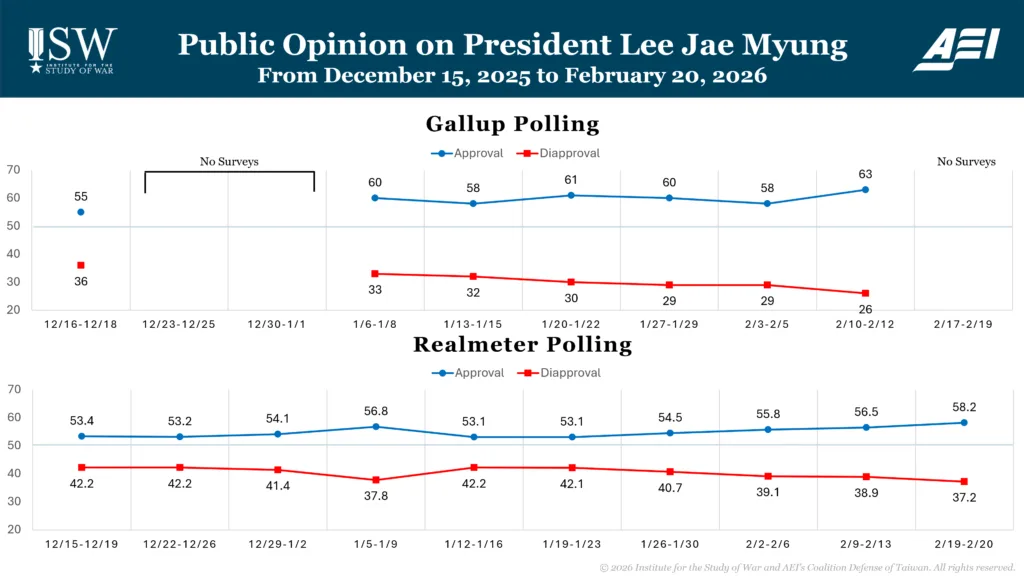
South Korean President Lee Jae Myung’s approval ratings continued their consistent upward trend over the last four weeks. Realmeter announced that Lee’s approval rating reached 58.2 percent in the third week of February, a 1.7 percent increase.[63] Realmeter attributed this week’s ratings increase to the recent Korea Composite Stock Price Index (KOSPI) boom and popular economic policies such as mortgage regulations for multi-homeowners.[64] The KOPSI index reached 5,931.86 points as of February 23, compared to 2,877.28 points on Lee’s June 4, 2025 inauguration day.[65] Realmeter further stated that people in their 40s and residents of the Seoul metropolitan area, who are highly sensitive to the real estate market, contributed to this increase.[66] Lee’s approval rating will likely keep climbing as long as the economic boom continues. Gallup did not conduct a survey this week due to the Lunar New Year holidays.
Counter-North Korean Coalition Building Efforts
An international anti-money laundering body warned the international community about North Korea’s illicit revenue-generating activities on February 13. Russia’s and the PRC’s obstruction of sanctions enforcement continues to enable North Korea to expand cryptocurrency-focused financial theft. The Financial Action Task Force (FATF), a multilateral standard-setting body for combating money laundering and terrorist financing, blacklisted North Korea, Iran, and Myanmar on February 13.[67] The FATF cited concerns over North Korea’s “continued failure” to address deficiencies related to money laundering, terrorist financing, and weapons of mass destruction (WMD) proliferation financing.[68] The FATF recommended that all countries terminate correspondent banking relations with North Korean banks, close overseas subsidiaries or branches of North Korean financial institutions, and limit business relationships and financial transactions involving North Korean nationals.[69] The FATF highlighted North Korea’s use of front companies, shell entities, joint ventures, and opaque ownership structures to evade sanctions, adding that the termination of the UN 1718 Committee Panel of Experts (PoE) mandate has weakened the international community’s ability to gather information and assess North Korea’s illicit financing networks.[70] The PoE mandate expired in March 2024 after Russia vetoed its extension and the PRC abstained.[71]
The FATF’s call for enhanced due diligence comes amid weakening sanctions enforcement. Russia’s and PRC’s dismantling of the PoE undermined multilateral investigative capacity at a time when North Korea is actively exploiting under-regulated digital asset platforms. Reports indicate that North Korea stole a record-high 2.02 billion US dollars in cryptocurrency in 2025, a 51 percent increase from 2024, accounting for 76 percent of global cryptocurrency exchange compromises that year.[72] North Korea will likely continue to exploit the decentralized and pseudonymous nature of digital assets, combined with facilitators’ evolving obfuscation techniques that make financial tracing difficult, to launder funds and support its WMD programs. FATF’s recommendations would require coordinated multilateral investigation efforts and closer cooperation with private sector financial and blockchain firms. The United States, South Korea, and Japan have already expanded their collaboration to disrupt North Korean cryptocurrency theft and recover stolen assets.[73]

[1] https://kcnawatch dot org/newstream/1771539529-716101143/respected-comrade-kim-jong-uns-opening-address-at-ninth-congress-of-wpk/
[2] https://www.ohmynews dot com/NWS_Web/View/at_pg.aspx?CNTN_CD=A0003208517&CMPT_CD=P0010&utm_source=naver&utm_medium=newsearch&utm_campaign=naver_news
[3] http://www.rodong.rep dot kp/ko/index.php?MTJAMjAyNi0wMi0yMC0wMzlAMTVAMUBAMEAxQA==
[4] http://www.rodong.rep dot kp/ko/index.php?MTJAMjAyNi0wMi0yMy0wMTdAMTVAMUBAMEA1QA==
[5] http://www.rodong.rep dot kp/ko/index.php?MTJAMjAyNi0wMi0yMy0wMTVAMTVAMUBAMEAyQDBAMA==
[6] https://nk.news1 dot kr/news/articles/6079999
[7] https://nk.news1 dot kr/news/articles/6079999
[8] https://nk.news1 dot kr/news/articles/6079999
[9] https://nk.news1 dot kr/news/articles/6079999
[10] https://repo.kinu.or dot kr/bitstream/2015.oak/2105/1/0001453489.pdf
[11] https://www.aei.org/articles/korean-peninsula-update-january-27-2026/
[12] https://www.kdi.re dot kr/kdipreview/doc.html?fn=19058_52025&rs=/kdidata/preview/pub
[13] https://kcnawatch dot org/newstream/1771453219-581373726/ceremony-of-presenting-600mm-calibre-multiple-rocket-launchers-held-in-dprk/
[14] https://www.nknews dot org/2026/02/kim-jong-un-formally-deploys-50-new-tactical-nuke-launchers-at-ceremony/?t=1771452318; https://kcnawatch dot org/newstream/1771453219-703185855/respected-comrade-kim-jong-uns-speech-at-ceremony-of-presenting-military-hardware/
[15] https://kcnawatch dot org/newstream/1771453219-581373726/ceremony-of-presenting-600mm-calibre-multiple-rocket-launchers-held-in-dprk/
[16] http://kcna dot co.jp/item/2023/202301/news01/20230101-20ee.html
[17] https://understandingwar.org/research/china-taiwan/korean-peninsula-update-february-3-2026/
[18] https://www.janes.com/osint-insights/defence-news/weapons/north-korea-tests-upgraded-large-calibre-rocket-launcher
[19] https://nationalinterest.org/blog/buzz/north-koreas-new-close-range-ballistic-missile-could-be-a-game-changer
[20] https://www.38north dot org/2024/05/north-korea-claims-autonomous-guidance-and-big-deployments-of-its-new-small-solid-srbm/
[21] https://understandingwar.org/research/china-taiwan/korean-peninsula-update-february-3-2026/
[22] https://understandingwar.org/research/china-taiwan/korean-peninsula-update-february-10-2026/
[23] https://www.nknews dot org/2026/02/kim-jong-un-formally-deploys-50-new-tactical-nuke-launchers-at-ceremony/?t=1771537879
[24] https://missilethreat.csis.org/missile/kn-25/
[25] https://understandingwar.org/research/china-taiwan/korean-peninsula-update-february-3-2026/
[26] https://www.joongang.co dot kr/article/25405661
[27] https://www.youtube.com/watch?v=wIfbUxksE70
[28] https://understandingwar.org/research/china-taiwan/korean-peninsula-update-january-22-2026/
[29] https://kcnawatch dot org/newstream/1771452843-630313854/%ea%b9%80%ec%97%ac%ec%a0%95-%ec%a1%b0%ec%84%a0%eb%a1%9c%eb%8f%99%eb%8b%b9-%ec%a4%91%ec%95%99%ec%9c%84%ec%9b%90%ed%9a%8c-%eb%b6%80%eb%b6%80%ec%9e%a5-%eb%8b%b4%ed%99%94-%eb%b0%9c%ed%91%9c/
[30] https://kcnawatch dot org/newstream/1771452843-630313854/%ea%b9%80%ec%97%ac%ec%a0%95-%ec%a1%b0%ec%84%a0%eb%a1%9c%eb%8f%99%eb%8b%b9-%ec%a4%91%ec%95%99%ec%9c%84%ec%9b%90%ed%9a%8c-%eb%b6%80%eb%b6%80%ec%9e%a5-%eb%8b%b4%ed%99%94-%eb%b0%9c%ed%91%9c/
[31] https://www.joongang.co dot kr/article/25405531
[32] https://unikorea.go dot kr/ebook/2026plan/#page=6
[33] https://www.ytn.co dot kr/_ln/0101_202602191129144314
[34] https://www.bbc.com/korean/articles/c4nyjy7l859o
[35] https://www.yna.co dot kr/view/AKR20260215005800504?section=nk/news/all
[36] https://www.nknews dot org/2026/02/chinese-envoy-visits-north-koreas-wonsan-kalma-resort-raises-hopes-for-tourism/#:~:text=Kim%20Jong%20Un%20officially%20opened,to%20tourists%20from%20other%20countries.
[37] https://www.nknews dot org/2026/02/chinese-envoy-visits-north-koreas-wonsan-kalma-resort-raises-hopes-for-tourism/#:~:text=Kim%20Jong%20Un%20officially%20opened,to%20tourists%20from%20other%20countries.
[38] https://mp.weixin.qq dot com/s/rZSKdqUUlQDjxBGFBVMm7w
[39] https://www.38north.org/2025/07/wonsan-kalma-beach-resort-hosts-a-high-level-visit/
[40] https://www.sixthtone dot com/news/1016723; https://www.bbc.com/news/articles/c707d1ez0kno
[41] https://www.upi dot com/Top_News/World-News/2019/09/09/North-Korea-Tourist-visits-in-2018-reached-200000/2311568039535/#:~:text=11:07%20AM-,Sept.,travelers%20to%20South%20Korea%20annually.
[42] https://www.nknews dot org/2019/10/as-chinese-tourism-to-north-korea-soars-local-operators-feel-the-strain/
[43] https://www.scmp dot com/news/asia/east-asia/article/3335934/north-korea-beckons-chinese-tourists-beach-resort-2026-calendar?module=perpetual_scroll_0&pgtype=article
[44] https://www.nknews dot org/2019/10/as-chinese-tourism-to-north-korea-soars-local-operators-feel-the-strain/; https://www.bbc.com/news/articles/c707d1ez0kno; https://www.sixthtone dot com/news/1016723
[45] https://www.chainalysis dot com/blog/crypto-hacking-stolen-funds-2026/; https://www.nknews dot org/2025/04/north-korea-has-earned-estimated-20b-from-military-support-for-russia-report/#:~:text=North%20Korea%20has%20earned%20estimated,contributions%2C%20according%20to%20the%20report.
[46]
https://m.kdi.re dot kr/file/download?atch_no=iYhs%2BOcF1lGPH40hOjO0cg%3D%3D
[47] https://www.yna.co dot kr/amp/view/AKR20260212049800504
[48] https://www.yna.co dot kr/amp/view/AKR20260212049800504
[49] https://www.yna.co dot kr/amp/view/AKR20260212049800504
[50] https://encykorea.aks.ac dot kr/Article/E0055826#:~:text=%EC%B2%9C%EB%8F%84%EA%B5%90%EC%B2%AD%EC%9A%B0%EB%8B%B9%EC%9D%B4%20%EC%A0%84%EA%B0%9C%ED%95%9C%20%EC%A0%95%EB%8B%B9%ED%99%9C%EB%8F%99%EB%8F%84%20%EC%A1%B0%EC%84%A0%EC%82%AC%ED%9A%8C%EB%AF%BC%EC%A3%BC%EB%8B%B9%EC%9D%98%20%EA%B2%BD%EC%9A%B0%EC%99%80%20%EA%B0%99%EC%9D%B4%20%EB%8C%80%EB%82%A8%EC%84%B1%EB%AA%85%EC%9D%98,%C2%B7%20%EC%82%AC%ED%9A%8C%EB%8B%A8%EC%B2%B4%20%EC%97%B0%EC%84%9D%ED%9A%8C%EC%9D%98%EC%9D%98%20%EA%B0%9C%EC%B5%9C%20%EC%A3%BC%EC%9E%A5%EC%8B%9C%EC%97%90%20%EC%A1%B4%EC%9E%AC%EB%A5%BC%20%EB%82%98%ED%83%80%EB%82%B4%EB%8A%94; https://encykorea.aks.ac dot kr/Article/E0066200
[51] https://encykorea.aks.ac dot kr/Article/E0055826#:~:text=%EC%B2%9C%EB%8F%84%EA%B5%90%EC%B2%AD%EC%9A%B0%EB%8B%B9%EC%9D%B4%20%EC%A0%84%EA%B0%9C%ED%95%9C%20%EC%A0%95%EB%8B%B9%ED%99%9C%EB%8F%99%EB%8F%84%20%EC%A1%B0%EC%84%A0%EC%82%AC%ED%9A%8C%EB%AF%BC%EC%A3%BC%EB%8B%B9%EC%9D%98%20%EA%B2%BD%EC%9A%B0%EC%99%80%20%EA%B0%99%EC%9D%B4%20%EB%8C%80%EB%82%A8%EC%84%B1%EB%AA%85%EC%9D%98,%C2%B7%20%EC%82%AC%ED%9A%8C%EB%8B%A8%EC%B2%B4%20%EC%97%B0%EC%84%9D%ED%9A%8C%EC%9D%98%EC%9D%98%20%EA%B0%9C%EC%B5%9C%20%EC%A3%BC%EC%9E%A5%EC%8B%9C%EC%97%90%20%EC%A1%B4%EC%9E%AC%EB%A5%BC%20%EB%82%98%ED%83%80%EB%82%B4%EB%8A%94; https://encykorea.aks.ac dot kr/Article/E0066200
[52] https://nkinfo.unikorea.go dot kr/nkp/knwldg/view/knwldg.do;jsessionid=rzDgmUC175knD_dQzlbB_QFx4dL-zasuV8IMlEin.ins12
[53] https://www.yna.co dot kr/amp/view/AKR20260212049800504
[54] https://en.yna.co dot kr/view/AEN20260220006152315
[55] https://en.yna.co dot kr/view/AEN20260220006152315
[56] https://www.mbn.co dot kr/news/politics/5176820; https://en.yna.co dot kr/view/AEN20260220006152315
[57] https://www.joongang.co dot kr/article/25406008
[58] https://www.joongang.co dot kr/article/25406008
[59] https://www.ohmynews dot com/NWS_Web/View/at_pg.aspx?CNTN_CD=A0003208942
[60] https://news.nate dot com/view/20260222n00056
[61] https://www.gallup.co dot kr/gallupdb/reportContent.asp?seqNo=1622
[62] https://www.gallup.co dot kr/gallupdb/reportContent.asp?seqNo=1620
[63] http://www.realmeter dot net/%ec%97%90%eb%84%88%ec%a7%80%ea%b2%bd%ec%a0%9c%ec%8b%a0%eb%ac%b8-%eb%a6%ac%ec%96%bc%eb%af%b8%ed%84%b0-2%ec%9b%94-3%ec%a3%bc-%ec%b0%a8-%ec%a3%bc%ea%b0%84-%eb%8f%99%ed%96%a5-%e6%9d%8e-%eb%8c%80/
[64] http://www.realmeter dot net/%ec%97%90%eb%84%88%ec%a7%80%ea%b2%bd%ec%a0%9c%ec%8b%a0%eb%ac%b8-%eb%a6%ac%ec%96%bc%eb%af%b8%ed%84%b0-2%ec%9b%94-3%ec%a3%bc-%ec%b0%a8-%ec%a3%bc%ea%b0%84-%eb%8f%99%ed%96%a5-%e6%9d%8e-%eb%8c%80/
[65] https://markets.hankyung dot com/indices/kospi
[66] http://www.realmeter dot net/%ec%97%90%eb%84%88%ec%a7%80%ea%b2%bd%ec%a0%9c%ec%8b%a0%eb%ac%b8-%eb%a6%ac%ec%96%bc%eb%af%b8%ed%84%b0-2%ec%9b%94-3%ec%a3%bc-%ec%b0%a8-%ec%a3%bc%ea%b0%84-%eb%8f%99%ed%96%a5-%e6%9d%8e-%eb%8c%80/
[67] https://www.yna.co dot kr/view/AKR20260218024800002?input=1195m
[68] https://www.fatf-gafi dot org/en/publications/High-risk-and-other-monitored-jurisdictions/Call-for-action-february-2026.html
[69] https://www.fatf-gafi dot org/en/publications/High-risk-and-other-monitored-jurisdictions/Call-for-action-february-2026.html
[70] https://www.fatf-gafi dot org/en/publications/High-risk-and-other-monitored-jurisdictions/Call-for-action-february-2026.html
[71] https://www.csis.org/analysis/russias-veto-dismembering-un-sanctions-regime-north-korea
[72] https://www.chainalysis dot com/blog/crypto-hacking-stolen-funds-2026/
[73] https://www.mofa.go dot kr/www/brd/m_25605/view.do?seq=10&srchFr=&srchTo=&srchWord=&srchTp=&multi_itm_seq=0&itm_seq_1=0&itm_seq_2=0&company_cd=&company_nm=