
Key Takeaways
- The Crimea occupation administration has closed the majority of children’s summer camp programs in occupied Crimea until September 1. The closure and evacuation of summer camps in occupied Crimea is likely to increase the risk of Ukrainian children being taken to summer camp programs deeper within Russia and exposed to additional re-education efforts.
- The Russian government is further solidifying its control over history education in occupied Ukraine, disseminating state narratives via state-curated textbooks and mandated curricula.
- Kremlin-controlled Russian Orthodox Church (ROC) clergy members and Donetsk Oblast occupation officials are facilitating religious programming at schools to militarize and indoctrinate Ukrainian schoolchildren under Russian occupation. Administrators continue efforts to prepare and motivate Ukrainian children and teenagers for eventual service in the Russian military, including by gamifying drone operations.
- Russia is setting conditions to hold State Duma elections for the first time in occupied Ukraine. The elections will not be free or fair.
- Russia is expanding digital governance in occupied Ukraine through the Russian Unified Public Services Portal (Gosuslugi).
- Fuel and water shortages, electricity outages, and the ongoing threat of Ukrainian drone strikes in occupied Crimea may generate short-term demographic impacts that could solidify in the longer term if the strike campaign persists.
- Russian occupation officials plan to implement Russian-style internal surveillance and population control architecture in occupied Donetsk Oblast.
- Russian state-owned bank Promsvyazbank’s (PSB) operations in occupied Ukraine support Russia’s wider efforts to force occupied areas into financial dependency on the Russian state.
- Russia continues to advance efforts to open customs and cargo checkpoints at ports in occupied Ukraine in order to further integrate these ports into Russia’s customs control and export systems.
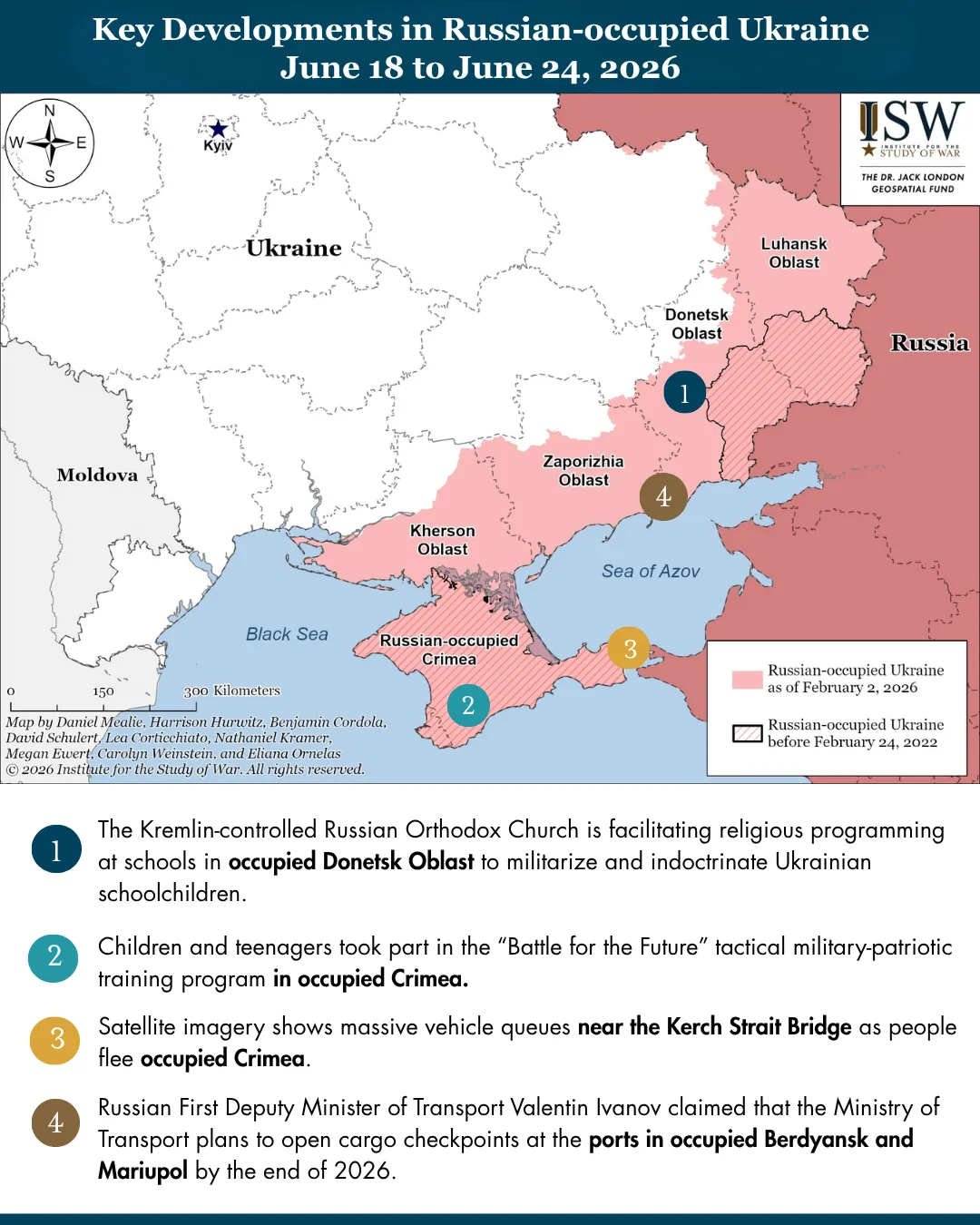
Deportation and Forcible Transfer of Ukrainian Citizens, Including Children
The Crimea occupation administration has closed the majority of children’s summer camp programs occurring in occupied Crimea until September 1 in response to Ukraine’s intensifying intermediate-range strike campaign against Russian energy and military assets located on and near the peninsula. Crimea occupation head Sergei Aksyonov announced the total suspension of the reservation, admission, and placement of children in children’s recreation and health facilities or related tourist activities in Crimea as of 1100 local time on June 22.[1] Aksyonov stated that the measures are necessary to ensure public safety “in the current situation,” obliquely referencing Ukrainian drone strikes on Russian assets across occupied Crimea. The Russian Ministry of Education announced on June 22 that it was facilitating the evacuation of children from the Artek International Children’s Center to “their permanent residences” alongside unspecified Russian security services.[2] Russian officials and media sources also noted the closure of the Alyye Parusa, Mandarin, Salat-Ak Bars, Kiparis, and Satera summer camps, amongst others.[3] ISW and other organizations such as the Yale Humanitarian Research Lab have long assessed that Russia exposes Ukrainian children at many of these Crimean summer camps to Russification, military-patriotic education, and overt militarization.[4]
The closure and evacuation of summer camps in occupied Crimea already appears to be proceeding chaotically, which is likely to increase the risk of Ukrainian children being taken to summer camp programs deeper within Russia and exposed to additional re-education efforts. Sevastopol occupation governor Mikhail Razvozhaev announced on June 22 that the Lapsy, Gorny, and Alkadar camps in occupied Sevastopol will continue to receive children and host summer camp sessions as planned on June 23 and June 24, despite closures throughout the rest of Crimea.[5] This is likely due to the fact that Russian law considers Sevastopol and its surrounding environs as an administrative entity distinct from the rest of occupied Crimea. Artek announced that children who are being evacuated from Artek also have the option to continue programming at a children’s camp in Russia’s Krasnodar Krai.[6] Nail Khairullin, Director of the Yamalo-Nenets Autonomous Okrug Department of Youth Policy, advertised that there are open spots remaining at the Ellada and Yubileiny summer camps in Krasnodar Krai and at an unspecified camp in Noyabrsk, Yamalo-Nenets, suggesting that Russian officials are engaged in efforts to transfer children from summer camps in Crimea to programs within Russia.[7] The lack of clarity over which camps remain open and operational, the mechanisms with which Russian officials and security forces will return children to their homes, and Russian efforts to send children from Crimean camps to camps within Russia are all likely to inject substantial confusion and difficulty in tracking where some of the children end up. International humanitarian law differentiates between the forced transfer of children within a country’s national borders (for example the transfer of children from occupied Kherson Oblast to Artek in occupied Crimea) versus the deportation of children outside of national borders (for example the deportation of children from occupied Kherson Oblast to a summer camp in Krasnodar Krai) — both important legal distinctions that Russia has systematically ignored and violated in its treatment of Ukrainian children.[8]

Sociocultural Control
The Russian government is further solidifying its control over history education in occupied Ukraine, disseminating state narratives via state-curated textbooks and mandated curricula. Russian Minister of Education Sergei Kravtsov announced on June 23 that the Russian government will introduce unified state textbooks on the “history of Donbas and Novorossiya” for students in grades five to seven in occupied Ukraine starting on September 1, 2026.[9] Kravtsov also noted that Russia has approved a unified concept for history education in Russia and occupied Ukraine, which includes increasing the number of hours dedicated to teaching Russian history in schools. The Russian Ministry of Education has been invested in introducing a unified history curriculum in schools in occupied Ukraine since 2023, when Russia began distributing unified tenth- and eleventh-grade history textbooks in occupied Ukraine that amplified Russian narratives on the “reunification of Crimea,” “the 2014 coup d’etat in Ukraine,” and “the causes and course of the special military operation.”[10] Kremlin officials have admitted that the unified history textbook highlights Russia’s ideological justifications for the illegal invasion and annexation of parts of Ukraine, and that the textbook denies Ukrainian statehood.[11] The history textbook is the latest in a series of Russian efforts to effectively infiltrate the school system in occupied Ukraine and spread pro-Russian narratives to children and teenagers via mandatory curricula.[12]
The Kremlin-controlled Russian Orthodox Church (ROC) continues to interface with Ukrainian children and expose them to pro-Russian indoctrination. ISW has previously assessed that the ROC acts as a direct extension of the Kremlin’s governance policy in occupied Ukraine.[13] The ROC’s occupied Donetsk Diocese claimed on June 16 that clergy members facilitated church visits, prayer services, and conversations about Russian Orthodox Christianity for children from school-affiliated camps.[14] Four groups from a school-affiliated summer camp, Solnyshko, visited the Church of St. Andrew the First-Called and the Church of the Three Hierarchs in occupied Donetsk City on June 8.[15] A group of students from an after-school camp visited the Church of the Holy Apostles of Peter and Paul in occupied Mospyne on June 11.[16] A group of students from a school-affiliated summer camp, Rainbow, visited St. Vladimir’s Church in occupied Donetsk City on June 15.[17] ROC clergy members facilitate such activities to impose Russian identity and culture on children attending school camps and to bolster Russian influence.[18]
ROC clergy members and Donetsk Oblast occupation officials are facilitating religious programming at schools to militarize and indoctrinate Ukrainian schoolchildren. Rector of the Holy Church of the Holy Blessed Prince Dmitry Donskoy, Dimitry Samonchev, led a conversation about spirituality and a morning exercise session for children at a school-affiliated summer camp, Rucheyok, in occupied Makiivka on June 9.[19] ROC clergy members likely combined religion and physical fitness exercise to use spirituality as a militarization tool, preparing children in occupied Ukraine both physically and mentally for future service in the Russian Armed Forces.[20] Donetsk Oblast occupation officials are increasingly involving the ROC in spiritual and moral education efforts in primary and secondary schools. The Rector of the Church of St. John Chrysostom, Georgy Stepanov, held a school consecration ceremony at the initiative of a secondary school administration in occupied Sarabash on June 11.[21] The occupied Donetsk Oblast Ministry of Education claimed on June 17 that it launched a pilot program to introduce a Russian Orthodox religious component into preschool education at 17 kindergartens, following discussions involving education officials, municipal authorities, and representatives of the ROC’s occupied Donetsk Diocese.[22] The initiative aims to familiarize children at an early age with Russian Orthodox culture and traditions of the Russian people, and to establish continuity in moral education between preschool and primary education.[23] The ROC’s increased involvement in preschools and secondary schools highlights occupation officials’ efforts to use spirituality as a tool to indoctrinate Ukrainian children and increase Russian influence in occupied Ukraine.
Militarization of Occupied Areas
Russian occupation administrators continue efforts to prepare and motivate Ukrainian children and teenagers for eventual service in the Russian military. The Crimean Patriot Center — a youth military-tactical training center in occupied Simferopol — announced on June 16 the start of the “Battle for the Future – Crimea” project.[24] Battle for the Future is a joint endeavor of the Crimean Patriot Center, the Crimea occupation Ministry of Education, Science, and Youth, and the Russian federal Defenders of the Fatherland Foundation that aims to commemorate Crimean partisan activities during the Second World War. Cadets from the Crimean Patriot Center and from the occupied Crimea branch of Yunarmia (Russian Young Army Cadets National Movement) took part in Battle for the Future under the mentorship of Russian veterans of the war in Ukraine. Children and teenagers participated in training on first aid, grenade throwing, tactical maneuvers, machine gun assembly, and shooting at moving targets.[25] The Crimean Patriot Center lauded the event as “an effective platform for sharing combat experience” with children and teenagers and claimed that it instilled “patriotic values in the younger generation.”[26] Pictures from the event show elementary school-aged children dressed in military-style fatigues holding service weapons.[27]
Yunarmia’s occupied Donetsk Oblast branch additionally announced on June 23 that the second stage of the selection process for the “Young Paratrooper” training camp for teenagers aged 13 to 17, which will run between July 30 and August 4.[28] The second stage of the selection process involves writing an essay on the role of the Russian airborne forces in the modern army. Young Paratrooper is a military-patriotic sports club for youth active throughout Russia and occupied Ukraine that aims to implement “a comprehensive military-patriotic education program” for “pre-conscription-aged young men.”[29] A similar program called “Yevpatoria Paratrooper” has been active in occupied Crimea since 2017, teaching tactical skills and military-patriotic curricula to young children.[30] ISW continues to assess that the proliferation of youth-focused programs and organizations intended to disseminate military-style training to children and teenagers in occupied Ukraine is intended to prepare Ukrainian youth for potential future service in the Russian military.[31]
The Crimea occupation administration continues to gamify drone operations in order to interest Ukrainian teenagers in eventual military service. Occupied Crimea-based media reported on June 19 that the final stage of the “Intellect — Crimean Drone League” drone racing competition took place in occupied Simferopol.[32] The drone league supports Crimea occupation head Sergei Aksyonov’s strategic initiative of creating a “strategic talent pool” of drone operators in occupied Crimea.[33] Occupation administrators across occupied Ukraine, and particularly in Crimea, have recently intensified efforts to institutionalize drone training programs for youth in the form of school courses and drone racing leagues and competitions.[34] Such initiatives normalize the proliferation of unmanned technologies amongst young people, covertly preparing Ukrainian youth for service in the contemporary Russian military.
Administrative and Bureaucratic Control
Russia is setting conditions to hold State Duma elections for the first time in occupied Ukraine. Russian Central Election Commission (CEC) Chairperson Ella Pamfilova stated on June 17 that the CEC decided to hold State Duma elections on September 20 in occupied Ukraine following consultations with the Russian Ministry of Defense (MoD), Federal Security Service (FSB), and regional occupation administrators.[35] Head of the Luhansk People’s Republic (LNR) occupation Electoral Commission Marinna Sumskaya stated on June 17 that occupied Luhansk Oblast’s electoral system has been fully integrated into the Russian one, and that elections will take place using the new “Elections 2.0” Russian state automated system (GAS).[36] GAS is Russia’s state information system designed for the automation and data management of elections, and launched its 2.0 version in early 2026.[37] The conduct of elections in occupied Ukraine on Russian software is likely to allow Russia to manipulate and control election results, as they likely have done in previous sham referenda in occupied Ukraine since 2014.[38] Kherson Oblast occupation Electoral Commission Chairperson Marina Zakharova claimed on June 20 that the Kherson Oblast occupation administration has decided not to allow remote electronic voting due to the security situation, and called on residents to participate in more traditional in-person voting measures at polling stations.[39]
The upcoming Russian State Duma elections in occupied Ukraine will not be free and fair. Russia has been preparing to control and manipulate the State Duma elections in occupied Ukraine since early 2026, including by finalizing the distribution of single-mandate constituencies in occupied areas and approving candidate lists of largely pro-Russian loyalists in April.[40] The ruling United Russia party is all but guaranteed to maintain its supremacy in occupied areas, as it has done in occupied Crimea since 2014.[41] Russian officials are already setting the expectation that elections will be carried out in an atmosphere of intense securitization and militarization, which is likely to impact overall voting behavior. The use of Russia’s state-controlled automated voting management system will also likely impact the conduct of the elections and skew voting outcomes. Russia relies on the conduct of elections in occupied Ukraine to maintain the guise of legitimacy and grassroots approval for its illegal occupation.[42]
Russia is expanding digital governance in occupied Ukraine through the Russian Unified Public Services Portal (Gosuslugi). Zaporizhia Oblast occupation Minister of Digital Development Grigoriy Prokhvatilov claimed on June 19 that the number of electronic federal and regional public services available to residents of occupied Zaporizhia Oblast on Gosuslugi has exceeded 100.[43] Donetsk People’s Republic (DNR) Prime Minister Andrei Chertkov announced on June 17 that the Donetsk Oblast occupation Ministry of Digital Development, Communications, and Mass Media is working on ways to accept applications for compensation for damaged or destroyed housing via Gosuslugi.[44] Chertkov emphasized that the Donetsk Oblast occupation administration is prioritizing the electronic submission of compensation documents. Russia has deployed Gosuslugi in occupied Ukraine as a central instrument of bureaucratic control and forced integration by using the application to tie basic service provision to Russian documentation.[45] Gosuslugi effectively functions as a bureaucratic gatekeeper — residents of occupied areas must first and foremost obtain Russian documentation to use the application, which is required for many simple administrative tasks such as property registration and social benefits allocation.
Occupation Administration Mismanagement and Internal Dynamics
Fuel shortages are worsening in occupied Crimea as the occupation administration continues to struggle to respond to Ukraine’s intermediate-range strike campaign against Russian fuel and logistics assets. Crimea occupation head Sergei Aksyonov announced that as of 0900 local time on June 21, all gas stations in occupied Crimea stopped selling fuel to any non-governmental individuals or entities.[46] Sevastopol occupation governor Mikhail Razvozhaev additionally announced that Sevastopol was pausing all fuel sales on June 22 and 23, except to emergency vehicles.[47] Fuel shortages are deepening throughout all of Russia and in occupied Ukraine due to Ukrainian strikes, but the impacts appear particularly acute in Crimea because of its isolated geographic position and tenuous and vulnerable physical connection to Russia.[48] The Crimea occupation administration announced on June 23, however, that passenger cars are now allowed to transport 200 liters of fuel per vehicle across the Kerch Strait Bridge, likely in an attempt to mitigate some of the fuel provision bottlenecks.[49]
Much of occupied Crimea is also experiencing electricity outages on top of fuel shortages. Crimean occupation energy company Krymenergo introduced electricity consumption restrictions on June 21.[50] Ukrainian military observer Kostyantyn Mashovets reported on June 22 that occupied Crimea is starting to have electricity and water issues, as there are power outages affecting critical equipment operations at the state water enterprise in Crimea.[51] Social media users in occupied Crimea have recently reported power outages in occupied Armyansk, Alushta, Simferopol, Sevastopol, and Dzhankoi.[52]
Fuel and water shortages, electricity outages, and the ongoing threat of Ukrainian drone strikes in occupied Crimea may generate short-term demographic impacts that could solidify in the longer term if the strike campaign persists. Crimea’s demographics have been fundamentally altered since Russia’s 2014 invasion and annexation, following which hundreds of thousands of Russians moved to the peninsula.[53] Many of these expatriates were Russian military and security personnel, particularly associated with the Russian Black Sea Fleet (BSF), which was based in occupied Crimea until mid-July 2024.[54] Ukrainian Navy Spokesperson Captain Third Rank Dmytro Pletenchuk stated on June 23 that the families of Black Sea Fleet (BSF) servicemembers living in occupied Crimea are trying to leave for Novorossiysk, Krasnodar Krai as a result of the strike campaign.[55] Russian tourism, which accounts for a substantial portion of Crimea’s economy, is also fleeing the peninsula. Russian Union of Travel Industry Head Ilya Umansky claimed on June 24 that Aksyonov’s decision to cancel children’s summer camps “deprived the region of a huge guaranteed flow of tourists, which annually supported hundreds of local businesses.”[56] Satellite footage from June 24 shows a massive buildup of vehicles heading towards the Kerch Strait Bridge from occupied Crimea — suggesting substantial numbers of people are actively leaving the area back to Russia.[57] The outflow of Russian residents of Crimea and of Russian tourists is likely to impact the demographic situation in Crimea, at least temporarily. Longer-term demographic shifts back to pre-2014 population dynamics will be in part a function of Ukraine’s ability to maintain its strike campaign to isolate occupied Crimea from Russia.
Physical and Legal Repressions
Donetsk Oblast occupation officials plan to implement a Russian-style internal surveillance and population control architecture in occupied Donetsk Oblast. CEO of Russian management company IC Invest Yekaterina Belousova claimed on June 18 that Donetsk Oblast occupation authorities plan to implement the “Safe Region” video surveillance system as part of broader infrastructure and digital development projects.[58] Russian regions, including Moscow and Kaliningrad oblasts, operate similar systems.[59] The initiative will include urban video monitoring and road safety systems, supported by the construction of a certified data center to store and process data and ensure the operation of digital services.[60] Belousova claimed that the project follows a memorandum signed at the St. Petersburg International Economic Forum and builds on Donetsk Oblast occupation administration’s May 2025 establishment of a state institution responsible for maintaining emergency call systems and public alert infrastructure.[61] Russian occupation officials previously used a similar “Safe City” platform (the municipal-level analogue of “Safe Region”) in occupied Crimea to surveil the population and discourage dissent, while empowering Russian security forces to crack down against identified pro-Ukrainian partisan activity.[62] The expansion of a similar initiative into occupied Donetsk Oblast indicates occupied Donetsk Oblast officials’ intensification of efforts to monitor residents and consolidate Russian law enforcement’s control over occupied populations.
Russian occupation courts issued harsh sentences and initiated cases against residents of occupied Ukraine for alleged pro‑Ukrainian activities between June 16 and 22. ISW collected information on eight total court cases involving residents of occupied Luhansk, Kherson, and Zaporizhia oblasts between June 16 and June 22, resulting in five different types of charges: terrorism or terrorism-related charges; state treason; espionage; financing Ukrainian forces; and extremism.[63] Russian-controlled courts harshly punished residents for their perceived affiliation with, or support for, the Ukrainian government or military in all eight cases. In one case, the occupied Zaporizhia Oblast branch of the Russian Federal Security Service (FSB) detained two women on suspicion of state treason on the allegation that they used Ukrainian banking apps to transfer funds to the Ukrainian military.[64] ISW has previously assessed that Russian security forces rely on tenuous evidence, such as the presence of a Ukrainian banking app on someone’s phone, to detain individuals on suspicion of “treason” or “espionage.”[65] Russian court action against Ukrainians for their perceived proximity to the Ukrainian state or Ukrainian military represents a form of lawfare that has been key to Russia’s repressive apparatus in occupied Ukraine.
Economic and Financial Control
Russian state-owned bank Promsvyazbank’s (PSB) operations in occupied Ukraine support Russia’s wider efforts to force occupied areas into financial dependency on the Russian state. PSB Deputy Chairman Mikhail Dorofeev claimed on June 19 that PSB is focusing on expanding in occupied Ukraine and that there are now more PSB branches per capita in occupied Ukraine than in Moscow Oblast.[66] Dorofeev claimed that PSB has led a “revolution” in the financial sector in occupied areas near the frontline in Ukraine, highlighting the presence of regular and 24-hour ATMs in occupied Kakhovka and Nova Kakhovka, Kherson Oblast. PSB’s occupied Zaporizhia Oblast branch reported on June 19 that it has approved 2,000 small business loans since the beginning of 2026 — a 50 percent increase compared to 2025.[67] PSB’s proliferation in occupied Ukraine, as well as its increased entrenchment in daily local-level financial services, is likely to generate long-term financial dependencies on the wider Russian banking system, further forcing the integration of these areas into Russia’s sphere of influence.[68]
Information Space Control
Nothing significant to report.
Infrastructure and Development Projects
Russia continues to advance efforts to open customs and cargo checkpoints at ports in occupied Ukraine in order to further integrate these ports into Russia’s customs control and export systems. Russian First Deputy Minister of Transport Valentin Ivanov claimed on June 16 that the Ministry of Transport plans to open cargo checkpoints at the ports in occupied Berdyansk and Mariupol by the end of 2026.[69] The Russian government approved decrees in 2025 on the establishment of border checkpoints at both the Mariupol and Berdyansk ports, and has since opened both ports to foreign-flagged ships.[70] The codification of customs and cargo checkpoints at these ports will likely further allow Russia to use them for the export of stolen Ukrainian goods to foreign markets.[71] Russia has already used both ports for the export of stolen Ukrainian wheat and metallurgical coke, but the formalization of customs checkpoints will likely scale up the export capacity of each port, particularly to international markets.[72]

[1] https://t.me/Aksenov82/9735; https://rk.gov dot ru/documents/5835745d-6c8e-426b-9904-950b6e203486
[2] https://t.me/minprosrf/18681
[3] https://t.me/nailkhairullin/2452; https://t.me/minprosrf/18681; https://t.me/idelrealii/45428; https://iz dot ru/2119716/naina-kurbanova/ne-do-kanikul-chto-budet-s-detskim-otdykhom-v-krymu
[4] https://ysph.yale.edu/download-file/56121661-9ac4-4e8b-a5e0-cb907c74fbc3/; https://understandingwar.org/research/russia-ukraine/russian-occupation-update-may-7-2026/; https://injir dot org/ua/dityachiy-tabir-fortuna-v-okupovanomu-krimu-okupanti-peretvorili-na-maydanchik-dlya-viyskovoyi-pidgotovki-ditey-16-05-2026/; https://understandingwar.org/research/russia-ukraine/russian-occupation-update-august-21-2025/; https://understandingwar.org/research/russia-ukraine/russian-occupation-update-january-22-2026/
[5] https://t.me/razvozhaev/21682
[6] https://t.me/artek1925/22731
[7] https://t.me/nailkhairullin/2452
[8] https://understandingwar.org/wp-content/uploads/2024/03/24-210-0120ISW20Occupation20playbook.pdf
[9] https://t.me/government_rus/30581
[10] https://www.interfax dot ru/russia/914508 ; http://kremlin dot ru/events/president/news/71892; https://understandingwar.org/research/russia-ukraine/russian-offensive-campaign-assessment_2-14/; https://www.amnesty.org/en/latest/news/2023/09/ukraine-russia-new-history-textbook-is-a-blatant-attempt-to-unlawfully-indoctrinate-school-children-in-russia-and-russian-occupied-ukrainian-territories/; https://www.voanews.com/a/7226178.html; https://www.hrw.org/report/2024/06/20/education-under-occupation/forced-russification-school-system-occupied-ukrainian ; https://www.atlanticcouncil.org/blogs/ukrainealert/putin-weaponizes-history-with-new-textbook-justifying-ukraine-invasion/; https://meduza dot io/en/feature/2023/08/07/such-unique-times-are-rare-in-history; https://understandingwar.org/research/russia-ukraine/russian-offensive-campaign-assessment-june-22-2025/
[11] https://understandingwar.org/research/russia-ukraine/russian-offensive-campaign-assessment-june-22-2025/
[12] https://understandingwar.org/research/russia-ukraine/russian-occupation-update-september-19-2025-2/; https://understandingwar.org/research/russia-ukraine/russian-occupation-update-june-9-2025/; https://understandingwar.org/research/russia-ukraine/russian-occupation-update-june-26-2025/; https://understandingwar.org/research/russia-ukraine/russian-occupation-update-july-14-2025/
[13] https://understandingwar.org/research/russia-ukraine/the-russian-orthodox-church-declares-holy-war-against-ukraine-and-articulates-tenets-of-russias-emerging-official-nationalist-ideology/; https://understandingwar.org/research/russia-ukraine/russian-occupation-update-may-19-2025/ ;
[14] https://dan-news dot ru/obschestvo/deti-iz-prishkolnyh-lagerej-znakomjatsja-s-pravoslaviem-v-hramah-doneckoj-eparhii/
[15] https://dan-news dot ru/obschestvo/deti-iz-prishkolnyh-lagerej-znakomjatsja-s-pravoslaviem-v-hramah-doneckoj-eparhii/
[16] https://dan-news dot ru/obschestvo/deti-iz-prishkolnyh-lagerej-znakomjatsja-s-pravoslaviem-v-hramah-doneckoj-eparhii/
[17] https://dan-news dot ru/obschestvo/deti-iz-prishkolnyh-lagerej-znakomjatsja-s-pravoslaviem-v-hramah-doneckoj-eparhii/
[18] https://understandingwar.org/research/russia-ukraine/russian-occupation-update-august-21-2025/; https://understandingwar.org/research/russia-ukraine/russian-occupation-update-january-15-2026/
[19] https://dan-news dot ru/obschestvo/deti-iz-prishkolnyh-lagerej-znakomjatsja-s-pravoslaviem-v-hramah-doneckoj-eparhii/
[20] https://understandingwar.org/research/russia-ukraine/russian-occupation-update-august-21-2025/
[21] https://dan-news dot ru/obschestvo/deti-iz-prishkolnyh-lagerej-znakomjatsja-s-pravoslaviem-v-hramah-doneckoj-eparhii/
[22] https://t.me/dnronline/139870
[23] https://t.me/dnronline/139870
[24] https://t.me/crimean_patriot/11549
[25] https://t.me/crimean_patriot/11588; https://t.me/crimean_patriot/11578; https://t.me/crimean_patriot/11566; https://t.me/crimean_patriot/11549
[26] https://t.me/crimean_patriot/11588
[27] https://t.me/crimean_patriot/11588
[28] https://vk dot com/wall-180860093_60192
[29] https://www.vesti dot ru/ns/skvorcov-yunyj-desantnik-ehto-ne-prosto-klub-a-shkola-zhizni-dlya-molodezhi
[30] https://suspilne dot media/1087826-zivij-sit-ak-rosiani-militarizuut-ditej-na-bazi-vijskovoi-castini-v-okupovanij-evpatorii/
[31] https://understandingwar.org/research/russia-ukraine/russian-occupation-update-june-4-2026/; https://understandingwar.org/research/russia-ukraine/russian-occupation-update-may-21-2026/
[32] https://crimea24tv dot ru/content/v-kubke-intellekt-krimskaya-liga-dron/; https://gk-intellect dot ru/news/v_krymu_zavershilsya_pervyy_sezon_intellekt_krymskoy_ligi_dronov
[33] https://t.me/Aksenov82/9070
[34] https://understandingwar.org/research/russia-ukraine/russian-occupation-update-february-26-2026/; https://understandingwar.org/research/russia-ukraine/russian-occupation-update-may-29-2026/
[35] https://tass dot ru/politika/27786651
[36] https://tass dot ru/politika/27780325
[37] https://tass dot ru/politika/27547005
[38] https://www.bbc.com/news/world-europe-66750202
[39] https://tass dot ru/obschestvo/27821161; https://tass dot ru/obschestvo/27820953
[40] https://understandingwar.org/research/russia-ukraine/russian-occupation-update-april-28-2025/; https://understandingwar.org/research/russia-ukraine/russian-occupation-update-april-30-2026/
[41] https://understandingwar.org/research/russia-ukraine/russian-occupation-update-april-30-2026/
[42] https://understandingwar.org/wp-content/uploads/2024/03/24-210-0120ISW20Occupation20playbook.pdf; https://understandingwar.org/research/russia-ukraine/russian-occupation-update-september-16-2025/
[43] https://zonews dot ru/news/mincifry-v-zaporozhskoj-oblasti-dostupno-uzhe-bolee-100-elektronnyh-uslug/
[44] https://tass dot ru/obschestvo/27778823
[45] https://understandingwar.org/research/russia-ukraine/russian-occupation-update-may-21-2026/; https://t.me/luhanskaVTSA/33634; https://t.me/VGA_Kherson/37945
[46] https://t.me/Aksenov82/9733
[47] https://t.me/razvozhaev/21672
[48] https://understandingwar.org/research/russia-ukraine/russian-offensive-campaign-assessment-june-23-2026/
[49] https://www.rbc dot ru/economics/23/06/2026/6a3a62af9a7947eb204f1d0e
[50] https://t.me/crimeaenergy/6229
[51] https://t.me/zvizdecmanhustu/3464
[52] https://crimea.ria dot ru/20260617/v-dzhankoe-iz-za-pereboev-v-rabote-energoobektov-vvedut-grafik-otklyucheniy-1156948982.html; https://t.me/Crimeanwind/102658 ; https://t.me/Crimeanwind/102652; https://t.me/Crimeanwind/102620; https://t.me/Crimeanwind/102609; https://t.me/Crimeanwind/102601; https://t.me/Crimeanwind/102599; https://t.me/Crimeanwind/102598; https://t.me/Crimeanwind/102597 ; https://t.me/Crimeanwind/102596 ; https://t.me/Crimeanwind/102595; https://t.me/Crimeanwind/102593; https://t.me/voenkorKotenok/73012
[53] https://understandingwar.org/research/russia-ukraine/russias-resettlement-strategy-in-occupied-ukraine/; https://understandingwar.org/wp-content/uploads/2024/03/24-210-0120ISW20Occupation20playbook.pdf
[54] https://www.reuters.com/world/europe/ukraine-says-russias-last-naval-patrol-ship-leaving-crimea-2024-07-15/
[55] https://armyinform.com dot ua/2026/06/23/rodyny-vijskovosluzhbovcziv-chornomorskogo-flotu-rf-tikayut-iz-krymu/
[56] https://gazetanovoros dot ru/news/lyudi-massovo-uezzhayut-chto-izvestno-o-situacii-v-krymu-pryamo-sejchas/
[57] https://x.com/cxemu/status/2070055783996240243
[58] https://dan-news dot ru/exclusive/v-dnr-vnedrjat-sistemu-bezopasnyj-region-napodobie-podmoskovja-i-kaliningrada/
[59] https://dan-news dot ru/exclusive/v-dnr-vnedrjat-sistemu-bezopasnyj-region-napodobie-podmoskovja-i-kaliningrada/
[60] https://dan-news.ru/exclusive/v-dnr-vnedrjat-sistemu-bezopasnyj-region-napodobie-podmoskovja-i-kaliningrada/
[61] https://dan-news.ru/exclusive/v-dnr-vnedrjat-sistemu-bezopasnyj-region-napodobie-podmoskovja-i-kaliningrada/
[62] https://understandingwar.org/research/russia-ukraine/russian-occupation-update-april-21-2025/; https://understandingwar.org/research/russia-ukraine/russian-occupation-update-july-7-2025/
[63] https://lug-info dot ru/news/ufsb-zaderzhalo-zhitelja-rubezhnogo-za-uchastie-v-ukrainskom-nacbatalone/; https://tass dot ru/proisshestviya/27797285; https://tass dot ru/proisshestviya/27784065; https://tass dot ru/proisshestviya/27799889 ; https://tass dot ru/proisshestviya/27799751; https://tass dot ru/proisshestviya/27782021; https://ria dot ru/20260622/shpionazh-2100400267.html; https://www.vesti dot ru/ns/delo-o-gosizmene-vozbuzhdeno-v-otnoshenii-rossiyanki-rabotavshej-na-sbu
[64] https://tass dot ru/proisshestviya/27799751
[65] https://understandingwar.org/research/russia-ukraine/russian-occupation-update-june-18-2026/; https://understandingwar.org/research/russia-ukraine/russian-occupation-update-june-4-2026/; https://understandingwar.org/research/russia-ukraine/russian-occupation-update-april-30-2026/
[66] https://www.vesti dot ru/ns/dorofeev-rasskazal-o-rabote-servisov-psb-v-novykh-regionakh-rossii
[67] https://tass dot ru/ekonomika/27809867
[68] https://understandingwar.org/research/russia-ukraine/russian-occupation-update-march-26-2026/; https://understandingwar.org/research/russia-ukraine/russian-occupation-update-april-9-2026/; https://understandingwar.org/research/russia-ukraine/russian-occupation-update-november-13-2025/
[69] https://tass dot ru/ekonomika/27771879
[70] https://understandingwar.org/research/russia-ukraine/russian-occupation-update-october-23-2025/; http://government dot ru/news/56967/; https://cfts.org.ua/news/2025/08/25/okupanti_dodali_do_pereliku_portiv_vidkritikh_dlya_zakhodu_inozemnikh_suden_mariupol_ta_berdyansk_84019
[71] https://understandingwar.org/research/russia-ukraine/russian-occupation-update-october-23-2025/
[72] https://t.me/andriyshTime/45189